
Nigeria and South Africa: Africa’s uneasy power couple
Nigeria and South Africa are Africa’s heavyweights. Together, they account for over 60 per cent of the economies of West and Southern Africa, and both have long played central roles in peacekeeping across the continent. Nigeria has deployed forces in Liberia and Sierra Leone, while South Africa has contributed in the Democratic Republic of the […]
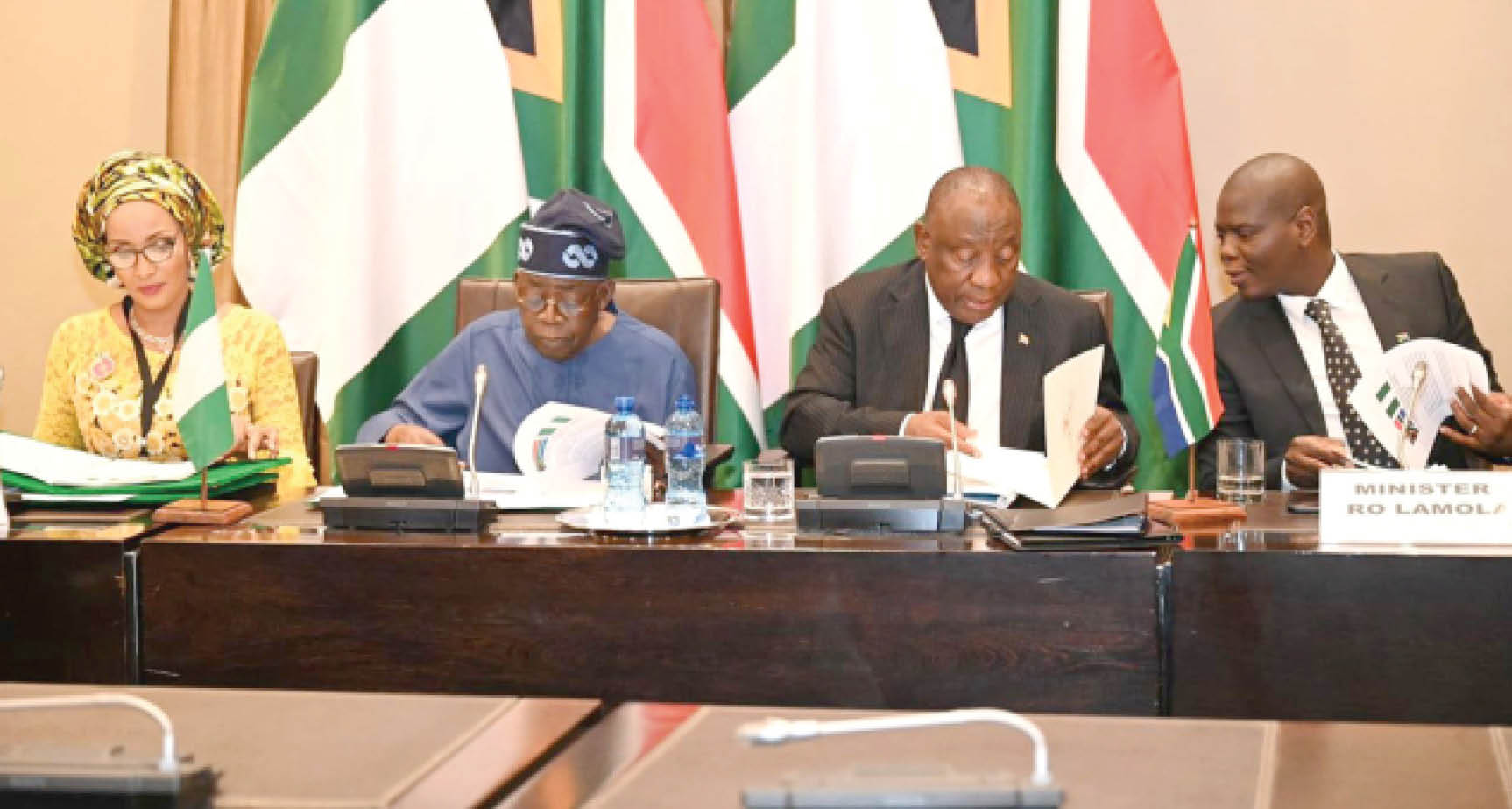
From left: Minister of State for Foreign Affairs, Ambassador Bianca Odumegwu Ojukwu; President Bola Ahmed Tinubu; South African President, Cyril Ramaphosa and South African Minister of International Relations and Cooperation, Ronald Lamola, during the signing of the communique from the 11th session of the Nigeria-South Africa Bi-National Commission in Tuynhuys, Cape Town, South Africa, yesterday
Nigeria and South Africa are Africa’s heavyweights. Together, they account for over 60 per cent of the economies of West and Southern Africa, and both have long played central roles in peacekeeping across the continent. Nigeria has deployed forces in Liberia and Sierra Leone, while South Africa has contributed in the Democratic Republic of the Congo (DRC) and Sudan. But influence is not only about armies and GDP. Nigeria also projects power through culture, notably Afrobeats and Nollywood, as well as through a foreign policy that promotes democracy and provides technical assistance. South Africa similarly wields soft power through its progressive constitution, diplomacy and globally recognised universities.
This combination of economic, military and cultural weight explains why Nigeria and South Africa dominate their respective regions. Elsewhere in Africa, regional leadership is contested. Egypt, Morocco and Algeria in the north; Kenya, Ethiopia and Tanzania in the east; and Cameroon and the Democratic Republic of the Congo in Central Africa all compete for influence. But in West and Southern Africa, Nigeria and South Africa largely face no comparable rivals. Their relationship is, therefore, pivotal for peace, economic development and continental integration.
And yet it has always been complicated. Scholars have called it a “rollercoaster without a safety bar”, a “mixed bag of sour and sweet,” and even an “omnium-gatherum of good and evil”. These descriptions are hardly exaggerations. The Nigeria–South Africa relationship has oscillated between solidarity and suspicion, often shaped by domestic politics and foreign policy priorities.
During apartheid, Nigeria was a fierce opponent of South Africa. The Sharpeville massacre of 1960 galvanised Nigeria’s activism against colonialism and white minority rule. The Nigerian leadership led the push for international sanctions, lobbied for South Africa’s exclusion from sporting events, advocated its expulsion from global organisations and supported bans on arms sales. Nigeria offered refuge and education to South African exiles. Nelson Mandela spent time in Nigeria in the early 1960s, and Thabo Mbeki represented the African National Congress in the country from 1976 to 1978. Nigeria also created the Southern African Relief Fund (SARF) in 1976, sparked by symbolic contributions such as a woman’s N100 donation during the Africa Day celebration, a gesture that inspired nationwide support, popularly known as the “Mandela tax”. For two decades, Nigeria chaired the United Nations Special Committee against Apartheid, using its economic and political weight to isolate the regime.
Nigeria’s activism extended beyond South Africa. In Angola, it supported the Popular Movement for the Liberation of Angola (MPLA) to counter South Africa-backed factions. After Zimbabwe gained independence in 1980, Nigeria provided US$10 million to help the new government reclaim The Herald newspaper from white South African owners. These assertive policies sometimes strained Nigeria’s relations with the United States and the United Kingdom, particularly under military ruler, Olusegun Obasanjo (1976–1979), who leveraged Nigeria’s economic might to challenge multinational corporations aligned with South Africa.
The end of apartheid in 1994 should have opened a new era of partnership. Mandela’s South Africa recognised Nigeria’s vital role in ending apartheid. Yet, early post-apartheid relations were rocky. Mandela’s commitment to democracy and human rights clashed with the authoritarian regime of Sani Abacha. The detention of Moshood Abiola after the annulled 1993 elections deepened tensions. In 1995, Abacha’s execution of environmental activist, Ken Saro-Wiwa and eight Ogoni activists, during a Commonwealth summit in New Zealand provoked international condemnation. Mandela called for sanctions and diplomatic isolation, famously warning: “Abacha is sitting on a volcano, and I am going to explode it under him.” In a dramatic reversal, the moral authority Nigeria once wielded against apartheid now resided with South Africa, while Nigeria became the pariah.
A brighter chapter arrived with Olusegun Obasanjo and Thabo Mbeki, who assumed the Nigerian and South African presidencies in 1999, just weeks apart. This period, often described as the “golden age” of bilateral relations, saw both nations champion human rights, democracy and economic reform, while advancing regional integration. Together, they played pivotal roles in transforming the Organisation of African Unity into the African Union, establishing the New Partnership for Africa’s Development (NEPAD) and creating the African Peer Review Mechanism.
Yet, the achievements of Obasanjo and Mbeki were not fully institutionalised. Leadership gaps in subsequent administrations, combined with domestic challenges such as poverty, inequality and political unrest, diverted attention from foreign policy. Relations have since been episodic, marked by disputes over United Nations Security Council reform, Côte d’Ivoire’s 2010 political crisis, and the election of Nkosazana Dlamini-Zuma as chair of the African Union Commission in 2012. The deportation of Nigerians and tragic events, such as the Synagogue Church of All Nations’ building collapse in 2014, have also strained ties. Commercial disputes, Nigerian criminal networks in South Africa, xenophobic attacks targeting Nigerians in South Africa and incidents of police violence have further complicated relations.
Even culture, which could help bridge divides, has produced mixed outcomes. Collaborative efforts between Nigerian and South African artists, such as Wizkid with DJ Maphorisa and AKA with Burna Boy, show promise, but they cannot erase structural rivalry. Some positive developments remain. The Bi-National Commission was relaunched in 2016, more than 120 South African companies operate in Nigeria and MTN’s 90 million Nigerian subscribers exceed South Africa’s population of about 63 million. Yet, tensions still linger beneath the surface.
The Nigeria–South Africa relationship exemplifies the complexities of African geopolitics. Economic, military and cultural power alone is insufficient; trust, consistent diplomacy and institutional frameworks are essential. President Cyril Ramaphosa captured this reality succinctly: “South Africa and Nigeria are joined at the hip, whether we like it or not.” Their partnership is unavoidable. For the continent to thrive, these two powers must rise above episodic rivalry and cultivate durable cooperation.
Africa’s stability and progress depend on this uneasy alliance. Nigeria and South Africa cannot afford to drift apart, nor can they allow personal politics and domestic challenges to undermine continental priorities. With foresight, strategic leadership and institutional commitment, this “power couple” can transform historical oscillation into sustained collaboration, ensuring that their influence benefits all of Africa, not just themselves.
Oluwaseun Tella is director, Centre for African Diplomacy and Leadership, University of Johannesburg.