
‘Nigeria First’ must be real, not rhetoric
The Federal Executive Council (FEC) recently approved a ‘Nigeria First’ policy aimed at prioritising the use of locally made goods and services in all government procurements. The Minister of Information and National Orientation, Mohammed Idris announced the policy while briefing State House correspondents after the FEC meeting chaired by President Bola Tinubu at the Presidential […]
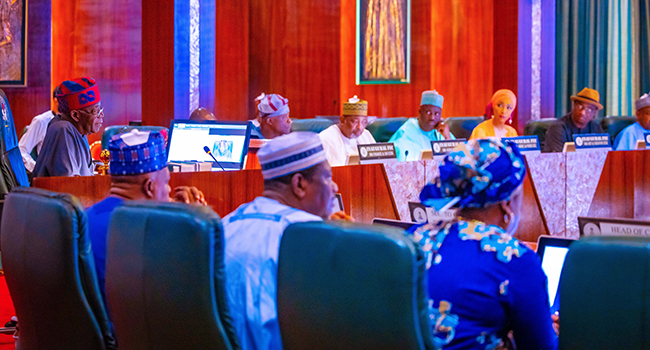
FILE PHOTO: FEC Meeting
The Federal Executive Council (FEC) recently approved a ‘Nigeria First’ policy aimed at prioritising the use of locally made goods and services in all government procurements.
The Minister of Information and National Orientation, Mohammed Idris announced the policy while briefing State House correspondents after the FEC meeting chaired by President Bola Tinubu at the Presidential Villa in Abuja.
Idris said the policy would soon be backed by an executive order, with the attorney-general being directed to draft the necessary legal instruments.
“This policy means that Nigeria comes first in all procurement processes; no foreign goods or devices that are already being produced locally will be procured without a clear and justified reason.
- Investigation: Addicts rot as drug business thrives in Abuja
- NLC threatens showdown over 89 labourers at Dangote refinery
“The Renewed Hope Nigeria First policy will not only strengthen local industries but also create jobs and reduce Nigeria’s over-reliance on imports. It is about bold leadership and investing in our people,” the minister said.
Those in charge of pushing the policy described the move as a strategic decision to revive national pride, support local industries and insulate the economy from external shocks.
But while novel in theory, this commitment must be matched with actions, not mere words, especially in a country long disillusioned by slogans that lack substance.
Considering that government is a continuum, we strongly note that this is not the first time such affirmations were made.
Almost every other government tends to make this pledge, and like what happened before, many Nigerians welcomed the recent declaration with cautious optimism.
The Nigeria First policy is not without precedence. In 2016, President Donald Trump of the United States of America launched his “America First” agenda, a nationalist economic policy aimed at boosting domestic production, protecting American jobs and minimising foreign dependency. And when he won the election for the second time, he continued with the zeal despite serious opposition. Whatever one might think of Trump’s politics, the administration went to significant lengths to enforce the policy: encouraging manufacturing, imposing tariffs to protect U. industries, and enacting tax reforms to encourage domestic investment. The United States, with its advanced infrastructure, reliable energy supply and well-developed legal and economic institutions, had the capacity to pursue such a policy with tangible results.
Nigeria, however, does not enjoy such luxuries. It is one thing to champion a nationalist economic agenda, it is another to execute it in a country plagued by persistent electricity shortages, dilapidated infrastructure, galloping inflation, a choking cost of production and widespread insecurity. The economic environment is hostile to local manufacturers, and without concrete interventions, the Nigeria First project will remain another hollow phrase added to the long list of unfulfilled government promises.
Indeed, for Nigeria First to work, leadership by example is non-negotiable. The president, vice president, governors, ministers and heads of ministries, departments and agencies (MDAs) must lead from the front. They should drive cars assembled in Nigeria, not foreign brands imported at great cost to the national purse. Their official wardrobes should showcase Nigerian textiles, not Italian suits and Parisian couture.
Their children should be enrolled in Nigerian universities and their families should receive treatment in Nigerian hospitals. This is not populism, it is patriotism. It is also policy consistency.
Furthermore, the Nigeria First policy must not be a discretionary initiative. It must be backed by a robust legislative framework. Instead of an executive order as being suggested, an Act of Parliament should enshrine its principles and impose stiff penalties on violators, particularly public officeholders who continue to patronise foreign goods and services with public funds. Without legal teeth, the policy will lack the moral force and institutional backing needed to drive behavioural change.
It is dishonest, if not outright deceitful, for the government to set austerity rules for the masses while the elite continue to live in vulgar affluence. Nigeria cannot afford a ruling class that flies private jets while asking the poor to endure fuel price hikes, ministers and legislators that earn millions of naira as salaries and allowances, sometimes in foreign currencies while directing the citizens to buy made-in-Nigeria to grow the naira. Such hypocrisy erodes public trust and renders policy initiatives like Nigeria First dead on arrival.
Other countries have succeeded in building local capacity, not through rhetoric but through structured support and firm policy direction. South Korea, for instance, used import substitution industrialization, combined with aggressive export promotion, to grow products like Samsung and Hyundai. China, now a global manufacturing powerhouse, once prohibited government officials from using foreign-made goods.
These countries understood that national development requires both discipline and sacrifice, especially from those at the top. Nigeria can emulate these examples, but only if our leaders first abandon the entitlement mentality that sees governance as a pathway to personal luxury.
The statement by the 2023 presidential candidate of the Peoples Democratic Party (PDP), Atiku Abubakar, who challenged President Tinubu to embrace his administration’s Nigeria First policy by trading his Escalade for Innoson, Nord or any made-in-Nigeria car, should not be dismissed.
Many pundits who applauded the initiative, nonetheless, asked those in power to lead by example instead of dismissing those who have reservations.
The Nigeria First policy could be a catalyst for industrial rebirth, economic independence and renewed national pride, but it cannot succeed under the current structure of privilege and exclusion. It must be built on integrity, inclusiveness and an enforceable law.