
Open defecation: Jigawa’s decision commendable
As a follow up to its national leadership status with respect to lifting the level of compliance with the standards of public health practice in Jigawa State, the government has reintroduced the house-to-house health inspection policy, known in Hausa language as ‘Duba Gari’. The ‘Duba Gari’ has historically been intended to focus on enforcing personal […]
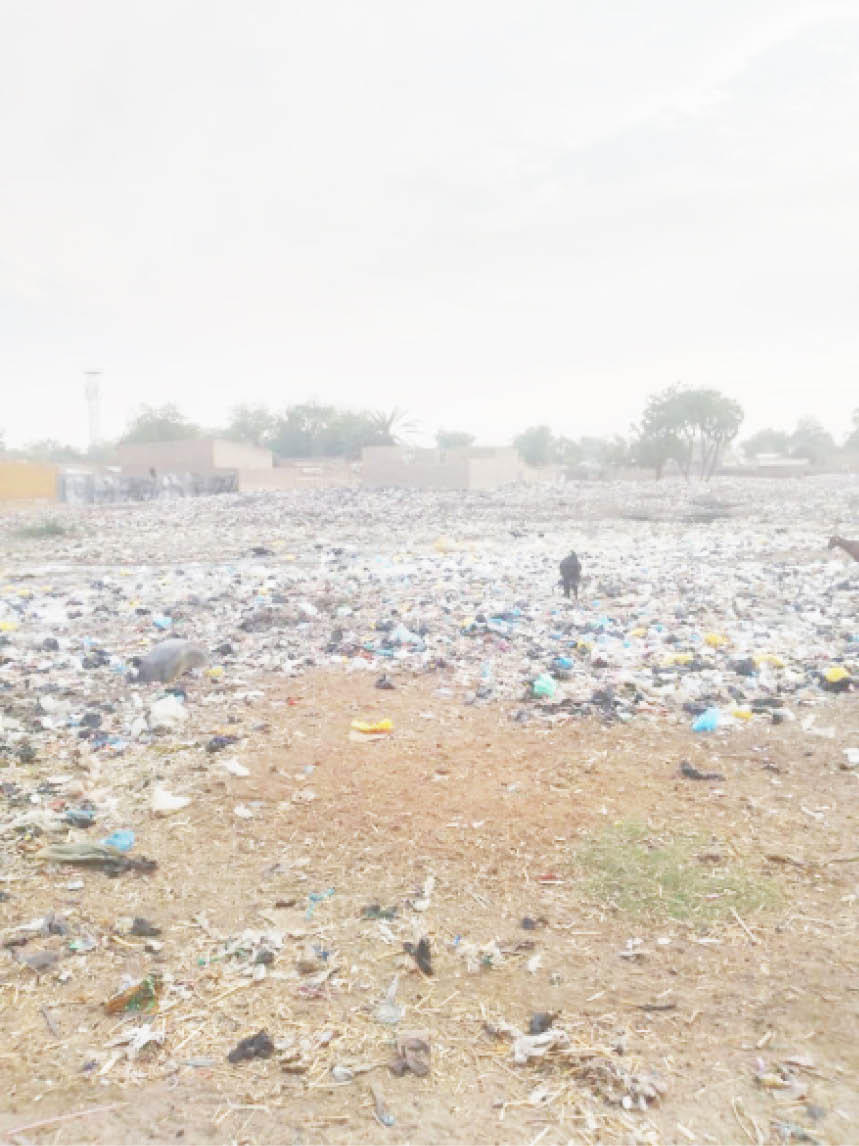
an open defecation site in damaturu
As a follow up to its national leadership status with respect to lifting the level of compliance with the standards of public health practice in Jigawa State, the government has reintroduced the house-to-house health inspection policy, known in Hausa language as ‘Duba Gari’.
The ‘Duba Gari’ has historically been intended to focus on enforcing personal hygiene and environmental cleanliness and involves the physical inspection by trained, designated health officers who go from house –to- house to check for lifestyle practices which breach personal and public health standards. The Commissioner for Environment and Climate Change, Dr. Nura Kazaure, announced the decision at the opening ceremony of a two-day orientation for 270 environmental health workers designated for the exercise.
According to Dr. Kazaure, the government’s decision stems from its commitment to maintaining the state’s Open Defecation Free (ODF) status which was achieved several years ago. He noted that one of the primary responsibilities of the inspectors in their conduct of house-to-house visits beyond the assessment of hygienic practices in each home include ensuring the provision of toilets in households to prevent open defecation within the state.
Speaking further, Dr. Nura Kazaure noted that “the Jigawa government already embarked on the construction of latrines in schools, motor parks, markets and other public places across the state aimed at making provisions of toilets for public use to discourage the public from defecating openly, which is a major cause of spread of dangerous diseases.”
- 2027 PERMUTATIONS: APC, ADC, PDP in show of strength as by-elections hold Saturday
- Provide social safety net for Nigerians, Okonjo-Iweala tells Tinubu
Seen in perspective, this new initiative by Jigawa State constitutes a commendable follow-up to its earlier efforts at improving sanitation across the state which in 2016 was acknowledged by the National Task Group on Sanitation (NTGS) as not only one of the leading ten top states in the country in that respect but was also declared the first Open Defecation Free (ODF) state.
By this, the state serves as a leading example for other states that may be better endowed materially, but lack the political will to do the needful, with respect to open defecation.
The Jigawa example offers hope that the fight against retrogressive health practices such as open defecation can be won, in spite of whatever constraints a state government may be facing. Against the backdrop of its political and socio-economic circumstances, the high light on Jigawa State remains justified given the progress it has made in respect of eliminating open defecation.
Jigawa State is home to six million people, of whom 70 per cent reside in rural areas, according the National Bureau of Statistics (NBS). The multidimensional poverty rate for Jigawa in 2022 was 84 per cent, and the state has the second lowest humanitarian development indices. Yet, due to the political will of successive administrations, the state has established itself at the top of the ladder of health-conscious states.
From the perspective of its fuller impact, open defecation has been described by a 2012 World Bank report as having dire consequences like contributing to outbreaks of various diseases which in turn cause nutritional deficiency, reduce school enrolment and attendance, loss of dignity and increased risk of insecurity especially among children and women. Other negative consequences so identified include environmental pollution and reduced productivity as well as diminishing human capital of the country’s workforce.
However, despite growing recognition of these consequences, open defecation remains a public health crisis in Nigeria, with negligible change in incidence since 2015 when empirical studies on its prevalence assumed a more formal status. For instance, in 2008 and 2010, Nigeria adopted two programmes namely Community-Led Total Sanitation (CLTS) and LGA-wide ODF strategy respectively, to promote sanitation uptake across the country. From such studies, it was established that there were as at then, about 48 million Nigerians – mostly within the poorest residents in rural areas, who defecated in the open each year, and the figure has remained relatively the same since the adoption by Nigeria of the Sustainable Development Goals (SDGs) in September 2015. And this was after decades of struggling to eliminate the unhealthy practice.
Substantial progress was however made in 2016 following the ratification by Nigeria of the SDGs programme, which calls for the elimination of open defecation by 2025. With UNICEF’s support, the Federal Ministry of Water Resources (FMWR) launched the National Open Defecation Free Roadmap (2016-2025), and declared among other initiatives, the launch of the ‘Clean Nigeria: Use the Toilet’ campaign aimed at increasing awareness, mobilizing public and private resources, and stimulating the demand, action and behaviour change needed for sanitation uptake. In that respect Nigeria needed to build 3.3 million toilets per annum, to end open defecation even by 2030, and which for now is not happening.
It is in this context that Daily Trust urges other state governments to emulate the Jigawa example if they are yet to do so. As the saying goes, cleanliness is next to Godliness.