
Outrage as Israel shuts Al-Aqsa Mosque in Ramadan
Several Arab and Islamic countries have condemned Israel’s continued closure of Al-Aqsa Mosque and the Haram al-Sharif in Jerusalem to Muslim worshipers, particularly during the holy month of Ramadan. As Ramadan started, Israel imposed restrictions on Palestinian worshippers entering Al-Aqsa Mosque in the occupied West Bank’s city of Jerusalem, notably barring persons under 55 years […]
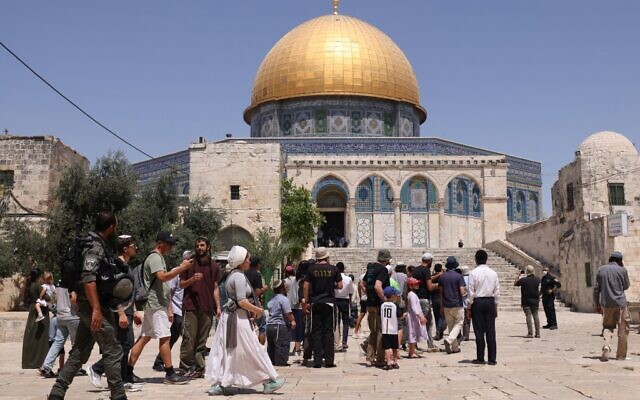
Members of the Israeli security forces stand guard, as a group of Orthodox Jews enter the al-Aqsa mosque compound in Jerusalem, during the annual Tisha B’Av (Ninth of Av) fasting and memorial day, commemorating the destruction of ancient Jewish temples some 2000 years ago, on July 18, 2021. (Photo by AHMAD GHARABLI / AFP)
Several Arab and Islamic countries have condemned Israel’s continued closure of Al-Aqsa Mosque and the Haram al-Sharif in Jerusalem to Muslim worshipers, particularly during the holy month of Ramadan.
As Ramadan started, Israel imposed restrictions on Palestinian worshippers entering Al-Aqsa Mosque in the occupied West Bank’s city of Jerusalem, notably barring persons under 55 years of age. Those permitted entry were subjected to searches, detention, and sometimes denied entry by Israeli soldiers.
When the Israeli-US war against Iran began on Saturday morning, February 28, Israeli security forces sealed Al-Aqsa entirely, preventing anyone from entering, including the mosque’s staff and guards.
In a joint statement, foreign ministers of Saudi Arabia, Jordan, the United Arab Emirates, Qatar, Indonesia, Pakistan, Egypt, and Türkiye affirmed their absolute rejection and condemnation of this illegal and unjustified measure, as well as Israel’s continued provocative actions at Al-Aqsa Mosque and the Haram Sharif and against worshipers.
They noted that security restrictions on access to the Old City of Jerusalem and its places of worship, coupled with discriminatory and arbitrary access restrictions to other places of worship in the old city, constitute a flagrant violation of international law, including international humanitarian law, the historical and legal status quo, and the principle of unrestricted access to places of worship.
They urged the international community to adopt a firm position that compels Israel to halt its ongoing violations and illegal practices against Islamic and Christian holy sites in Jerusalem, as well as its violations of the sanctity of these holy places.
Also, the General Secretariat of the Arab League described the closure of Al-Aqsa Mosque to Muslim worshippers as a violation of freedom of worship and an infringement of the historical and legal status quo of the holy sites in the city of Jerusalem.
In a statement on Thursday, the General Secretariat stressed that Al-Aqsa Mosque holds a special religious and historical status for Muslims around the world, and that any measures restricting access to it or hindering the performance of religious rituals there could lead to an escalation of tensions and undermine efforts to achieve calm and stability, SPA reported.
Also, the speaker of the Arab Parliament, Mohammed bin Ahmed Al-Yamahi, said restricting access to Al-Aqsa Mosque is a troubling escalation that provokes Muslims globally and reflects efforts to alter the city’s Arab and Islamic identity.
The Malaysian Foreign Ministry, in a statement on Thursday, said the closure of the mosque to Muslims “represents yet another provocation against Muslim worshippers and further escalates tensions in the Occupied Palestinian Territory.”
Occupation and control
After the occupation of East Jerusalem in 1967, Israel imposed its control over the mosque while maintaining the Islamic Waqf administration, in what became known as the “status quo”.
Since the 1990s, fundamentalist Jewish groups have begun entering its courtyards under police protection, and in 2003, Israeli authorities officially permitted settlers to storm the mosque’s courtyards through the Mughrabi Gate for specific hours.
Over the years, the number of extremist Jewish attacks on the Al-Aqsa Mosque compound increased.
In 2019, some were permitted to perform silent prayers within the courtyards. Then, in 2021–2022, Israeli court rulings were issued, which many considered a step toward expanding Jewish prayer at the site, sparking recurring tensions surrounding the mosque.
The continued closure of the mosque raises Palestinian fears that Israel is justifying it under the guise of emergency and public safety measures. However, observers consider it a pivotal step, culminating a long history of Judaization attempts and paving the way for a different reality.
Abdullah Marouf, a researcher specialising in Al-Aqsa Mosque affairs, told TNA that with the mosque’s closure, the temporal division of Al-Aqsa has become a reality, a fact Israel had already established before the closure.
He explained that Israel added an hour for settler incursions during Ramadan, meaning that the temporal division is now a reality, with nine hours allocated for Jews and nine hours for Muslims, and the mosque closed at night to both.
“The complete closure now has implications far beyond temporal division. It’s clear that Israel is trying to establish itself as the sole administrative authority, replacing the Islamic Waqf Department at Al-Aqsa,” he added. (Saudi Gazette/The New Arab)