
Palestine in international law: Equality or discrimination? (II)
“Intolerance begets intolerance and injury breeds injury” Sir Richard F. Burton There were moments in history when the idea of international law was discarded in favour of unilateral acts that were conceived to advance the interests of certain classes of people in some countries. Law, legality, morality and justice, are inconvenient facts that have […]
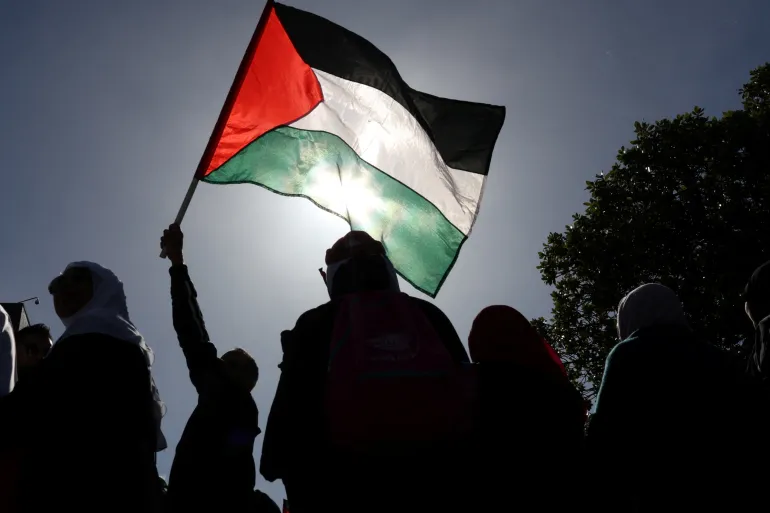
Palestine
“Intolerance begets intolerance and injury breeds injury” Sir Richard F. Burton
There were moments in history when the idea of international law was discarded in favour of unilateral acts that were conceived to advance the interests of certain classes of people in some countries. Law, legality, morality and justice, are inconvenient facts that have stood in the way of powerful nations and strong men in much of history, thereby necessitating their removal or their sidelining from the consideration of such nations and individuals, in the execution of their plans against others much weaker than themselves. Between 1933 and 1945, the restraints of law, legality, morality, treaties, conventions and solemn assurances and promises, were thrown to the four winds, and in their place, a cynical doctrine of aggressive war and conquest was substituted, that plunged much of the world into misery and calamity of hitherto unknown proportions.
Today, we are seeing how the inconvenient fact of international law is being discarded in respect of the Palestinian people and their right to live as human beings, and their right to a state of their own living side by side with Israel on a two-state principle. It should be realised that Palestine cannot continue to be a black hole, written off the map of the world and whose concerns are no longer of importance to the rest of us. This should necessitate that the world should act decisively and with one intent to ensure that the stated purpose of the resolution of the conflict in this part of the Middle East results in the creation of a viable, stable, contiguous and independent Palestinian State, living side by side with Israel, on areas that have been delineated along the 1967 borders with East Jerusalem as its capital. Barring such an outcome, the purposes of international law would be vitiated and its utility as a framework for regulating the conducts of states on the basis of legality and recognised forms of civilized behaviours would be rendered inconsequential and irrelevant.
It is for this reason that we shall make recourse again to the proceedings of the Nuremberg international criminal tribunal to buttress our submission from the facts of precedence and the established rules of law and international practice. Accordingly, it should serve our purpose to recall the following statement by the United States’ Chief of Counsel at the tribunal who said “There is perhaps no need to recall in these pages that the Nurnberg trial represents the first time in history that legal proceedings have been instituted against leaders of an enemy nation. It is perhaps equal supererogation to state here that there are no exact precedents for the charges made by the American, British, French, and Russian prosecutors that to plot or wage a war of aggression is a crime for which individuals may be punished. Yet it was because of these very facts that in its indictment the prosecution presented a challenge to itself quite as great as to the defence. A heavy burden was laid on the accusing nations to make sure that their proof measured up to the magnitude of their accusations, and that the daring of their grand conception was matched by the industry of their research, lest the hard-bought opportunity to make International Law a guardian of peace should fail by default”.
This passage was lifted directly from the official records of the United States Government (The Red Book) that detailed the proceedings of the International Military Tribunal established in 1945, to try the leaders of the Third Reich for egregious crimes perpetrated during WWII. It seems after all that the opportunity to make international law the “guardian of peace” will fail as feared, on account of the indifference towards the situation of the Palestinians, or the selective application of its principles and tenets, shown by today’s major global powers, particularly as it applies to the leadership of the State of Israel in the ongoing conflict with the Palestinian people in Gaza and elsewhere in that long-suffering enclave. The International Military Tribunal at Nuremberg that started its hearings on November 20, 1945, established a precedence in the trial of national leaders for crimes against peace, crimes of war and crimes against humanity and charges of conspiracy to instigate war and the illegal use of force and state powers to oppress, dominate and cause such outrages as to constitute crimes against humanity.
The International Criminal Court (ICC) on its part, has also taken in hand the incidents that it construed to constitute war crimes, crimes of genocide and crimes against humanity, against the State of Israel and its current civilian and military leadership, in the war that they are waging against the Palestinian people. The centrality of international law to the Palestinians’ struggle has been systematically eroded and dismantled, to render their cause ineffectual, illegal and subsequently without merit or legitimacy. This has now led to a situation whereby wholesale uprooting and forceful relocation of the Palestinians has become a state policy and in the process of being executed before the entire world. The process began a long time ago but has recently been systematised by the exclusion of the United Nations from the so-called “peace process” between the Palestinians and Israelis which has led to nowhere but to the entrenchment of the de facto occupation and control of Palestinian territories by Israel through the expansion of Jewish settlements and the racial cleansing of the original inhabitants, the Palestinians.
Under the circumstances, several aspects or provisions of international law have either been completely ignored or wilfully violated in the furtherance of set objectives designed to completely dispossess the Palestinians of their lands, and establish the cherished “Greater Israel” at the expense of the owners of the land. Principles governing statelessness, refugees, internal displacement, occupation, self-determination of peoples, the right of return, expropriation of land, destruction of private and public assets and properties, segregation of people on the basis of race and religion, racial discrimination and xenophobia, the degrading treatment of people and persons, extrajudicial killings, illegal imprisonment and denial of freedoms, etc, are all encapsulated in one form or the other, in various provisions of international law, starting with the Universal Declaration of Human Rights (UDHR) of 1948. The violation of these tenets or the perpetration of the prohibited acts as the case may be under any circumstances, must be challenged and repudiated, and their observance must be the minimum to be demanded by all civilised nations and right-thinking people everywhere. There cannot be an exception to this rule when the victims are Palestinians and the perpetrator is the State of Israel.
These principles are deemed sacrosanct because they are peremptory in nature and constitute the core elements of fundamental principles of international human rights and humanitarian law. They are the foundations upon which the international order is established, and the world’s peace, security and justice are rested. The Palestinian claim to the right to self-determination is both a moral and an historical issue, that is also anchored on the facts of international law, as enshrined in the Charter of United Nations and other legal provisions. International law forbids and prohibits the forceful acquisition of land and the displacement of its inhabitants under any pretext. What Israel is doing today and has done for several decades since its establishment in 1948, constitutes a clear violation of all relevant provisions of international law and human morality.
Israel’s occupation of the West Bank, the Gaza Strip, and East Jerusalem and other Palestinian Territories as well as lands belonging to Lebanon and Syria, has been judged as illegal and therefore, against international law and international morality. Proceeding from this, all Israeli settlements without exception, and other constructions like the “Apartheid Wall” of separation, roads, security posts, checkpoints etc., in the occupied territories, are considered illegal under international law, as they violate the Fourth Geneva Convention. The decades’ long phenomenon of Palestinian refugee issue that has remained unresolved, which has affected millions of displaced Palestinians who have been effectively rendered stateless, continues to remain a blot on the conscience of humanity and the honour and dignity of all nations.