
Parties, stakeholders debate single-day elections
A heated debate has trailed a proposal by the House of Representatives to amend the constitution to mandate the Independent National Electoral Commission (INEC) to conduct presidential, governorship, National Assembly, state assembly and local government elections on the same day. Stakeholders, including political parties, politicians, civil society organisations (CSOs), analysts, academics and others have continued […]
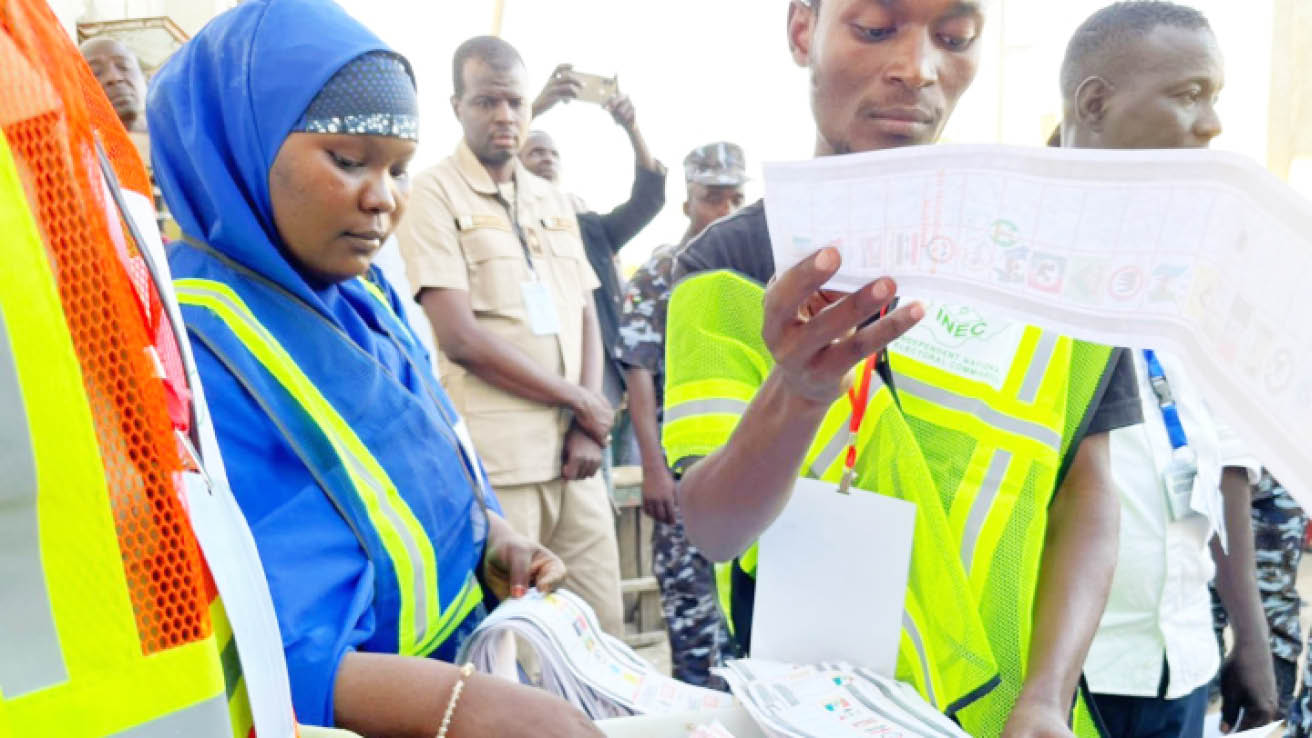
A heated debate has trailed a proposal by the House of Representatives to amend the constitution to mandate the Independent National Electoral Commission (INEC) to conduct presidential, governorship, National Assembly, state assembly and local government elections on the same day.
Stakeholders, including political parties, politicians, civil society organisations (CSOs), analysts, academics and others have continued to express divergent views on the idea.
Proponents argue that holding all elections in one day would cut costs and limit result manipulation. Critics, however, say Nigeria’s peculiar electoral challenges make such an arrangement impractical and potentially problematic.
Currently, INEC conducts presidential and National Assembly elections on the same day, while governorship and state assembly polls are held together on another day.
Similarly, state electoral bodies conduct local government elections independently, not simultaneously across the 774 local government areas, nor alongside federal or state polls.
Daily Trust reports that in March 2025, the House of Representatives passed for second reading a bill seeking to amend the 1999 Constitution to provide for same-day elections at all levels.
Sponsored by Imo lawmaker, Ikenga Ugochinyere and 35 others, the bill was presented during plenary by House Leader, Prof. Julius Ihonvbere.
The bill seeks to amend Section 116 of the Constitution by inserting a new subsection (3) to read: “All elections into the offices of President, Governors, National Assembly, State Houses of Assembly, and Local Government Area Councils shall hold simultaneously on the same date to be determined by the Independent National Electoral Commission in consultation with the National Assembly and in accordance with the Electoral Act.”
A similar amendment is proposed for Section 132, inserting a new paragraph (a) under subsection (1) to reinforce the requirement for simultaneous elections.
When put to a voice vote by Deputy Speaker Benjamin Kalu, who presided over the session, lawmakers overwhelmingly backed the bill. It was subsequently referred to the House Committee on Constitution Review for further legislative action.
Daily Trust reports that a public hearing is expected as part of the procedures before the bill can scale third reading and be sent for presidential assent.
What the parties are saying
Efforts to get the official positions of the ruling All Progressives Congress (APC) and the coalition-led African Democratic Congress (ADC) were unsuccessful as the party’s National Publicity Secretaries, Felix Morka and Bolaji Abdullahi, did not respond to enquiries at the time of filing this report.
However, APC’s National Director of Publicity, Bala Ibrahim, speaking in his personal capacity, told Daily Trust that one major concern about same-day polls was security.
He said the number of police personnel in the country is insufficient to be deployed for such a large-scale exercise, stressing that overstretched manpower would pose serious challenges on election day.
“I have no objection to that happening because it had happened before in the Second Republic.
“But the issue is the problem of manpower, particularly, the provision of security on the day of the election. You will need the police to man these polling booths, and they are already overstretched. This is my personal opinion,” he said.
“You see, one of the reasons for staggering the elections is to allow for adequate deployment of security personnel to man the polling booths. But if everything is to work the same day, in a situation where you don’t have enough police, there will be a challenge,” he added.
For the Peoples Democratic Party (PDP), National Publicity Secretary Debo Ologunagba told Daily Trust that “It is a conversation that is still ongoing and we have made our contribution, but the National Assembly has a position on that. Like I said, it is ongoing, we are watching how the discussions will go, and we will take it from there.
“Let me say that we can express our view, and of course, the National Assembly will have their say. We have members in the National Assembly; that is the way we work. We will speak through the relevant organ as appropriate, because as a party we have to speak through our elected representatives. We are on that, and we have been talking to them.”
The New Nigeria Peoples Party (NNPP), through its spokesperson, Ladipo Johnson, expressed support for the bill, saying it would save costs, improve logistics and reduce disruptions to national life.
Speaking to one of our correspondents, Johnson noted that the idea is not new and could make the electoral process more efficient if properly managed by INEC.
“I think it’s better. I think it will be cheaper for us. There was a time we used to do that. It will be cheaper and logistically, you don’t repeat the same thing two weeks after or one week after, especially in difficult terrains like the riverine areas,” he said.
He argued that staggered elections come at a high cost to the nation, both financially and in terms of productivity.
“The country loses so much money each day that we do not work, each day that we have a public holiday. So, let alone the disruption that comes from elections. We have to try to make it minimal. Have your elections in one day and that’s it,” he added.
Johnson maintained that simultaneous elections would also strengthen transparency and accountability at polling units.
Responding to concerns that such an arrangement could make rigging easier, he insisted the opposite would be the case.
“It is even more difficult. Do you know why? If you belong to a party, you have a senatorial candidate; his agents will be there. You have a House of Assembly candidate; his agents will be there. House of Reps, gubernatorial, all of them. So it will even cost parties less because they can pool resources together,” he explained.
He further noted that one-day elections could increase voter turnout as citizens would be more motivated to cast ballots for multiple offices at once.
“When you have a large turnout, some people might not like the governor, but they may be saying, ‘that senatorial, I have to vote for it.’ Others will say, ‘the presidential, I have to vote.’ It will force them to come out, collect the ballot papers and vote. But if it is not like that, after voting presidential, people just go and sleep. They won’t do gubernatorial,” he said.
While acknowledging that states like Anambra and others, where governorship elections fall outside the general cycle due to court judgments, may remain exceptions, he stressed that harmonising national and state polls would serve Nigeria’s best interest.
Action Alliance (AA) National Secretary, James Vernimbe, said the party is yet to take an official position on the issue.
He, however, added: “In my own opinion, it’s very good; I’m in support of it. It will save the cost of elections, reduce rigging and manipulation of results. So I am fully in support of it.”
More mixed reactions trail proposal
Also commenting, the National Coordinator of the Obidient Movement, Dr Yunusa Tanko, said the arrangement would reduce manipulation, cut costs and encourage voter participation.
According to him, this would make it more difficult for politicians to tamper with results.
“It’s a good idea. At least everything will happen on the same day, and the result will be published on the same day. So if those who are masters in manipulating results will have to manipulate every result that comes in within their system, that will be a big task for them,” he said.
He argued that staggered elections, though intended to strengthen credibility, have instead created loopholes for rigging.
Tanko maintained that a single-day election would not only guarantee clarity but also protect the sanctity of the ballot.
“If we can do the election in one day, the result will come out on the same day. In fact, on one day you are done with your voting. It gives you clarity and gives you opportunity to make sure that the vote is not being stolen,” he said.
On logistics, Tanko insisted it is possible and would even save Nigeria huge resources.
“In fact, if you reduce the heavy spending we are making on our electioneering, we spend once and the paper is once. Imagine if you have presidential elections, federal and senate elections all done on the same day, including the state assembly and all. It reduces the cost that is being used to produce ballot paper in different staggered elections,” he argued.
He also linked single-day elections to boosting voter turnout, noting that Nigeria suffers voter apathy whenever the polls are spread out.
“Once the election is not for the presidency, the number of people who come out is far less than those who come out to vote for president. But if we do it once, you have almost the same number or at least close,” he said.
A former presidential candidate and elder statesman, Chief Chekwas Okorie, told Daily Trust he has long been a proponent of single-day elections.
He said conducting all elections on the same day would save cost, end repeated shutdowns of the economy in the name of election holidays and prevent INEC from citing glitches in isolated polls.
“I am one of those who started canvassing for single-day elections in Nigeria many years ago for so many reasons. It’s more economical. And we don’t have to lock down the economy two or three times in the name of holidays to conduct elections.
“On election days, markets are shut, banking institutions are closed, and even hospitals are not allowed to operate. These issues will be a thing of the past with the new law coming,” he said.
“Everything to make the elections hold in one day is in place. We have the technology: the electronic register, electronic voting cards, capacity to transmit results from the polling units to the portal.
“So if introduced, the idea of having results in one particular set of elections and INEC coming to claim glitches will also be removed. This will rekindle confidence and trigger greater participation in the electoral process,” he said.
But former House of Representatives member and ex-governorship aspirant in Rivers State, Hon Bernard Mikko, told Daily Trust that the focus should be on ensuring votes count, not on legislating same-day polls.
“It should be about whether the people’s votes will count, whether people will exercise their franchise without fear or intimidation,” he said.
Going down memory lane, Mikko said: “If you go back to the 1959 pre-independence elections, were they staggered or were they held in one day? Coming back to the Fourth Republic, why was it staggered? Have they done an audit?
“Is it the staggering or the conducting in one day that is making the votes not count? Systems that are not working in Nigeria are working in other climes. So is the problem with our elections the laws or the management, or the electoral process? These are the questions we should ask ourselves.
“In the last general elections, the INEC chairman promised that the election results would be transmitted from polling units electronically. Did they do so? Was it the laws that made it impossible, or was it the staggering of the elections?
“If they want to combine the elections, will they also combine the attitude, the orientation and characteristics of all the actors in one single respect honestly? People want to see their votes count, whether they hold all elections in one day or they are staggered.”
A former Adamawa State governorship candidate on the platform of the Social Democratic Party (SDP) and opposition coalition leader, Dr Umar Ardo, outrightly faulted the proposal, warning that it would overwhelm the electoral system and heighten the risk of manipulation.
In an interview with Daily Trust, Ardo said that while the idea may appear cost-effective and aimed at curbing malpractices, it fails to consider the enormous logistical burden it would place on INEC.
He said elections are currently split in phases to allow collation officers and INEC staff time to sort, count and announce results from the five categories.
“Even with elections split across two weeks, it takes long hours for INEC staff to sort and announce results. The real problem has always been at the ward and local government collation levels, where manipulation, result changes, and ballot box snatching occur,” Ardo said.
He warned that combining the five elections in a single day would stretch the process late into the night, creating fertile grounds for rigging.
Instead of a single-day poll, Ardo suggested splitting elections into two phases: one for the executive arm (president and governors) and another for the legislature (senators, House of Representatives and state assemblies).
An APC chieftain from the North East, Barrister Abdullahi Jalo, however, welcomed the bill, saying it would save costs, reduce rigging and curb ballot box snatching and violence.
INEC mum
When contacted, the Chief Press Secretary to the INEC Chairman, Rotimi Oyekanmi, declined to comment on the matter.
However, a senior INEC official, who spoke on condition of anonymity, told Daily Trust that passing the bill could create more problems for the electoral body.
He described the idea as unrealistic, dangerous and capable of truncating elections, arguing that what Nigeria needs is not constant tinkering with electoral laws but a change in political culture.
“There is a reason INEC split the national elections and the state elections. If you put them together, just look at the shared logistical requirements of doing that. Is this really advisable? In which jurisdiction do they conduct that quantum of election in one day? They should point to one country where they do that.
“Nobody is saying the National Assembly does not have the right to make laws. But have they even spoken to INEC? Did they talk to INEC for the Commission’s advice or input on that kind of thing?” he queried.
Disadvantages outweigh advantages – Analysts
On their part, political scientists and analysts acknowledged that while the proposal carries certain advantages, its drawbacks far outweigh the benefits, given the realities of Nigeria’s current electoral system.
The National President of the Nigerian Political Science Association (NPSA), Prof Hassan Saliu, said the proposal makes sense from a cost perspective but warned that Nigeria is not ready for it.
“This will make rigging much more convenient and difficult to prove in court. It will be hard for anybody to establish that a particular election has been rigged because of the lumping together of contests,” he said.
Saliu added, “Let’s continue to consolidate the transparency and credibility of elections and, maybe in the future, when we have reached a much more satisfactory level, such an idea can then be introduced.”
Prof Kamilu Sani Fage, a senior lecturer in political science at Bayero University, Kano, said conducting all elections in Nigeria on the same day may appear attractive, but it could plunge the country’s fragile electoral system into deeper crisis.
“You see, it’s possible to organise all five elections in one day. It may have its own positive effect, and its negative effect. The positive side of it is that it will minimise costs. Everything will be run in a day, and perhaps it will also minimise, or at least eliminate, the bandwagon effect,” he said.
Fage, however, warned that the disadvantages far outweigh the advantages.
“If you now put all five elections together, they may generate a lot of problems for the system. The first is the fact that the majority of the electorate is illiterate. So, by the time you have so many parties, and then you have people who are not educated or aware of the process, there will be confusion. Besides, it will be very tiring and exhausting for people to stay all day trying to run elections,” he said.
Fage further argued, “Look at what is happening now, with INEC running staggered elections, and yet there is confusion and a lot of malpractices. So, I think if you put it together at this moment it is not going to be an easy task, given that our process is still largely manual.
“Above all, if you put all the elections in one day, if there is rigging, one can rig the whole election in a day. For example, if you are using the incumbency factor, the government of the day can rig all five elections because it has the power.”
On his part, public affairs analyst and senior lecturer in the Department of History at Sokoto State University, Dr Godwin Odeh, described the proposal as unrealistic, stressful, and open to manipulation.
In an interview with Daily Trust, Odeh argued that Nigeria’s electoral process is already overstretched under the current arrangement and warned that conducting five elections simultaneously would only compound the problems.
He maintained that apart from logistical challenges, such a system would put undue pressure on voters and INEC officials, heighten confusion at polling units, and raise the risk of electoral violence.
“Imagine people handling multiple ballot papers at the same time. It is fundamentally stressful and overwhelming, not just for voters but also for officials who have to sort and count. If you combine presidential and gubernatorial elections with others, the tension it generates will only multiply. It is too bulky and too risky,” Odeh stressed.