
PDP governors now 8 as Diri resigns
The Peoples Democratic Party (PDP) has lost yet another state governor following the resignation of Bayelsa State Governor Douye Diri from the party on Wednesday, bringing the total number of PDP governors to eight. As of May 29, 2023, following the transition, the All Progressives Congress (APC) controlled 20 states, the PDP held 13, while […]
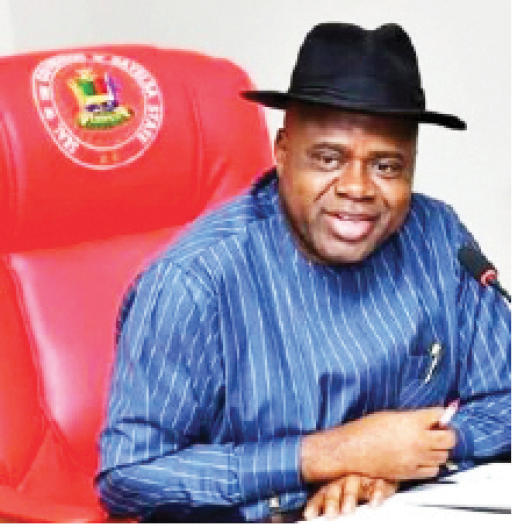
Governor Douye Diri of Bayelsa State
The Peoples Democratic Party (PDP) has lost yet another state governor following the resignation of Bayelsa State Governor Douye Diri from the party on Wednesday, bringing the total number of PDP governors to eight.
As of May 29, 2023, following the transition, the All Progressives Congress (APC) controlled 20 states, the PDP held 13, while the Labour Party (LP), New Nigeria People’s Party (NNPP), and All Progressives Grand Alliance (APGA) controlled one state each.
However, the number of PDP-controlled states declined after the APC won the Edo governorship election in November 2023. The ruling party’s dominance further deepened following the defection of the governors of Akwa Ibom and Delta states to the APC earlier in the year, a move later followed by the Enugu State governor on Tuesday, with the Bayelsa State governor expected to join the APC on Saturday.
The opposition party has continued to suffer a steady decline in strength, losing control of several states amid a wave of defections to the ruling APC. More PDP governors, including those of Taraba, Zamfara, and Kano currently under the NNPP, are rumoured to be in talks to join the APC, a development that could see the ruling party surpass the record 28 states once held by the PDP at the height of its dominance before the 2027 general election.
Governor Diri, who chaired the PDP zoning committee that allocated the party’s presidential ticket to the South, announced his exit from the PDP on Wednesday during an expanded State Executive Council meeting at the Government House in Yenagoa, ending weeks of speculation about his defection. He said the decision followed “extensive consultations” with key stakeholders in the state.
“After extensive consultation, today, the 15th of October 2025, I wish to formally notify you that I, Governor Douye Diri, do hereby resign my membership of the Peoples Democratic Party,” he declared.
“I am not resigning alone. I am here with Mr Speaker, Deputy Speaker and all the members of our party in the Assembly who are with me on this. So today, I have formally resigned from the PDP for very obvious reasons.”
Diri, who served previously as a commissioner, principal secretary, House of Representatives member, and senator (all under the PDP) said the decision was a difficult but necessary step “to move Bayelsa forward.”
He confirmed that the Speaker of the House of Assembly, Abraham Ingobere; his deputy, Michael Ogbere; the All Progressives Grand Alliance (APGA) minority leader, Edward Brigidi; and several lawmakers were joining him in the move.
Although Diri did not state his next political destination, multiple sources within the state said he would officially join the APC on Saturday in a ceremony expected to be attended by top APC leaders.
Speaking during the session, the Speaker of the Bayelsa State House of Assembly, Abraham Ingobere, said the PDP no longer had the capacity or strength to produce candidates capable of winning elections in the country.
“If a party floats a candidate and there are irregularities in the primaries that produced that candidate, at the end of the day, you will see that the efforts put in there would be wasted,” he said.
He commended the governor for taking what he described as a bold and timely decision, saying, “You have taken a very bold step in leading your political family out of this situation, and you have done so at the right time. Bayelsa State and the Ijaw people, with you as the Governor-General of the Ijaw nation, have faced a situation where you lack access to the presidency to present issues affecting the Ijaw people. We have seen in the past how some minority groups insulted the Ijaw race simply because they were aligned with the presidency. So, we believe this is the right position you have taken. We are with you. This is not borne out of compulsion but out of conviction.”
Deputy governor refuses to leave PDP
While Governor Diri’s resignation has reshaped Bayelsa’s political landscape, his deputy, Senator Lawrence Ewhrudjakpo, has refused to defect, choosing instead to remain in the PDP out of loyalty to his political mentor, former Governor Seriake Dickson.
A reliable source close to the deputy governor told Daily Trust that Ewhrudjakpo’s decision stemmed from his long-standing alliance with Dickson, who introduced him to politics and remains influential in Bayelsa’s PDP structure.
“Senator Ewhrudjakpo is not joining the governor. His loyalty is with Dickson, who made him what he is politically. He has made it clear that he cannot abandon the PDP,” the source said.
The deputy governor’s decision has reportedly sparked tension in Government House and the state assembly, with some pro-Diri lawmakers allegedly considering impeachment proceedings to “ensure political alignment at the top”.
The situation mirrors a 2018 standoff in Sokoto State, when then-Governor Aminu Tambuwal defected from the APC to the PDP while his deputy, Ahmad Aliyu, remained with the ruling party, a move that led to a strained working relationship until the end of their tenure.
Dickson reaffirms loyalty to PDP, faults Diri’s move
Reacting to the development, former Bayelsa governor and senator representing Bayelsa West, Seriake Dickson, criticised Diri’s resignation and reaffirmed his unwavering commitment to the PDP.
Speaking after the plenary at the National Assembly on Wednesday, Dickson warned that the mass defection of opposition governors posed a danger to Nigeria’s democracy and could turn the country into a “one-party state”.
“I am where I have always been. I don’t believe Nigeria should become a one-party state,” Dickson said. “As a democrat, I understand the ups and downs of politics, but I remain constant and steadfast in the PDP.”
He revealed that Diri had consulted him before defecting but said he saw no compelling reason to leave the party.
“To his credit, he consulted me, but I didn’t see any reason compelling enough to defect. The PDP gave Bayelsa the opportunity to produce a vice president, an acting president, and even a president. The APC cannot offer that,” he said.
Dickson accused some governors of contributing to the PDP’s internal crises rather than helping to rebuild the party, describing their defection as “political class suicide”.
“It’s sad. Instead of fixing the problems, they let the crisis fester and now they are bailing out. This ridicules our democracy and endangers multiparty politics,” he said.
Wike taunts defecting governors
In a separate reaction, Federal Capital Territory (FCT) Minister Nyesom Wike mocked the defecting PDP governors, saying they should be thanking him for “showing them the road” to the APC.
Speaking at the flag-off of the construction of carriageways on the Outer Southern Expressway in Abuja, Wike recalled how some of the same governors once accused him of destabilising the PDP and working for the ruling party.
“I have been watching those who said I wanted to destroy the PDP. Today, all of them are now in the APC,” Wike said. “So, if it’s true that I worked for the APC, then they should thank me for paving the way for them. I’ve done a good job for them.”
Wike, a former Rivers governor, praised President Bola Ahmed Tinubu for improving fiscal discipline and ensuring that states had sufficient resources for governance.
Kano PDP chair blames APC for PDP crisis
Meanwhile, Kano State PDP Chairman Yusuf Ado Kibiya has accused the APC-led federal government of fuelling internal crises within the opposition to weaken Nigeria’s democracy.
In an interview, Kibiya said some members of the PDP’s National Working Committee (NWC) had allegedly colluded with “external forces” to sabotage the party’s National Executive Committee (NEC) meeting, which was postponed earlier this week.
“The government is working very hard to turn Nigeria into a one-party state. They are investing heavily in truncating the PDP, but they are making a big mistake because this is a new dawn for our party,” he said.
On the wave of defections, Kibiya dismissed the governors’ exit as inconsequential, saying, “Governors are not the electorate. The people will decide who governs them, not politicians seeking personal gain.”
Kibiya maintained that the PDP remained strong in Kano and was rebuilding its grassroots structures to contest power effectively in 2027.