
Personal Financial Planning – Managing Expenses (II)
As mentioned over the last few weeks, we can earn substantial income but fail to spend and/or invest it wisely, leading to difficulties in creating the wealth that can give us the type of quality life that we desire. Hence, being alert to and controlling expenses is crucial to enhancing our chances of personal financial […]
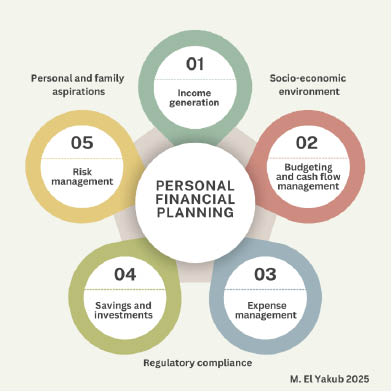
personal financial planning
As mentioned over the last few weeks, we can earn substantial income but fail to spend and/or invest it wisely, leading to difficulties in creating the wealth that can give us the type of quality life that we desire. Hence, being alert to and controlling expenses is crucial to enhancing our chances of personal financial success. How do we achieve that?
Why do we incur expenses? We have already established that given the structure of modern society, we cannot escape having to spend our way through life. As discussed earlier, we will need to pay for our utilities, groceries, travel, etc. So, we really cannot escape incurring expenses. However, we can be pragmatic about it in ways that we maximise the value we gain for each Naira we spend.
Types of expenses: Generally speaking, there are two types of expenses, viz, fixed expenses and variable expenses. Fixed expenses are expenses that we incur regardless of what we do or do not do. For instance, whether we work extra hard and smart to earn more money or not, what we spend on our feeding is generally flat (except when you decide to give yourself and your family a treat eating out for one reason or another. There is also the assumption here that the rate of inflation remains generally steady over a period). Obviously, the person who makes more money can spend more on their feeding than another person who doesn’t earn as much. But for each of them at their respective income levels, chances are that their feeding expenses are relatively flat over a period. Similarly, the person who has a regular 8 am to 5 pm job needs to commute to their place of work daily. For this individual, their transportation costs will also be reasonably fixed over a period. However, a plumber that transports themselves from their workshop to their current project site (where they charge a daily rate) would only bear transportation costs to the site if and when they are working at the site. Consequently, their transportation costs to worksites will vary with the work they have on hand. We can reasonably expect that the more project sites they are working on, the more their transportation costs would increase (while at the same time the more revenues/income they also earn). The feeding costs and the transportation costs to work for the 8 am to 5 pm employee are examples of fixed expenses, while the transportation costs to worksites for the plumber is an example of a variable expense.
Understanding which type of expense we are dealing with at any point in time and in different situations influences how we are able to manage and control them. For instance, it is important to find ways to ensure that fixed expenses are minimised because they have little to do with what you earn. Even as it is important to also see how variable expenses can be minimised in a situation, one can always relate it to the income they are making.
The quantum of expenses: For each type of expense, we need to know either how much we spend over what period (for fixed expenses) or how much we spend per income-earning activity (for variable expenses). Understanding the quantum of expense is important for planning purposes. First, we need to ensure that our incomes cover our expenses. Second, we will need to review each expense item, whether fixed or variable, to ensure that we minimise them for the highest value we can get.
One of the ways to minimise expense is to always check out for options of the product (goods or services) that we desire to procure. An additional way is to always negotiate for the best value at the best price possible. Do you try negotiating even when prices are ‘fixed’? I do! And, quite honestly, I frequently receive discounts and add-ons that one wouldn’t get without trying.
Budgeting: Regardless of the type and quantum of expense we may incur periodically or from one activity to another, the common tool for managing and controlling expense is the personal budget. A budget is an individual’s estimation of income they expect to earn, expenses they expect to incur, and investments they plan to make (or liquidate) over a specified future period. In the same vein that a corporate budget would be drawn to align with corporate objectives, resources and strategy, a personal budget should be drawn taking into consideration earnings, other resources, obligations, age, personal requirements, lifestyle and aspirations, personal realities like health situation, place of residence, etc.
Budgets are drawn by individuals/households for many purposes, such as to help them achieve some or all of the following and more:
- Bring out, set and pursue short-term and long-term financial goals
- Capture expected incomes
- Forecast, track and monitor spending
- Build an emergency fund
- Achieve the required financial stability and independence
- Help meet contractual obligations as they fall due
- Provide monitoring and control capacity over finances and financial situation
- Manage investments
- Identify wastes to be eliminated and opportunities to be seized
- Reduce financial stresses and improve mental health, etc.
Keeping track of our inflows and outflows and exactly what we are spending on and investing towards achieving various financial and non-financial goals is important to the overall scheme of everything else we are doing in life. Unfortunately, we are a people not too inclined to drawing budgets and striving to live by them. We simply get inflows, spend and invest out of them, and roll over any surplus or deficits to the following month and continue on with our lives. This mindset and approach to managing personal finances is unwise.
Next week, we will take up why we don’t take budgeting seriously,what we can do about that, as well as types of budgets.