
Plateau killings and our creeping descent into inhumanity
Plateau State Governor Caleb Mutfwang must be having a sinking feeling as he is presented daily with reports of the destruction of lives and properties in various villages and settlements in the state. As of last week, in a space of less than a month, about 200 people, mostly women, children and the old have […]
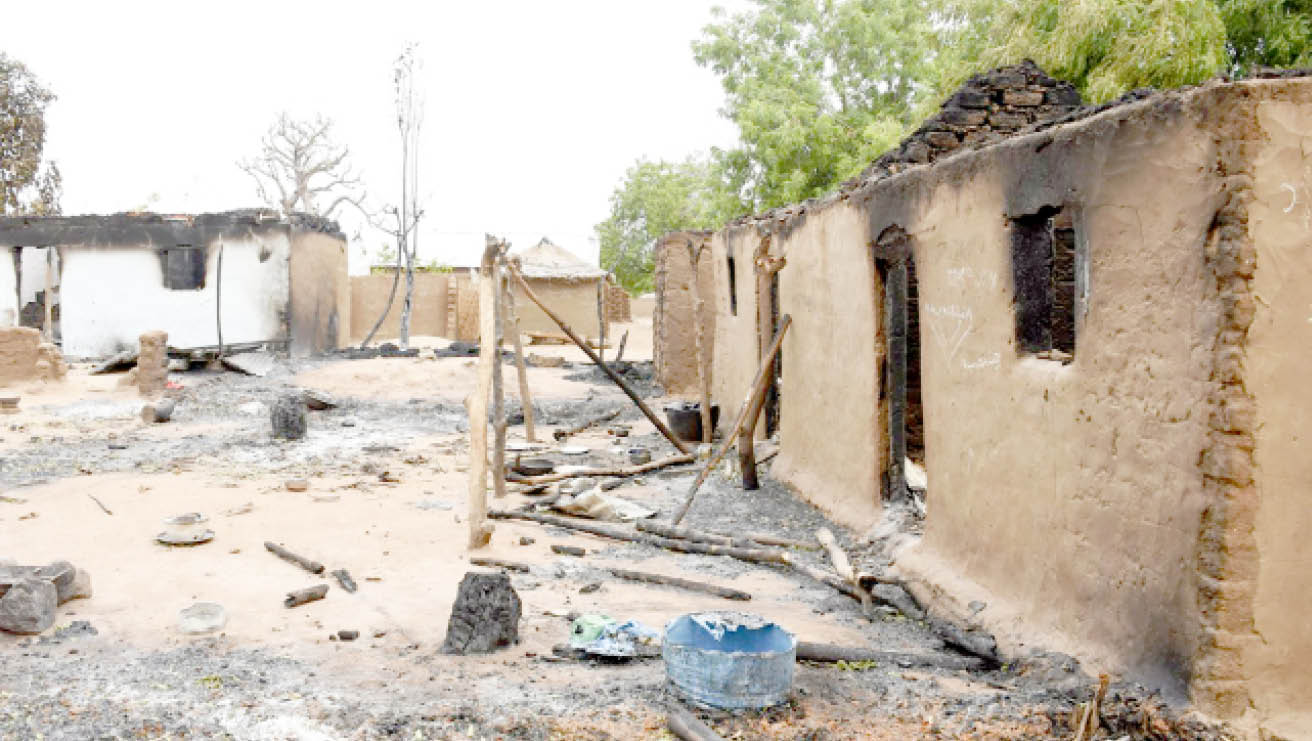
plateau killings
Plateau State Governor Caleb Mutfwang must be having a sinking feeling as he is presented daily with reports of the destruction of lives and properties in various villages and settlements in the state. As of last week, in a space of less than a month, about 200 people, mostly women, children and the old have been killed, with many more wounded, some of them fatally.
Across the state from Mangu to Bokkos and Bassa local government areas, the scale of the destruction has been unimaginable. Ancestral homes, farms and commercial premises have been razed. In the process, aside from the scores killed, livelihoods may have been destroyed forever as victims now living in makeshift camps begin to come to terms with the scale of the losses incurred.
As he muses over the carnage and the resulting humanitarian crises that have been rocking the state, he will no doubt be praying ‘’O Lord, let this not be my portion”. And for good reason too. He will recall that just days after he was sworn in as governor, the very first challenge he was confronted with was a communal crisis in his own Mangu Local Government Area, where scores were killed and properties destroyed in Mangu town and surrounding villages. It got so bad that the entire local government was put under curfew.
As a former chairman of the local government council, he must know first-hand the intractable nature of the crises in the state, which dates back to the 2000s in Yelwan Shendam during the administration of President Olusegun Obasanjo.
- NIGERIA DAILY: What The Nigerian Constitution Says About The Vice President
- Pope Francis: What happens when a pope dies
Although not a native of Plateau State, I was nevertheless raised there from puberty to adulthood. The Plateau of my years was truly the ‘’Home of Peace and Tourism’’. In those areas where the killings are raging currently, I have had friends, classmates and often visited without any fear and apprehension. We used to swim in the disused tin mining ponds and help ourselves to fresh farm products belonging to farmers. And at the nearby Fulani settlements, we were often offered fresh fura da nono by friendly and welcoming Fulani herdsmen and milk maidens.
To everyone who knew and lived in the Plateau of those days, it was the place to be. God in His infinite mercy made the place so beautiful and hospitable, complemented it with mineral riches in the bowels of the land that drew people from all over the world, making it arguably the most cosmopolitan city in Nigeria.
As someone who shares a very close affinity with Plateau State, I cannot but have a sense of deep regret about what is happening in the state today. The beautiful Plateau of my childhood and adolescence has been desecrated and replaced by an ugliness of unspeakable barbarism and inhumanity. The once friendly neighbours are at daggers drawn. Anger, suspicion and tension rule the land. Deep down in my heart, and I believe in the hearts of many others who have seen the graphic images of destruction of lives and properties in Plateau State, they too must be bleeding at this inhumanity to man.
Many are of the view that the cycle of violence occurring in Plateau and elsewhere in Nigeria can be attributed to the failure to identify the perpetrators of such acts and bring them to justice by the relevant authorities. This is largely true because the scale and pattern of destruction in the killing fields of Plateau and other parts of the country indicate a premeditated plan of action which could only have been at the instance of parties with enough motivation and resources to finance the mayhem.
The danger is that as the circle of violence widens and gains ground across the country, it takes a life of its own complete with its own economies of scale in terms of sale and purchase of weapons, looting and seizure of properties, extortion and larceny and the resultant collapse of normal law and order.
It is sad to observe that in some areas of the country where violence has taken root, we have already reached the point where the humanity that once bound our communities has now broken down irretrievably. Inhumanity signified in brutality and blatant disregard for the rights of others to live has become the new normal. Some of these communities have been taken over by brigands and their enforcers, who have reduced these areas to the level of bestiality.
It is also disturbing that as part of this descent to inhumanity, profiling and prejudice has taken over our minds in judging others. We are increasingly resorting to see the worst in others and to proceed to judge them on the basis of our own preconceived notions, rightly or wrongly, thereby reinforcing a ‘’we’’ versus ‘’them’’ perception. All the shared sense of community and humanity that had sustained us all these years no longer matter. We are beginning to remove from our senses the values of compassion, empathy and consideration for others. And by that we are getting more inclined towards swift and summary actions at the slightest differences between individuals of different ethnicities, religious faiths and denominations.
The violence happening in Plateau State is more of reprisal and revenge in nature, to avenge earlier ones perpetrated by one group against the other. Surveys have shown that vendetta killings of this nature are hard to stop because revenge for an earlier violence committed against a given community becomes an obligation that must be carried out and this is etched in the community through generations. The scars of such violence, if not resolved through proper mediation and remedial measures applied, will keep recurring and widening, taking on dimensions that may engulf the entire country eventually.
If the authorities are aware of these dangers, their responses have not been adequate enough. By now, the recurring and widening incidences of such violence should have prompted governments at all levels to have enough knowledge on the nexus of the issue. And from this the authorities would have been able to deploy the necessary measures to tackle the problem in multi-dimensional ways. All too often, when such incidences occur, we hear and see actions that appear to emphasise the optics rather than substance of the issues. And failure to apply decisive judicial sanctions on known perpetrators allows political figures and community champions to seek to make political capital out of the issues.
The killings in Plateau are but one of the several variants of the siege of insecurity bedevilling the country. There is the Boko Haram insurgency, which flavour is religious terrorism; banditry and kidnapping, which is essentially criminal and extortionate in nature and sectarian communal as well as herdsmen/farmers crises involving neighbouring communities over farm and grazing lands.
Collectively, these crises are morphing into a major existential security challenge to the country. We may not be able to travel our roads, go to our farms and markets to purchase essential items. Our children and wards may not be able to go to school, and in the worst-case scenario, we may not be able to go to our offices and our business establishments. We have seen this happen in countries around us and if we are not able to tackle the incipient developments in this regard, we may fall into that vicious circle (God forbid).
My sincere condolences to the families of those who have lost loved ones. My commiseration also to the wounded and in distress over the loss of properties and livelihood.
Corrigendum
My attention was brought to a factual error in my last week’s article on the Mambilla Power Project. I wrote that Sunrise, the company that was contracted to handle the project, was paid some mobilisation fees. I have been told, and I have checked with relevant authorities, that this was not the case. Not a kobo was paid to Sunrise.