
Potable water still eludes millions nationwide
The declaration, in 1993, of the 22nd of March of every year as World Water Day by the United Nations (UN) was an action that indicated a full resolve to raise the level of public awareness on the indispensability of water to human existence. Since then, the UN, as well as regional bodies, governments of […]
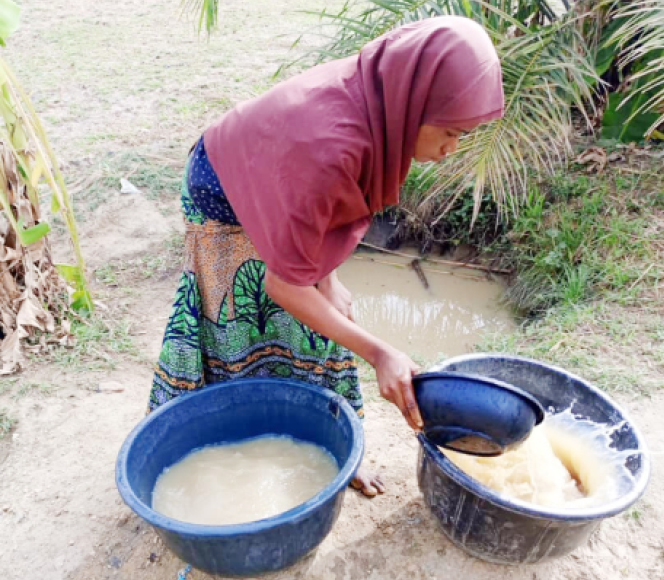
a woman fetching water from one of the ponds
The declaration, in 1993, of the 22nd of March of every year as World Water Day by the United Nations (UN) was an action that indicated a full resolve to raise the level of public awareness on the indispensability of water to human existence. Since then, the UN, as well as regional bodies, governments of various countries and several non-governmental organisations, have continued to observe the day in a manner that brings out the unquantifiable value or essence of water to human existence.
The theme of this year’s event—Water and Gender—was clearly meant to draw attention to the critical link between water as a fundamental resource and gender equality as an obvious demand of the modern world. It, in fact, underscores the commitment towards the creation of a condition or environment that can effectively guarantee unhindered access to abundant and clean water by all the peoples of the world.
As part of its contribution to the observance of World Water Day, the African Union Commission (AUC), in particular, lamented that “millions of Africans still lack safe water and sanitation, undermining health, productivity and human dignity.” The Water and Sanitation Unit of the Sustainable Environment and Blue Economy Directorate of the Union announced that the continental body has already declared 2026 as the year of “Assuring Water Availability and Safe Sanitation Systems” as a clear response to the challenges associated with water supply, distribution and sanitation.
All these are declarations that have pointed to the readiness of the two bodies to raise the levels of their commitment to the resolution of the protracted crisis that hinders the provision of adequate and clean water to the populace. By these declarations, the UN and AU, as well as all other relevant governmental and non-governmental organisations, are duly required to widen the scope of their advocacy in order to ensure that the messages about the issues relating to water provision and utilisation are sufficiently delivered.
In Nigeria, the challenges in the water sector are enormous enough to generate concern among the citizens. Apart from consumption for survival and other forms of utilisation, water—or, more appropriately, the availability of it—is the only guarantee for the practice of all-year agricultural activities. It is in recognition of this fundamental fact that it becomes highly imperative for governments at all levels to ensure potable water is made accessible to all Nigerians.
It is in this regard that Daily Trust strongly calls on the authorities at all levels to give ministries of water resources at federal and state levels the requisite funding to live up to their responsibilities by ensuring that all sources or reservoirs of water are adequately preserved. This is the best way to enhance the health and social welfare of the people, which are currently under threat as a result of the inadequacy of water.
There should be a clear policy of government that will align with this year’s theme of World Water Day. “Water and Gender” as a theme is clearly about the need to drastically reduce gaps or inequalities that have seemingly continued to characterise the processes of water supply and distribution.
We are seriously disturbed that women and girls bear the largest chunk of the burden of water shortage and uncleanliness, which obviously results in the decline of their health status. In most rural and semi-urban areas, water is a very scarce resource, and even the little that is available is, in most cases, unfit for human consumption. This explains the rapid spread of water-borne diseases to which human lives are regularly lost.
At the level of the national economy, the inadequacy of sources and reservoirs of water, like earth dams and some other facilities for the provision of water, is a huge challenge that must be surmounted as a key measure for the stabilisation of the water sector. The disturbing level of neglect to which such reservoirs and facilities are subjected explains the suffering of water consumers and other users.
The dismal budgetary allocation by both the federal and state governments is shameful and unacceptable. Despite the fact that most of the states are blessed with various water options like rivers and dams, they are left to rot. There are over 300 dams in Nigeria but it is very common to see water vendors roaming the streets of most of the state capitals. Citizens who can afford it have resorted to self-help by digging boreholes in their houses. Water is life and it must be prioritised.
We have seen the preponderance of white elephant projects across the states.
This newspaper considers it absolutely necessary to remind the federal and state governments of the need to not only recognise the growing concern over the persistence of problems in the water sector but also to key into the campaign for the provision of abundant and hygienic water. Nigerians deserve to get much more and cleaner water at all times.