
Reflections on sacrifice
I am writing this on Sallah day, just after returning from the Eid. It is a beautiful day. Warm. Sunny. And full of bright smiling faces. Ever since I can remember, Eid has always been a period of feasting, merriment, fine clothes, friendship, and camaraderie. It has always been a period of social bonding. As […]
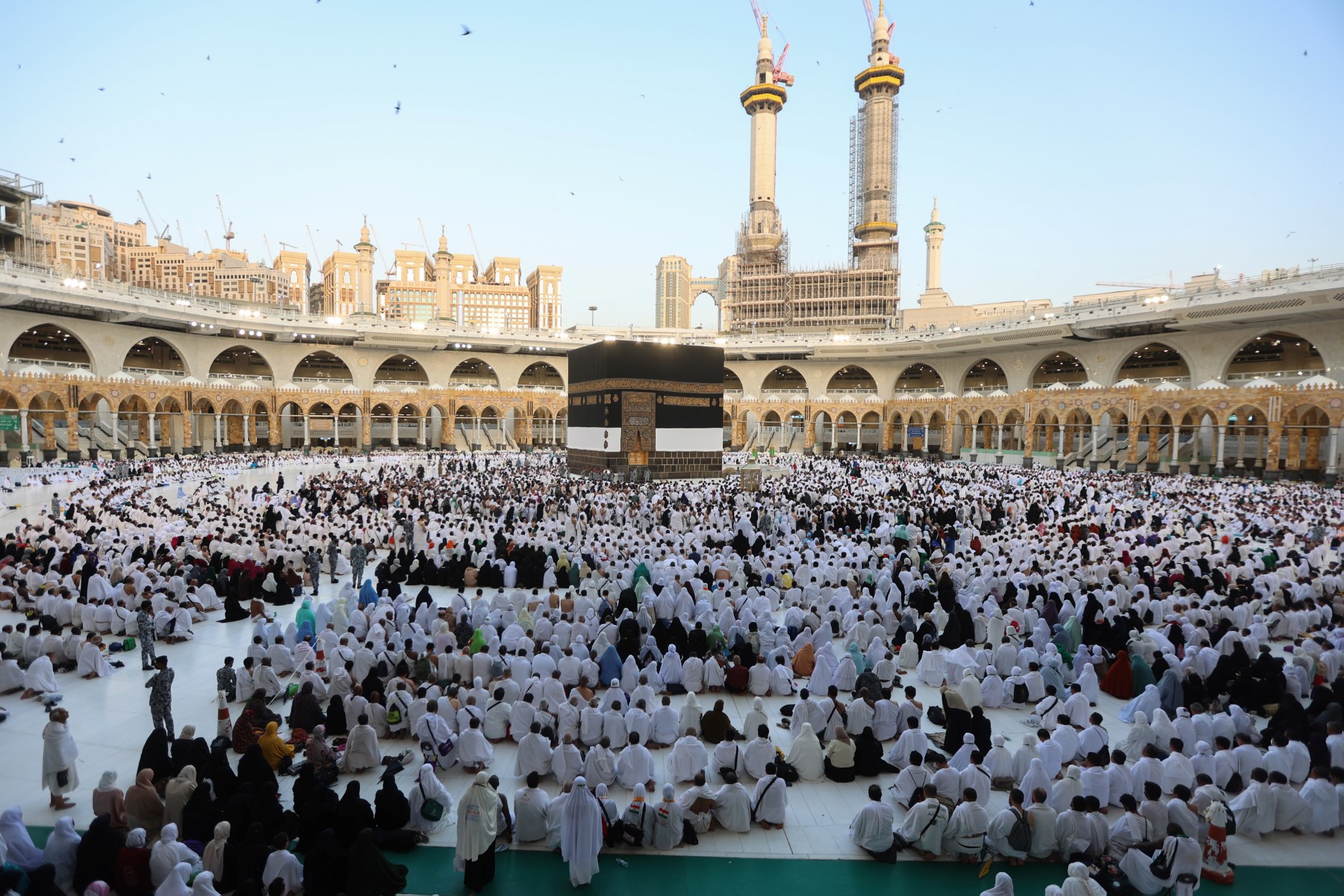
FILE PHOTO: Muslim pilgrims gather around the Kaaba, Islam’s holiest shrine, as they perform Eid Al-Adha morning prayers in Mecca, on June 28, 2023. (Photo by Abdulghani BASHEER / AFP)
I am writing this on Sallah day, just after returning from the Eid. It is a beautiful day. Warm. Sunny. And full of bright smiling faces.
Ever since I can remember, Eid has always been a period of feasting, merriment, fine clothes, friendship, and camaraderie. It has always been a period of social bonding. As children, we were always oblivious to the tensions and mechanics around Eid, where parents make enormous sacrifices for their children to have a memorable festival of feasting and devotion. Now, as a parent myself, one has assumed those responsibilities of making sacrifices to ensure that all of one’s dependants, and even non-dependants, have reasons to smile and feast on this very special day.
Sacrifice. That is a word that is synonymous with this Eid al-Adha (which essentially translates as feast of the sacrifice). Upon reflection, it becomes obvious that there are levels to the sacrifice that is required of us, especially on this day, that often slips beneath the radar. It is these sacrifices that often matter the most.
A lot of the focus is often on the big sacrifice. The often flamboyant sacrifice of lambs and bulls. This draws, of course, from the narration in the Abrahamic faiths where the prophet Ibrahim (AS) was asked by God to offer his son in sacrifice as a test. The prophet did not hesitate, but God, not being a blood-guzzling entity, asked for a stay of execution, essentially, and substituted the human child with a ram.
A sacrifice is a sacrifice, right? Blood is spilled in the end—of an animal, not man. A life is taken. The Qur’an explicitly states that Allah requires neither the blood nor the flesh of the sacrifice, but the God-consciousness in the act. So, the command is to share a portion of the meat with those who could not afford so that everyone has something to feast upon and praise God on these days of feasting and merriment. So then, when stripped to the bone (pun intended), who really is the sacrifice for?
Interestingly, a couple of weeks ago, I found myself discussing religion and the essence of sacrifice with a kind Christian pastor. He had invited me to his house in a very quiet and green outskirt of Iowa City for a regular chinwag. Sitting on his patio, with birds chirping and mugs of coffee in our hands, our conversations veered from family to politics, faith, and sacrifice.
Of course, there are (and I suspect there always will be) fundamental differences in our perceptions about sacrifice, but there was also common ground. As a Christian, and a pastor, the cornerstone of his faith rests on Jesus (AS) sacrificing himself for the sins of the world. It is this sacrifice, the good pastor argued, that essentially gives all Christians the privilege of forgiveness (I paraphrase, of course). He argued his case with conviction, naturally.
As a Muslim, my understanding varies. The Qur’an teaches, in several chapters and verses, but especially in Suratul Fatir (Qur’an 35:18), that no one person shall bear the sin of another, even if they are related or beloved to each other. Essentially, every individual, save for children, the mentally challenged, and those who act completely out of ignorance, must take responsibility for their deeds, and no sacrifice would provide a deus ex machina-style escape from accountability.
These are fundamental differences that separate Islam from Christianity. No amount of coffee will change this because they are foundational ideologies of both faiths. What cannot be altered is that both faiths are built on the concept of sacrifice, and this is not just the blood type. Faith requires one to sacrifice their wealth for the good of the whole, their time in service of others. Considering, as the Qur’an teaches, that God is more than self-sufficient, that makes sense in several ways.
First, the concept of sacrifice as a whole is more for social good than for divine recompense. The measure of the sacrifice of a ram is in the sincerity of the sacrifice and how many people it feeds, not how many people it impresses. Thus, sacrifice being a religious and social construct also translates to what is required from us, as citizens, for nation building. And this we touched on with the gentleman priest.
In Nigeria, especially, with the elections approaching, this issue of what will it take to get the sort of leaders the country needs, instead of the ones Nigerians deserve—and there is a great distinction here—becomes central. The sort of leader the country needs is the one who will sacrifice their personal comfort and our socially reinforced penchant for public thievery to build the country, selflessly develop infrastructure, and establish a social welfare system that caters for the less privileged. The leaders most Nigerians deserve are the sort we get, the ones who buy their way into office, treat public office as investments to be procured at great cost, and profit recouped at the expense of tears, sweat, and blood, as we have been seeing over the years.
To get the leaders Nigeria needs requires the kind of sacrifice we are clearly unprepared for. This is principally the sacrificing of our sentiments for competence and meritocracy, the sacrifice of our bad and corrupt seeds to the dictates of the laws of the land when they loot public funds and abuse their office. But these sentiments that predispose us to supporting and even protecting public officers of our ethnicity, religion, or region when they are found wanting, or even if we all know they are neither competent for the role nor sincere in their intentions, and the privileging of sentiments over merit, have remained.
Until Nigerians are willing to make these sacrifices, we will always end up with the sort of leaders we deserve even if our unwillingness to take accountability for our actions presents us as innocent. The truth is we enable the corruption by accepting bribes, soap, and rice in exchange for votes. Or by looking away while mandates are stolen, or even refusing to accept that we are practising the basest form of transactional politics at the expense of public good. The token items handed out for free will eventually be paid for at a premium and with multiple folds of interest when that politician secures office and has access to public funds. Perhaps, viewed from another lens, that is the form of sacrifice we have chosen to make.
If anything demonstrates this, it is the recent party primaries that we have witnessed across the country, where videos show party officials and delegates who have chosen to sacrifice their dignity and public good for short-term benefits, jumping counts from 10 to 102 in a public count of votes.
Our existence as humans, every day, requires us to make sacrifices on so many levels: for God because he ordained it, for country because it requires it, for family because it is our duty, often for the good of all. The choices we make always have implications on the collective. Our choices are often dependent on numerous variables and dynamics. The sad reality is that as a people, we have not often made the right choices and have made the wrong sacrifices when we make any at all. And that is why we are here.
So, while the rams are being slaughtered and feasted upon, we must not lose sight of the lesson of the season—and that is the act may be divinely ordained, the benefit is supposed to be communal, for those who can afford to give an offering to those who can’t so all can eat well and be merry.
Eid Mubarak.