
Senate Presidency: Adamu as clean break from the past
Judging from the list of those who appeared to have indicated interest, it is evident that the race for the Senate throne has already gathered momentum and is largely centred around senators Ahmad Lawan, Ali Ndume and Danjuma Goje as frontline contenders, all from the North East zone where it is presumed to have been […]
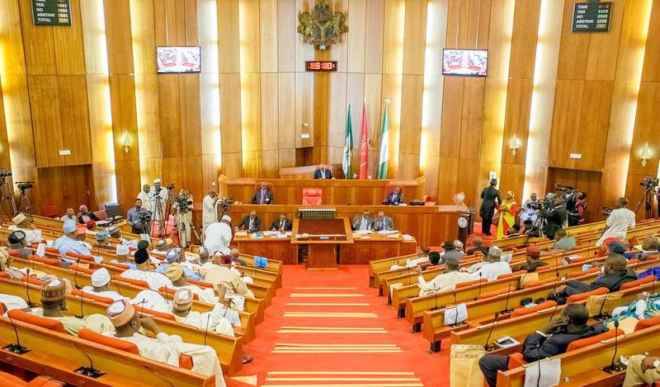
Judging from the list of those who appeared to have indicated interest, it is evident that the race for the Senate throne has already gathered momentum and is largely centred around senators Ahmad Lawan, Ali Ndume and Danjuma Goje as frontline contenders, all from the North East zone where it is presumed to have been zoned. On the list of contenders is also Alhaji Abdullahi Adamu, a two-term governor from Nasarawa state, who, as the speculation goes, is currently being considered for the office of the leader of the Senate.
This is notwithstanding the recent party pronouncement that seeks to resolve the issue decidedly in favour of Ahmad Lawan, the senate leader from the North East, who was in 2015 initially tipped by the APC for the job.
Abdullahi Adamu remains the best candidate for Senate president, by virtue of him being apparently free of the encumbrances that stem from the leadership tussle as well as the wrangling, bickering and rancour which characterized the 8th National Assembly. He stands out as the best because, unlike the rest, who aspire to lead the green chamber, he cannot, by any stretch of the imagination, be linked, or associated with any existing external power block, or a Godfather that, for whatever reason, may seek to control or exert influence over the Senate. His capacity to define and thus pursue an independent cause for the Senate, can thus hardly be called into question. And so also is his capability to serve as a stabilizing factor in steering the affairs of the Red Chamber, judging from the apparent neutral posture he had consistently projected over the years which, thus, places him in an strategically vantage position to view issues objectively, proffer solutions and then move the Senate forward.
It is instructive to note that, for the 9th National Assembly to depart in any significant manner from the confrontation course charted and treaded by its current leadership, it is imperative that it must have at the helm of affairs, not only fresh set of leaders, who represent a radical departure from the past but who are also imbued with a progressive vision deemed necessary to vigorously, systematically and with high sense of passion, drive the APC change agenda to its very logical conclusion.
Adamu’s unflinching loyalty to and high sense of passion for Mr. President and his administration, clearly and convincingly, demonstrated at various critical moments, sands him out as a rallying point and indeed a huge pillar of support for Buhari administration at its most critical hours of need, when the rest of those who now parade themselves as aspirants to the throne of green chamber had either chosen to sit on the fence, or at best had remained at the background, engaging only in their usual stock of trade: leadership tussle. If there is any body today who should rightfully lay claim to the Senate presidency that person should be none other than Abdullahi Adamu; who, as we all know, had stood firmly, wholeheartedly and consistently behind the president whenever the need to do so had arisen.
Given his intimidating pedigree as a former student leader, an engineer, a lawyer, a seasoned technocrat, a party chairman, an astute businessman, a farmer, a former minister of the Federal Republic of Nigeria, a two term governor, the pioneer chairman, Nigeria Governors’ Forum (NGF), a former presidential aspirant and of course, currently a senator, Abdullahi Adamu is more than endowed with what it takes in terms of academic qualification, experience as well as versatility to effectively steer the affairs of the 9th National Assembly, largely in line with the expectations of the president as well as the electorates that renewed his mandate for yet another term of four years.
Coming from the North Central Zone, the geographical zone that corresponds to the Middle Belt of Nigeria and which more than any other, accommodates the multiple cultural contradictions that characterize Nigeria’s heterogeneity, Abdullahi Adamu, currently aspiring to preside over the affairs of the Red Chamber, is more strategically positioned to adequately discharge the functions attached to the office of the Senate president.
There is, first, the point that the Senate presidency has remained in reality, domiciled in the North Central Zone, regardless of the objective circumstances that underscored its shift from the North East, being the zone its occupant was initially intended to be domiciled. In other words, no one single occupant of the Senate presidency under the present administration had ever hailed from the North East.
Second, there is the fact that, once an institution, or a practice, is allowed to emerge, evolve and become tolerated as a convention for over a period of time, such institution or practice as the case may be, automatically acquires the force of law and thus becomes legitimized. This same manner of logic applies to the Senate presidency, whose current occupant, regardless of the circumstances of his emergence, happens to hail from the North Central Zone and no successful attempt was ever made to reverse the situation. As a matter of fact, the same manner of logic can be deployed to explain the issue of military intervention in our body politics, a stark reality which has remained an aberration and yet an integral aspect of our history as a Nation and which no amount of wishful thinking can simply reverse or obliterate.
Third, consequent upon the emergence of Dr. Bukola Saraki, from the North Central, as Senate president, serial measures had been adopted, consciously, or unconsciously, as part of efforts to compensate the North East for losses it was deemed to have suffered by way of its failure to grab the No. 3 job in the land.
As the situation stands today, the occupants of the office of the chief of staff to the president, the Army chief of staff, the chief of Air Staff, the National Security Adviser, the Director General, National intelligence Agency (NIA), comptroller General of Customs, Acting chief justice of the Federation, Group Managing Director, Nigerian National petroleum corporation (NNPC), Secretary General, organization of petroleum Exporting Countries (OPEC), North East Development Commission (NEDC), North East Rehabilitation Commission (NERC), Minister of Education, Executive secretary, Tertiary Education Trust Fund, (TETFUND) Minister of Environment, Minister of Federal capital Territory (FCT), to mention amongst others, all happen to have come from the North East Zone. It is pertinent, at this juncture, to mention, for the records that apart from the incumbent inspector General of police (IGP), who was at any rate appointed recently, no other single prominent political office holder hails from the North central zone of the country.
If the North East, in addition to whatever advantages it currently enjoys in terms of its control of relatively large chunk of strategic and juicy political offices, is to be conferred with the No.3 office in the land, what then becomes the fate of the North Central Zone in the overall equation of power distribution in the polity, especially when there exists no concrete ground to support the view that the lop-sidedness is fundamentally a function of the relative demographic, or voting capacity, or both of the two Zones. Judging from the 2019 presidential election results for instance, the North East turned in 3,238,783 as against 2,313,375 by the North Central Zone, the differential being only 925,408.000 in favour of the former.
In order to avoid the mistake of the past, it is imperative that the APC should, first, retain the office of the Senate president in the North Central. In other words, the North East has grabbed more than its fair and legitimate share in terms of overall distribution arithmetic of political offices and without doubt, this was largely in consideration to the losses it sustained when it failed to successfully produce the senate president as originally strategized.
Mr. Ibrahim is the former DG, Nigeria Governors’ Forum.