
Shettima backs Dangote; NNPCL links gas scarcity to strike
Vice President Kashim Shettima has backed the Dangote Refinery in the ongoing dispute with the Petroleum Refinery and the Petroleum and Natural Gas Senior Staff Association of Nigeria (PENGASSAN), declaring that Nigeria is bigger than any trade union. Shettima spoke yesterday at the opening ceremony of the 31st Nigeria Economic Summit (NES31) in Abuja while […]
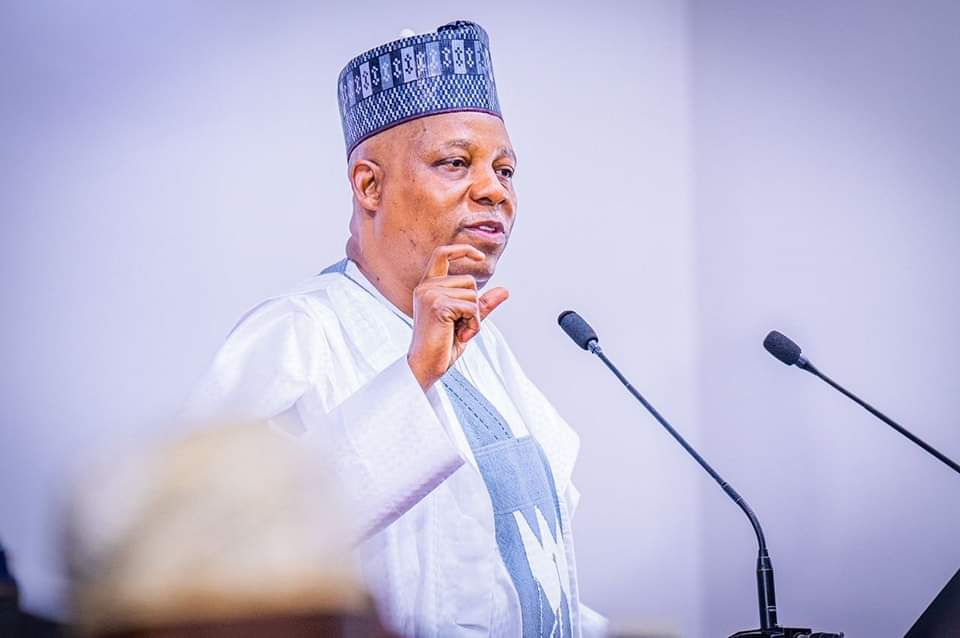
president kashim shettima
Vice President Kashim Shettima has backed the Dangote Refinery in the ongoing dispute with the Petroleum Refinery and the Petroleum and Natural Gas Senior Staff Association of Nigeria (PENGASSAN), declaring that Nigeria is bigger than any trade union.
Shettima spoke yesterday at the opening ceremony of the 31st Nigeria Economic Summit (NES31) in Abuja while emphasising the critical importance of the 650,000-barrel-per-day Dangote Refinery.
He added that the $20 billion refinery is a national asset that must be supported to function.
Shettima’s comment is coming on the heels of the strike by oil workers under the aegis of the Petroleum and Natural Gas Senior Staff Association of Nigeria (PENGASSAN) over dispute with the Dangote Refinery.
- Lawyers boycott court in Kebbi over abduction of member
- Al-Habibiyyah Calls for Coordinated Charity System, says global funding shrinking
Although the strike has been called off, the vice president had condemned the action of PENGASSAN.
He said, “Aliko Dangote, he is not an individual, he is an institution, and he is a leading light in Nigeria’s economic parliament. And how we treat this gentleman will determine how outsiders will judge us. If he had invested $10 billion in Microsoft, in Amazon, or in Google, he probably might be worth $70 to $80 billion by now.
“But he opted to invest in his country, and we owe it to future generations to jealously protect, promote, preserve, and protect the interests of this great Nigeria.
“I wish to call for caution, retrospection, and a deeper sense of patriotism from both labour and the organised private sector in defining and improving the relationship between labour and industry in the interest of maintaining our steadily improving economic fortunes.
“It is not about holding the whole nation to ransom because of a minor labour dispute.
“Nigeria is greater than PENGASSAN. Nigeria is greater than each and every one of us.”
Cooking gas hits N3,000 as scarcity bites harder
There is no respite yet for Nigerians over the scarcity of liquefied petroleum gas (LPG) also known as cooking gas as many consumers trek long distances to refill their cylinder while prices have gone up at major gas stations.
Findings by our correspondents across the country yesterday revealed that the scarcity was biting harder with a kilogram selling for over N3,000 in some parts of the country.
This is just as marketers projected that it might take the end of the week or beginning of next week before normalcy would return as trucks had resumed loading at depots.
In Lagos, consumers, who spoke to Daily Trust, voiced their displeasure over the hike in the cost per kilogram ranging from N2000 to N2500 in retail outlets in their neighborhoods, saying they travelled long distance to buy at major filling stations.
Daily Trust findings showed that major filling stations like Mobil, AP in Ikeja were part of the few dispensing gas due to the non-availability of the product in some retail outlets and hike in the cost of the few who sell.
Isaac Sunday, who said he trekked from Airforce Base in Oshodi to Mobil filling station on Lateef Jakande road in Ikeja, expressed dissatisfaction over the scarcity, saying retail outlets in his vicinity sold per kilogram of gas between N2000 and N2500.
At Mobil filling station, the cost per kg was N1300. Sunday stated that, that was cheap compared to N2500.
“It has been very hard because coming from Airforce base Oshodi to Ikeja just to get gas. It is sold at N1,300 here but in some places, it is N2000 or N2500 and I spent N1400 as transport fare just to get gas,” he said.
Sunday, who brought two cylinders, stressed that if the scarcity persists, he would return next week to refill other cylinders at home, begging the government to intervene and resolve the scarcity.
“I brought two cylinders; I will spend N7800 which if I buy from my side I will spend N12,000. It is possible I will come again next week because the gas in the other cylinders will soon run out. We are appealing to the government to ease the pain. The cost of transportation to come here is high,” he said.
He jettisoned the option of charcoal as an alternative citing the impact on climate, while confirming that his neighbors have opted to use charcoal.
“I heard the information about this place earlier but my neighbours around me have started using charcoal and firewood. We are trying to move forward based on emission into the atmosphere and there we are going back to charcoal in this era. We are supposed to be going forward and not backward and there is the issue of a hike in electricity. If we use electric cookers, it will increase our bill,” he said.
David Marsel who came from the same axis with Sunday stressed that non-availability of gas is piling stress on people, recalling the queue at Conoil filling station at Bolade, Oshodi.
“I went to Bolade, there were a lot of women, I thought something was happening until I was told they were queueing to buy gas. So when I was informed by my friends that they were coming here, I followed them,” he said.
He raised concern that the scarcity of gas has led to the hike in the cost in some places, stressing that it will increase the cost of buying food from vendors.
“The cost of food will increase. The government should come to our aid because it is getting out of hand,” he said.
A resident of Ogun State, Bello David, accused some stations of sharp practices by taking advantage of the scarcity.
He said: “I was at NNPC filling Station along Mowe- Ofada Road, Ogun State and the attendant is having a field day as he switched off and on the pump to favour some people.
“At this particular filling station it was N1,4000 per 1kg. But I had to leave the place for another place where I bought 12.5 kg for N16, 250,” he said.
In Abuja, there was scarcity of gas but the price had not substantially increased as a kilogram was still sold for N1,050.
In Jabi, the LPG section of AA Rano fuel station was not dispensing cooking gas when one of our correspondents visited yesterday, despite that the station opened for cars to refuel their vehicles.
Our reporter saw customers turning back after no one attended to them.
However, a black market seller of the product was seen taking some customers back to purchase from him, having come along with his gas cylinder to sell from customers who have trooping to the station.
“Gas, gas, gas,” he retorted while one of his colleagues was seen dispensing the product to the buyers.
He also used a white van to camouflage his activities so as not to raise alarm with the officials of the filling station as he parked opposite the fuel station to the product.
When approached, he did not give his name, but said the station was not having the product reason for non-attendance to customers.
“You can see their dispensing machine is on but they are not having because it finished recently. I am selling the product at N1,200 against the N1,150 it sold for last week.
“The stations have increased their prices to N1, 100 and still they are not able to get the product,” he stated.
On what could be the cause of the scarcity, he said it was due to the strike embarked upon by Petroleum and Natural Gas Senior Staff Association of Nigeria (PENGASSAN) last week which affected loading of the product to trucks.
Checks by Daily Trust showed that the price of cooking gas had risen to N1350 per KG in Kano following the scarcity of the commodity.
Before now, retail outlets in Kano were selling cooking gas for N1200 per Kg but the price had jumped to N1440 in some areas.
Our reporter reports that at GD Gas, a retail outlet in Tarauni Local Government Area, customers stayed on a queue with empty cylinders to refill.
Mai Wada Jakada said many outlets he visited were out of stock and was lucky to see the product at GD Gas.
He was, however, worried the price had gone up from its previous rate.
Shuaibu Rano, another resident of Ja’in Quarters in Gwale Local Government Area, said he bought cooking gas some few days back at N1300 per Kg but learned that the price has now hit N1400.
Some LPG plants on Zaria road visited by our reporter were empty with no customers.
However, LPG plants big players like AA Rano were full with customers and their cylinders taking turns to refill.
Kwara
In Kwara State, the recent surge in the price of cooking gas has continued to bite harder on consumers in Ilorin, with many lamenting the unstable market trend and dwindling supply.
Speaking on the situation, a consumer, Mr. Kunle Jimoh, said the price of one kilogram of gas had increased from N1,000 to N1,200 within two weeks.
“I had prepared to buy about six kilograms, but I had to settle for just three because of the sudden hike,” he said.
Another resident, Mr. Ayo Mosun, also decried the inconsistency in pricing, saying the product had become unpredictable.
“I used to buy a kilogram for N1,000, but now it sells for between N1,100 and N1,250. The price is not stable, and you can’t even tell what it will be the next moment,” he lamented.
A gas retailer, Alhaji Yunus Adeniji, attributed the situation to lingering supply challenges linked to the standoff between the Dangote Refinery and the Petroleum and Natural Gas Senior Staff Association of Nigeria (PENGASSAN).
“It’s been quite a while since we had steady supply. The issue, as we hear, is connected to the Dangote and PENGASSAN matter,” he explained.
Another retailer, Mr. Abiodun Olumide, who manages Tobi Gas, also blamed the sharp increase on inadequate supply.
“We haven’t received new stock recently, so we’re still selling from the little we had before. As we speak, the price has climbed to N1,200 from N1,100 just yesterday,” he added.
Bayelsa
The price of cooking gas has increased sharply from N1200 to N1500 in Bayelsa State as scarcity hit the state.
Also, in Port Harcourt, Rivers State, the price of gas has risen from N1300 to N1400.
Checks in some of the gas stations in Yenagoa, Bayelsa State capital, on Monday evening indicated that most of the retail outlets who had already ordered their products before the scarcity started were yet to get supply.
A manager at a gas filling outlet in Amarata axis of Yenagoa, Bayelsa State, told Daily Trust that the scarcity was as a result of the strike action by the Petroleum and Natural Gas Senior Staff Association of Nigeria (PENGASSAN).
A resident of Okaka, Mr Ebinimi Kingsley, said that he just filled the cooking gas at a popular filling station belonging to a politician in the state at the cost of N1500.
He said before he filled the gas, he had wandered to about three stations without seeing gas to buy.
Already, queues are piling up in the few outlets who still have gas, while there is a concern that when the stock finished, it will be difficult to see where to buy gas.
An operator of a retail outlet at Ebis Mechanic road in Yenagoa, Young Nnaemeka, said he had almost finished the stock he filled last week because people were rushing to buy gas since yesterday.
Scarcity may end Friday – Marketers
Meanwhile, marketers are projecting the end of the week or early next week before normalcy returns as trucks have resumed loading.
The president of the Nigerian Association of Liquefied Petroleum Gas Marketers (NALPGAM), Mr. Oladapo Olatunbosun, in a chat with one of our correspondents yesterday, said trucking had resumed, but it would take weekend or early next week for the backlog to clear.
He said: “The backlog will be clear by next week. So, gas will soon come to town, they are trucking out at many terminals, Dangote is trucking out; NIPCO is trucking out, Ardova is trucking out and many others and as they are reaching the town, they are selling to customers.
“So the backlogs will be cleared between now and Friday we should be back to normalcy,” he said.
He stated that there has not been any official price increase, saying the hike witnessed in some parts of the country was due to market forces.
“It is a normal business thing when the market force reacts, when there is relative scarcity the price will go up because the demand outweighs the supply, but when the supply is now in excess, the price will come back down, so it’s just an artificial price increase in price and I’m sure it will come down.”
He also decried the congestion at some of the terminals, saying trucks were not well arranged at most of the terminals.
“If you go to terminal you will see that trucks are not well arranged, that’s the problem, if they are well arranged, NIPCO can truck out 50. If NIPCO trucks out 50 for three days, the whole Lagos will get gas but they are not well arranged, because everyone wants to load at the same time which is not possible.
“So I believe before Friday normalcy will return, the gas price has not gone up from the source, those that took advantage of that just made quick gain and that quick gain will come down when there is enough supply,” he added.
NNPCL explains scarcity
The strike declared by the Petroleum and Natural Gas Senior Staff Association of Nigeria (PENGASSAN) is responsible for the recent increase in cooking gas price, according to Group Chief Executive Officer of the Nigerian National Petroleum Company Limited (NNPCL), Bayo Ojulari.
Addressing State House correspondents yesterday after visiting President Bola Tinubu, Ojulari said the cooking gas price hike was caused by the disruption of operations during the PENGASSAN strike.
“The increase you saw was relatively artificial because for the period of the strike, movements and loading were delayed by about two, three days,” he said.
“And because of that, you see that impact. As things return back to normal, it takes some time for distribution to be fully restored,” he added.
Ojulari also accused some retailers of taking advantage of the temporary supply disruption to inflate the cooking gas price.
“As you know, in Nigeria, people take opportunity. With that delay, some of the people that had existing resources and reserves had to put up the price,” he said.
“My expectation is that now that things are back to normal, prices should return to what they were before the strike.”