
Soldiers, insurgents die in battle over Borno community
A captain of the Nigerian Army and a private soldier lost their lives during a renewed night raid by Boko Haram terrorists on Izge community in the outskirt of Gwoza, Borno State, Daily Trust reports. Community leaders and locals said the terrorists also suffered collateral damage during the Wednesday’s onslaught, which is the latest in […]
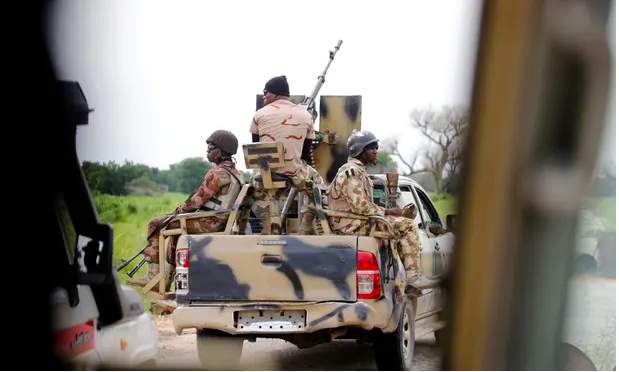
A captain of the Nigerian Army and a private soldier lost their lives during a renewed night raid by Boko Haram terrorists on Izge community in the outskirt of Gwoza, Borno State, Daily Trust reports.
Community leaders and locals said the terrorists also suffered collateral damage during the Wednesday’s onslaught, which is the latest in a series of attacks on Gwoza and adjoining communities.
Gwoza, roughly 130 kilometres away from Maiduguri, the state capital has been in the spotlight for long due to persistent attacks on the town and most of the villages around it.
In the latest attack on Izge, the Emir of Gwoza, Alhaji Mohammed Shehu Timta, confirmed the killing of the military personnel and paid tribute to them for their gallantry.
“My people in the Izge community came under Boko Haram invasion today (Wednesday) at about 1 am. Unfortunately, a Captain and a Soldier paid the supreme price.
“But in a brave and swift reaction from the military, men of the Civilian Joint Task Force, Local hunters, vigilantes and the resilient community, the attack was repelled with the killing of three terrorists.
“As the community is still trailing the terrorists, over 10 bicycles, motorcycles, a one-sized military vehicle and one sophisticated rifle with ammunition were recovered from the terrorists.
“Let me commend our military forces, other security agencies, men of CJTF, local hunters and vigilantes and our resilient people for their bravery, because as I speak, many people are still in the bush combing the whereabouts of the fleeing terrorists.”
The monarch also commended the state governor, Professor Babagana, for his relentless efforts in providing enabling resources to the security agencies and our CJTF members in the fight against Boko Haram/ISWAP terrorists, which has brought about relative peace and resettlement of many displaced people back to their ancestral homes.
“I want to equally call on the federal government to equip our security forces with technological warfare/weapons to defeat the remnants of Boko Haram members terrorising our communities almost on a daily basis,” he said.
Gwoza under crossfire for long
Emir Shehu Timta has been vocal about peace-building and supporting efforts to restore normalcy in his domain, Borno State and the North East sub region for long.
He is also a victim of Boko Haram brutality, considering that he is the son of the late Emir, Alhaji Idrissa Timta, who was killed by Boko Haram in May 2014.
After the assassination of his father, the Gwoza Emirate Council and kingmakers nominated Shehu Timta as the successor, and his selection was ratified by the then Borno State governor, Kashim Shettima and was officially appointed as emir in June 2014.
For over a decade, the town of Gwoza in southern Borno State has lived under the shadow of Boko Haram’s violence.
Gwoza was at a time a peaceful mountainous community Gwoza, but it is now one of the epicentres of Nigeria’s insurgency nightmare.
Its deep cultural roots are being threatened and its resilient people are constantly on the edge, despite relentless efforts by the federal and Borno State government to ensure that the main town and the adjoining communities remain standing.
Caught between its strategic location and the ambitions of the Boko Haram insurgents to take it over, Gwoza’s story is one of loss, displacement, and unyielding survival.
The so-called Boko Haram caliphate
Between 2013 and 2014, Boko Haram began targeting communities across Gwoza Local Government Area with increasing intensity. Villages were raided, homes set ablaze, and terrified residents forced to flee.
But the horror reached a new height in May 2014, when the then emir, Idrissa Timta, was murdered by the Abubakar Shekau led insurgents, in a brazen roadside ambush near Zhur.
By July 2014, Boko Haram had turned its full attention to Gwoza town.
The militants overran military installations, executed residents, and declared the area under their control. In a chilling video released in August 2014, the group’s notorious leader Shekau, stood amid the ruins and declared Gwoza the capital of a new Islamic caliphate.
It was a move that signified not only a territorial claim but also a psychological blow to Nigeria’s sovereignty.
It took until March 27, 2015, for the Nigerian military to reclaim Gwoza after months of fierce battles, aided by multinational joint forces from neighbouring countries. However, while the caliphate was dismantled, the scars of occupation and the fear of return still linger.
Why Gwoza?
Gwoza’s misfortune lies in its geography. Nestled near the Mandara Mountains and bordering Cameroon, the town offers insurgents both a natural fortress and a cross-border escape route.
Moreover, its proximity to Sambisa Forest, Boko Haram’s infamous hideout, makes it a convenient launch pad for attacks and retreats.
Beyond logistics, Gwoza held symbolic importance for Boko Haram. It was their first major territorial conquest, a place where Shekau could physically manifest his radical ideology. The sect’s repeated attacks also targeted the town’s ethnically and religiously diverse population.
Endless pain
In early October 2024, Boko Haram insurgents attacked Ngoshe, a community in Gwoza, killing six farmers and abducting five others, including women. Among the victims was Jubril Dada Zarana, commander of the Civilian Joint Task Force (CJTF) in the area.
After the incident, Senator Ali Ndume, who represents the area in the National Assembly, expressed concern over the looting of crops by terrorists in communities such as Ngoshe, Kirawa, Ashigashiya, and surrounding areas near the Mandara Mountains. He reported that nearly half of the agricultural produce has been stolen, leaving farmers frustrated and hungry.
The senator also highlighted the need for intensified military operations in areas like Sambisa Forest and the Mandara Mountains, where remnants of Boko Haram continue to pose threats to resettled communities. He emphasized that the renewed attacks have caused serious economic setbacks, particularly for farmers who have returned to their ancestral homes.
In January 2025, suspected Boko Haram terrorists invaded parts of Gwoza LGA, killing firewood scavengers and injuring others with improvised explosive devices (IEDs).
For now, the economy of Gwoza, once supported by agriculture and cross-border trade, has been recording dwindling fortunes due to the activities of insurgents. Schools, health centres, markets and symbols of authority have been destroyed or closed, but then rebuilt. The people have continued to weather the storm.
Traditional leaders, religious figures, and community groups continue to push for dialogue, peace-building, and reconciliation.