
Spending the Abacha money wrongly
At a Commonwealth Conference on anti-corruption last year, Vice President Yemi Osinbajo announced to the gathering that the decision was to spend repatriated $320m Abacha loot (for want of a better word) on its Conditional Cash Transfer Scheme as support for the poor and most vulnerable persons in the country. This he further revealed, was […]
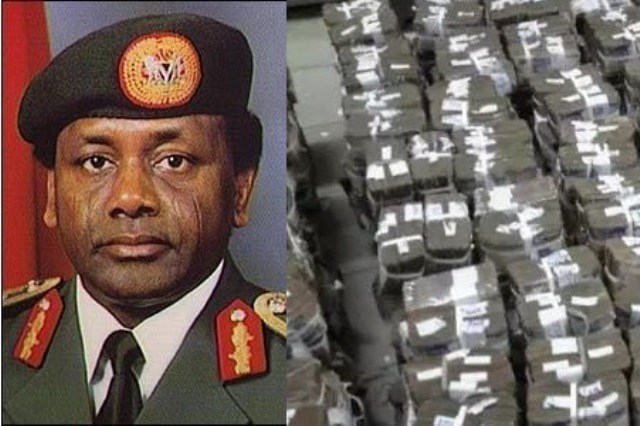
General Sani Abacha
At a Commonwealth Conference on anti-corruption last year, Vice President Yemi Osinbajo announced to the gathering that the decision was to spend repatriated $320m Abacha loot (for want of a better word) on its Conditional Cash Transfer Scheme as support for the poor and most vulnerable persons in the country. This he further revealed, was a condition entered with the Swiss authorities upon which the Abacha stashed funds were released to Nigeria. A Conditional Cash Transfer Scheme as we now know it, is a process whereby identified poor and vulnerable persons were doled out cash in a bid to cushion the pangs of deprivation and in a way, “take thousands out of poverty”.
I was one of the commentators that objected to this conditionality. I argued then that there was no doubt to the funds belonging to Nigeria and as such, the country should not be belittled by such a crude term, as opposed to our government appropriating the money as it deemed fit. I also noted that despite the much help cash grants would provide to our needy, cash in itself was not a solution to poverty. My old father used to admonish us to save money, not in cash but in assets and know how. Cash, he always said, was the end of money. Once money became cash, it got spent. Shikenan. Cash to the poor and vulnerable was for meeting immediate needs, essentially food and basic and bare necessities, and in the end sustaining yet, the poverty and vulnerability.
We have the benefit of hindsight today. We have spent $320m. Can we pinpoint the impact and nod our heads in satisfaction that it was money well spent? I do not have details, but the fact that the managers of the conditional grants are not proud enough to advertise their successes tells me a lot. As is commonly asked in social media, who did this to us? Where in the world did it ever work, that the poor and vulnerable were doled out cash grants ranging from N5,000 to N30,000 to address poverty and vulnerability?
As you read this, the Federal Government will have by now, signed a tripartite pact with the United States of America and the Island of New Jersey for the repatriation of another $321m stashed away by the late former Head of State, Gen. Sani Abacha. Attorney-General of the Federation and Minister of Justice, Abubakar Malami (SAN), signs the agreement on behalf of the Federal Government at the United States-Nigeria Bi-national Commission in Washington DC, leading a delegation that includes Minister of Industry, Trade and Investment, Otunba Adeniyi Adebayo; Minister of Defence, Maj. Gen. Bashir Magashi, Minister of Foreign Affairs, Geoffrey Onyeama; National Security Adviser, Maj. Gen. Babagana Monguno, and the Minister of Humanitarian Affairs, Disaster Management and Social Development, Hajiya Sadiya Umar Faruk.
This team is returning to Nigeria with a repatriation of $321m of funds stolen from the treasury. Using the parallel exchange rate of N361.50 to the dollar, the amount translates to N116.04bn which if shared equally to states would provide each of the states including the Federal Capital Territory, funds in the region of N3.1bn.
Chicken change you might call this amount. But consider what it takes to lift our vulnerable folks out of their vulnerability. Probably just N500,000. In a rural community, what a farmer needs direly before the rains are a set of oxen, a plough, a harrow, and a carte. He can ill afford these, but it equates to a brand new tractor and its implements. Also if we look at the quantum, we would be able address the farmer’s vulnerability with this enablement and to a state, N500m in one year committed to this capacity building would as well address food sufficiency immensely aside the impact on capacity building for the peasant farmer. Between 2007 and 2015, Jigawa State with the lowest allocated revenue, utilized a revolving loan of N560m to address a Work Bull Programme. Farmers were registered into cooperatives and afforded each a pair of work bulls, a plough, a harrow, and a wagon. Success in all spheres was remarkable. High yields from full capacity cropping attained food sufficiency and the rate of repayment was well over 90% enabling more cooperative farmers to be enrolled. A survey conducted revealed that most beneficiaries did not only repay their loans, but as well added their assets in work bulls and implement attachments.
This is only one example out of many that can be explored nationwide. Housewives in the North can be empowered to set up cottage knitting factories producing basic family needs in knitwear. Even agricultural sectors such as domestic animal husbandry, poultry and fish farming can be explored to truly turn the lives of our common folks around.
Nigeria’s current deplorable security situation without doubt is owed to the worsening condition of the poor masses. Our inability to address this early is the reason the entire society is today, endangered. Is it not a tragedy that we spent a whopping $320m in this period and it is looking as if we poured water through a sieve into an ocean? And more tragic it will be if the coming tranche of the recovered funds goes down the same drain as the first. It is unbelievable that all this time, a stipend of N5,000 has been paid to poor and vulnerable persons under the Federal Government’s Social Investment Programme (SIP). Where is the impact? It is surprising that this failure is being recorded under President Buhari who managed the Petroleum Trust Fund Intervention so remarkably.
Also, the safety net scheme SIP appears not to have covered the country enough, if we recall that First Lady Aisha Muhammadu Buhari had lamented bitterly that the scheme did not reach Adamawa State, her State. There is no certainty that the scheme covered the 36 States and the Federal Capital Territory. This time around, the recovered funds should be appropriated to all states to manage on a development template. If anything at all, this will make inclusiveness a certainty. Recovered loot should not again be enmeshed in questionable accountability.
It is noteworthy that the Minister of Humanitarian Affairs, Disaster Management and Social Development, Hajiya Sadiya Umar Faruk is on the entourage to the United States. Of recent, she had began to address the issue of empowerment with renewed vigour. She needs to propose a more pragmatic approach to social development and poverty alleviation than the utopian frivolity that attended the last application of conditional cash transfer and safety net efforts, namely the SIP. Nigerians will hold the government and through her, to a promise of tangible results.