
Stakeholders demand protection of smallholder farmers
Stakeholders in agriculture, environment and community development have called for high-level transparency and public engagement before advancing industrial animal farming under a memorandum of understanding (MoU) signed between the Niger State Government and J&S Soluções (JBS), a Brazilian multinational and one of the world’s largest meat-processing corporations. The concerns emerged at a Northern Regional Workshop […]
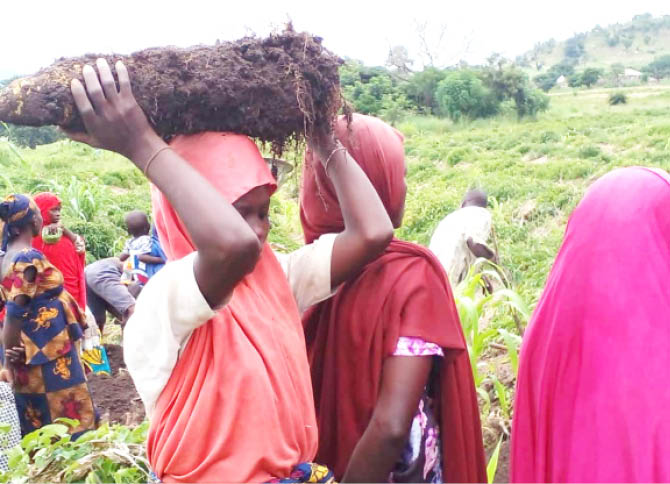
farmers harvesting yams in taraba
Stakeholders in agriculture, environment and community development have called for high-level transparency and public engagement before advancing industrial animal farming under a memorandum of understanding (MoU) signed between the Niger State Government and J&S Soluções (JBS), a Brazilian multinational and one of the world’s largest meat-processing corporations.
The concerns emerged at a Northern Regional Workshop organised in Minna by the Youth in Agroecology and Restoration Network (YARN), which brought together representatives from relevant ministries, community groups and environmental advocates to discuss the implications of industrial animal farming in the state.
The workshop, titled, “Implications of Industrial Animal Farming in Nigeria,” was co-hosted by YARN, HOMEF, Environmental Rights Action, HEDA Resource Centre, and the World Animal Protection.
It brought together key stakeholders from farmers associations, the government, academia, civil society, local farming communities, environmental groups, health and private sectors, to examine the potential consequences of embracing industrial animal farming in Nigeria, using JBS as a case study.
Speaking at the event, the YARN programme manager, Mr Seyi Olawuyi, said stakeholders needed to know the content of the MoU the government had signed with JBS, noting that the goal of the workshop was to ensure that residents understand industrial animal farming and its significance for Niger State, environmentally, socially and economically before large-scale operations commence.
“We are advocating that small farmers should be protected; we are also advocating a safe environment. We want a situation whereby a Nigerian will eat what is good for his/her health, not something like junk in the name of food,” Prince Olawuyi emphasized.
Olawuyi noted that the state’s partnership with the JBS marked a major shift from traditional livestock production systems to industrial-scale farming, a transformation that could reshape land use, local livelihoods and environmental management across the state.
“Industrial animal farming has serious implications, positive or negative, and communities must be carried along, not just the government. We want Nigerians to make informed decisions,” he said.
He added that YARN planned to engage other states, including Ogun, Kano, Oyo, Cross River and Lagos, to enable communities understand industrial livestock investments and how to safeguard environmental safety and smallholder farmers.
Dr Mohammed Baba, Director of Animal Production at the Niger State Ministry of Livestock and Fisheries, maintained that the government was committed to ensuring the initiative benefits the livestock farmers and the state in general.
He said the government had held several meetings with the JBS and already conducted animal sampling and inspected a 500-hectare plot of land already allocated at Tagwai for the project.
He said the investment would enhance livestock production, improve performance and add value to what already exists in the state.
Participants, however, expressed reservations, saying they lacked clear information about JBS’s intentions and the contents of the MoU.
One of the participants, Mrs Adama Aliyu from the Fish Farmers Association of Nigeria, said community members still did not know what the JBS was after, adding that vague information around land acquisition and operations was fueling anxiety.