
Stampedes and the failure of palliatives
The death of 213 Nigerians in 11 years from separate stampedes that occurred during the sharing of palliatives is a national tragedy that could only occur where governance has failed. While Islam exhorts the feeding of the poor during the one-month period of the Ramadan fast, the needless culture where state governments, lawmakers and politicians […]
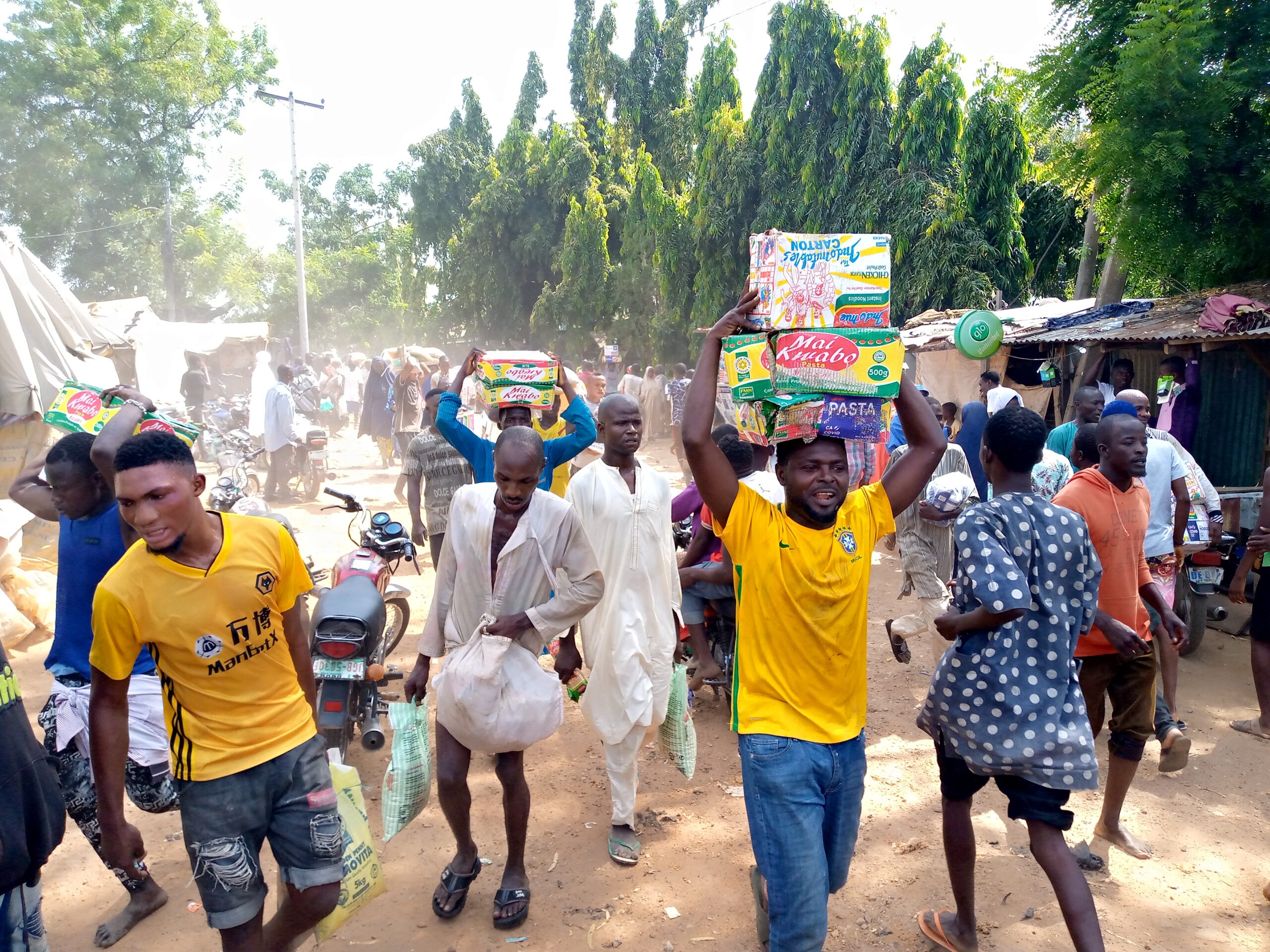
Resident transports palliative looted from a warehouse in Gwagwalada. Looting of palliatives has overshadowed the end of the ENDSARS protest nationwide
The death of 213 Nigerians in 11 years from separate stampedes that occurred during the sharing of palliatives is a national tragedy that could only occur where governance has failed.
While Islam exhorts the feeding of the poor during the one-month period of the Ramadan fast, the needless culture where state governments, lawmakers and politicians deploy the distribution of rice as a condescending tool is not only scandalous but also the height of humiliation of citizens in Nigeria’s democratic experience.
On February 26, 2026, no fewer than four persons were killed in a stampede during the distribution of annual Ramadan alms at Kofar-Guga quarters in Katsina. The spokesperson of the Katsina State Police Command, DSP Aliyu Abubakar, who confirmed the incident, said a large crowd had gathered at the residence of a philanthropist situated at Kofar-Guga quarters, Katsina, resulting in a stampede incident from which four of the injured died.
It would be recalled that in 2024, stampedes during food distributions killed about 72 people in Ibadan, Oyo State; Okija community, Anambra State; and the Federal Capital Territory (FCT), Abuja.
On October 16, 2013, a stampede during the annual Eid-el-Fitr food distribution exercise in Ilorin, Kwara State, led to the death of 20 people, with several others injured. On May 28, 2022, at least 31 persons were confirmed dead in a stampede at the venue of a food distribution programme tagged “Shop for Free”, organised by the King’s Assembly in Port Harcourt, Rivers State. In February 2020, 23 people were reported killed in a stampede that occurred when officials of the Borno State Government distributed food items to Nigerian refugees living in the Niger Republic.
The huge public funds expended by many state governments on the provision of palliatives for the public feeding of the poor during Ramadan have become more of a disaster than the relief they are designed to offer. This is even as the huge resources annually appropriated by some northern state governments in the name of Ramadan feeding of the masses have never had any visible impact on the lives of citizens in the poverty-stricken northern region of Nigeria.
In the spirit of the 2026 Ramadan fast, for instance, the Governor of Yobe State, Mai Mala Buni, approved the distribution of Ramadan palliatives to vulnerable households across the 17 Local Government Areas of the state. The state government said the distribution forms part of broader efforts to alleviate hardship and enable vulnerable families to observe the holy month with dignity and comfort. The government of Jigawa State, too, has distributed Ramadan packages to over three thousand civil servants in the state.
Whereas the role of interventions by government cannot be dismissed in terms of national emergencies, vulnerable groups of Nigerians would feel the impact more if such funds were strategically deployed to agriculture, empowerment of youths and women with skills, and the establishment of small-scale industries, all of which seek to provide long-term solutions.
Regrettably, government in the past few years has developed a myopic perception of the functions of palliatives because of the too much premium it has placed on them, which also explains why it has failed to get some of the solutions to our national challenges right. Palliatives are supposed to be interventions for specific purposes, meant to provide some temporary relief, not a permanent solution to a critical national phenomenon such as poverty and unemployment.
Leaders, particularly state governors, have prioritised palliatives in their governance issues to the extent that it is almost becoming a basis for assessing the performance of elected public officers, all because of their misconstrued perception of some socio-economic indicators, including poverty and empowerment. Allocating huge funds for Ramadan feeding is not the best approach to tackling the country’s economic challenges faced by citizens. The temporary solution or relief offered by palliatives in the form of public Ramadan feeding is nothing but a temporary postponement of the evil day.
State governments now sponsor weddings instead of providing mass transit services; share rice instead of empowering small- and medium-scale entrepreneurs. Poverty and unemployment are better fought and conquered through the empowerment of citizens with skills, not by palliatives. No country develops on the distribution of palliatives. Nigerians are often short-changed when leaders prioritise palliatives with an ulterior motive to pilfer public funds that are huge enough to provide permanent solutions to the country’s socio-economic challenges.
With the country’s huge economic potentials, including its population, which offers strong opportunities for reducing the poverty and unemployment rate, Nigerians, especially youths, need skills more than they need public feeding during Ramadan. When adequately empowered with skills instead of palliatives, they would have no need, thereafter, to queue for any Ramadan palliatives. Humiliating Nigerians with outrageous Ramadan palliatives is, indeed, disrespectful to human dignity. It should stop.