
Subsidise fertiliser to avert food insecurity
The high cost of fertiliser in the country, which is a strong recipe for a devastating food crisis in Nigeria, is being watched almost insensitively by the government at the national and sub-national levels. This is even as existing statistics already show that a huge population of Nigerians, including children, are already suffering from malnutrition. […]
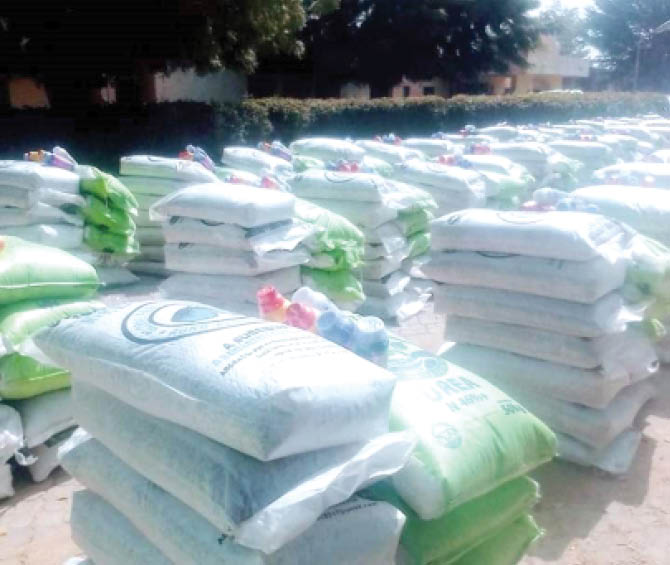
assorted fertiliser
The high cost of fertiliser in the country, which is a strong recipe for a devastating food crisis in Nigeria, is being watched almost insensitively by the government at the national and sub-national levels. This is even as existing statistics already show that a huge population of Nigerians, including children, are already suffering from malnutrition.
In a recent media report, farmers and their associations cried out that the current cost of fertiliser is not within their reach. The national president of the All Farmers’ Association of Nigeria (AFAN), Kabiru Ibrahim, an architect, recently warned that the country’s effort to achieve food security was being threatened by the high cost of fertiliser.
Depending on the market visited, a bag of urea fertiliser now costs about N50, 000, a significant increase from its previous price of about N35, 000. Similarly, NPK fertiliser is now sold for about N55, 000 in many rural communities. This high cost of fertiliser is consequently forcing smallholder farmers to abandon the cultivation of staple food crops, especially maize and rice. Instead, they are shifting to crops such as millet, sorghum, beans, groundnut, soybeans, sesame and cassava that require little or no fertiliser. Other small-scale farmers have also switched over from planting fertiliser-intensive crops to vegetables such as onion and pepper.
Maize farmers explained that the money realised from the sale of a bag of maize would not buy a bag of fertiliser. Nigeria approximately requires about 21 million metric tonnes of maize annually, but current production has reportedly dropped to around 10.5 million metric tones, barely a half of national demand. This is raising fears of wider shortages and price hikes in the months ahead.
This is in spite of the recent claim by the federal government that it had distributed fertiliser free of charge to farmers nationwide in order to support cultivation and improve yield.
The Minister of Agriculture and Food Security, Abubakar Kyari, in a statement released on June 22, 2025 noted, “The ministry has invested over N200 billion in terms of intervention.” Nigerian farmers are asking for how to access the fertilizers.
Meanwhile, a country where some companies produce and export huge tonnes of fertiliser with limited access by local farmers to the same product presents a more ridiculous scenario. Given its strategic relevance to national security and economy, agriculture is a sector where government participation and direct intervention is crucial. Peace and political stability are often guaranteed when there is food security. People are unhappy and angry each time they are hungry.
There is nothing wrong with government owning shares in indigenous fertiliser companies. Globally, agriculture is the most subsidised sector, particularly for smallholder farmers. If the N200 billion intervention claim by the minister of agriculture was in any form close to fact, the current cry by farmers over the cost of fertiliser would not have been heard. This makes a reference to the Presidential Fertilizer Initiative under the administration of the late President Muhammadu Buhari relevant. Fertiliser then was sold between N5,000 and N5,500, which was affordable to smallholder farmers.
It would be recalled that Nigeria, in 2021 signed an agreement to establish fertiliser plants worth $1.3 billion. The project was expected to help with the production of fertiliser essentials, such as ammonia, phosphoric acid, sulfuric acid, nitrogen, phosphorous and potassium (NPK) and diammonium phosphate (DAP) brands using Nigeria’s gas reserves. We deeply lament how the fulfillment of this pact failed to meet the 2025 target set as its commencement date. Nevertheless, this project must not be left to die. The greater part of the agrarian crises faced by many smallholder farmers in Nigeria today is a direct consequence of the under-development of the country’s fertiliser industry.
The move by some state governments to subsidise and increase farmers’ access to fertiliser is commendable. For example, the Kaduna State Government recently inaugurated a multi-stakeholder fertiliser distribution committee to oversee a fair and transparent delivery of over 300 truckloads of fertiliser to 100,000 farmers across the state. Under the initiative, smallholder farmers would receive two bags of fertiliser for free while commercial farmers shall benefit from a 40 per cent subsidy to reduce input cost.
In Gombe, the state government said it had procured 10,000 metric tonnes (200,000 bags) of fertiliser worth N8.8 billion to support the 2025 wet season farming. Governor Inuwa Yahaya said, “The fertilizers were procured at the rate of N44, 000 per bag but would be sold to farmers at a subsidised rate of N27,000 per bag; representing a discount of 38.6 per cent.” In Kano State, the government has flagged off the distribution of 79,200 bags of fertiliser for distribution to farmers across its 44 local government areas.
While we call on other state governments in the country to emulate the few states that have subsidised the cost of fertiliser for their farmers, Weekend Trust also urges the federal government to consider the high cost of fertiliser as a national emergency and quickly provide its own form of intervention.
Farmers and agricultural scientists maintain that, “With crop varieties that mature in 80 to 90 days, it is not too late to intervene in the 2025 wet season.”
The repercussion of government turning its back at this situation portends a double jeopardy for the country.
Fertiliser subsidy should not end in the pockets of select government officials or their cronies to the detriment of the real beneficiaries – farmers. A situation where four farmers are told to share one bag of fertiliser is not an intervention or subsidy. To check the sharp practices of middlemen, an effective mechanism should be put in place. Middlemen are not spirits, they are human beings.
To avert food insecurity and guarantee political, social and economic security in Nigeria, the government at all levels must subsidise the cost of fertiliser.