
Summit: Will 10th Senate proposed security summit change narrative?
The 10th Senate has resolved to hold a two-day National Security Summit to address the country’s rising insecurity. The resolution was reached at a resumed plenary on Tuesday sequel to the motion sponsored by Senator Jimoh Ibrahim (APC, Ondo South), and co-sponsored by Senators Titus Zam (APC, Benue North West), Nwebonyi Onyeka Peter (Ebonyi North) […]
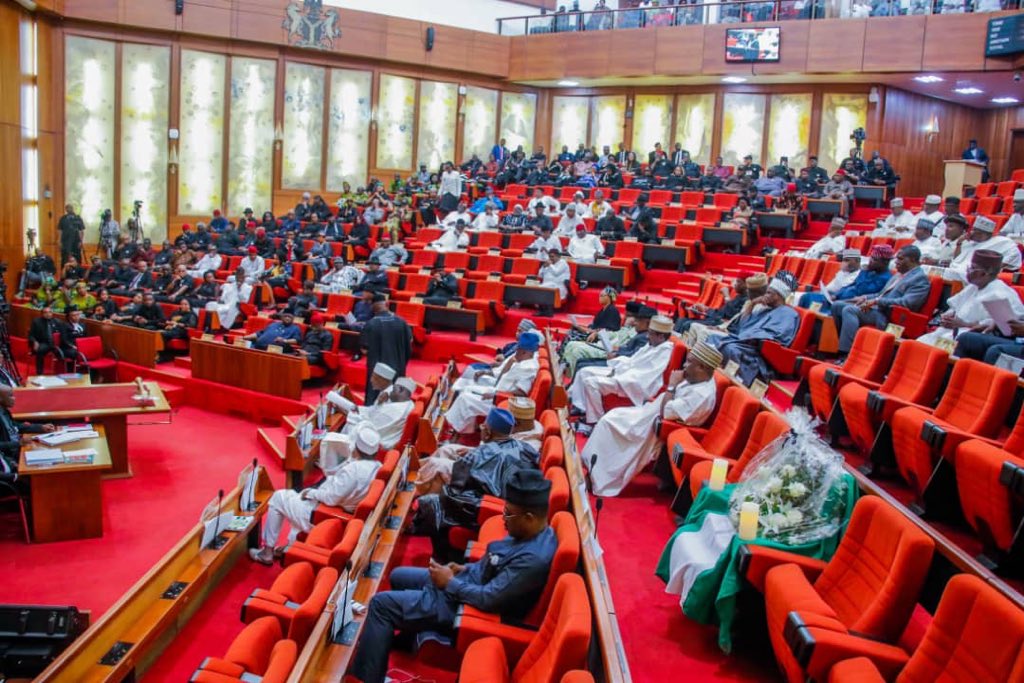
Nigerian Senate
The 10th Senate has resolved to hold a two-day National Security Summit to address the country’s rising insecurity.
The resolution was reached at a resumed plenary on Tuesday sequel to the motion sponsored by Senator Jimoh Ibrahim (APC, Ondo South), and co-sponsored by Senators Titus Zam (APC, Benue North West), Nwebonyi Onyeka Peter (Ebonyi North) and Osita Ngwu (Enugu West).
Even though senators were divided on the issue of convening another security summit after the one organised by the 8th Senate that had yielded no visible implementation, the Senate later resolved that the summit be held during a voice vote.
Daily Trust reports that despite efforts by government to end the spate of killings and abduction of innocent citizens in the country, the crime has continued to fester. There is a resurgence of Boko Haram attacks in the North East. Similarly, bandits have been attacking, killing and kidnapping innocent Nigerians in the North West region.
New terror groups keep springing up, the most recent being the Lakurawa and the Mahmuda, which have been launching attacks on innocent Nigerians in Kebbi, Niger and other states in the North West and North Central zones.
Presenting his motion, Senator Jimoh Ibrahim said there was the need for alternative language to be deployed in military engagements as well as enhanced funding to advance the professional practice and tradition expected of the military.
“No country will allow its citizens to understand security by living with insecurity. Therefore, the ideology of peace for all as outlined in the executive policies of the renewed hope agenda should be upheld and promoted,” he said.
8th Assembly summit
Daily Trust reports that the House of Representatives and the Senate had at different times made efforts at convening a national security summit.
The 8th National Assembly, in particular, had succeeded in convening a national security summit which lasted from February 8 to 12 in Abuja in 2018, with the aim to proffer solutions to the growing rate of insecurity in the country.
The Senate later adopted 20 recommendations from the summit. But experts have argued that those recommendations were never implemented after the summit had gulped billions of naira. Pundits have argued that the failure to implement the recommendations of the summit has led to the worsened security challenges in the country.
In the report which contained 20 recommendations, the 8th Senate called for low-interest rate loans for herders to develop ranching businesses in the country as well as integrate the Almajiri system with the formal educational system. However, granting of loans to herders is one question that is yet to be answered.
The summit recommended that the country’s basic security infrastructure must be comprehensively reviewed and strengthened. It also recommended that the security challenges of the country must be isolated from political partisanship, and ethno-religious sentiments.
But Daily Trust reports that the issue of insecurity has always been politicised as leading political parties in the country often use it to achieve political points. The ruling All Progressives Congress (APC) and the leading opposition Peoples Democratic Party (PDP) as well as the Labour Party (LP) have been reported to have issued statements that seem to have politicised security issues.
Security issues are still being given ethnic and religious coloration in the country.
In order to increase the capacity of the Nigerian police, military and other para-military agencies to respond to national security issues, the summit suggested that the federal government must ensure that there was further recruitment in these agencies.
But statistical data still show that from 2018 when the recommendations were made to date, the police, military and other security forces are overstretched with each of the forces having less than 500,000 personnel to serve the over 200 million Nigerians. This is not to say that recruitment of personnel has not taken place since then.
The summit also suggested that investments by the federal government must be made in order to incorporate technology into the core of Nigeria’s national security architecture and management.
However, Daily Trust reports that while critical bodies including the National Assembly, opposition parties, some security experts, and Civil Society Organisations have been making modest efforts at ensure implementation, Nigeria is still lacking behind in use of technology to fight insecurity.
The summit equally advocated that Nigeria must reduce its dependence on importing its basic security equipment and must immediately develop its internal research and development capacities in order to meet the basic national security needs.
But records have shown that Nigerian government still makes budgetary provisions for the procurement of arms and ammuntions abroad.
The summit charged the judiciary to operate with the highest standards of justice in order to ensure that citizens have confidence in the judicial system’s ability to freely and fairly dispense justice. But many Nigerians still lament lack of fairness and justice by the judiciary. Some have even argued that the judiciary has compromised.
Other recommendations were that “The nation must examine options other than the use of force in its response to national security issues. The nation must develop strategies to improve the chances of resolving conflicts without resorting to the use of force.
“The nation must immediately develop a strategy to limit the proliferation of firearms and other light weapons amongst the citizens. Nigeria must assert its sovereignty amongst its neighbours, particular in the areas of arms control, drugs, terrorism, transhumance and economic sabotage. Additionally, all international commitment that impact our domestic national security must be reviewed.
“The international commuty has demonstrated its willingness to support Nigeria in the fight against violent groups. In this regard, the nation must improve in areas that inhibit its support from the international community — particularly in the areas of human rights, accountability and transparency.
“The presence of millions of IDPs in the North-East and millions of other who have had no education or strong social links presents a potent threat the present and future security of the nation. The nation must immediately develop careful policies and initiatives that are aimed at addressing the reconstruction, rehabilitation, and development of the North-East and the development of the uneducated members of our society.”
The summit further recommended that “The entire focus of governments across all levels must target poverty reduction, as poverty is a threat to national security. All current policies must be re-evaluated to ensure that they are effective.
“The nation must develop its knowledge and skills in managing its extensive forest reserves in order to turn them into assets. This is because the nation’s demographic indices indicate shifts in our population size, composition, land use and impact of the environment on human economic activities.
“There is a need to generate the strong political will to improve the policy, legislation, regulatory and enforcement capacities to reduce the damage of the production, importation and consumption of illicit drugs in the nation — which represent a major threat to national security.”
Analysts differ
But analysts who spoke with Daily Trust yesterday expressed different views on the matter.
A political analyst, Jackson Lekan Ojo, told Daily Trust in a telephone interview yesterday that the summit is another proposed jamboree that would yield no positive result.
Ojo, who is also a Certified Gold Member of International Security Association, and Fellow International Institute of Professional Security said, “It is the duty of the President and Commander-in-Chief of the Armed Forces of the Federal Republic of Nigeria to call for a national security summit.”
He said, “And this national summit has to be a discreet one; to be done clandestinely so that even the people that are causing this insecurity will not know that national security summit is going on.
“But National Assembly will call for a national security summit and at the end of the day, if it does not go down well with Mr President, he won’t implement the recommendations.”
“What we need this time around is for the Commander-in-Chief through the office of the National Security Adviser to call for a discreet security summit. Call retired and serving military officers, retired and serving para-military officers, some university dons, private security experts, youth leaders, traditional rulers, and when they are calling for this, it is not supposed to be announced.
“It is only in Nigeria here that they announce security strategies. The people that are causing insecurity also listen to the news, and they begin to militate against the plans. That is why at the end of the day, it will not work out.”
But another analyst, Aminu Yakudima, countered Ojo, saying a security summit is most needed at this time. He urged the National Assembly to be committed to the project, and to ensure that the resolutions that would be reached at the summit are implemented by the executive.
He said, “We need it because the country is boiling as far as insecurity is concerned. You can see we are clocking to the 15th year of insecurity and insurgency in the North East, and Borno and Yobe are the worst hit.
“Today, children going to schools in Borno and Yobe have not been in school for 10 years. So, you can see the gap that is being created.
“In the North West, you can see the banditry that is ongoing and these people have even graduated to making it to be an industry for making money.
“As of last year, we had heard from reliable source and good statistics that they had made over two billion from collection of ransom.
“In the South East, insecurity is also very serious. You can see the situation of Benue in the North Central is terrible. So, this is the right time for the summit.
“I will urge the National Assembly to be focused with all seriousness and to make it happen, be on top of the situation and insist that the executive implements the resolutions that maybe reached at that summit.”