
That sadistic almajirai teacher is not alone
The recent viral footage of a purported cleric viciously beating an almajiri (tsangaya pupil) under his care in Borno State is a horrifying reminder of the deep-seated rot within the almajirci system—an anomaly that continues to rob northern Nigeria’s children of their dignity, their future and their humanity. In the heartrending video which went viral, […]
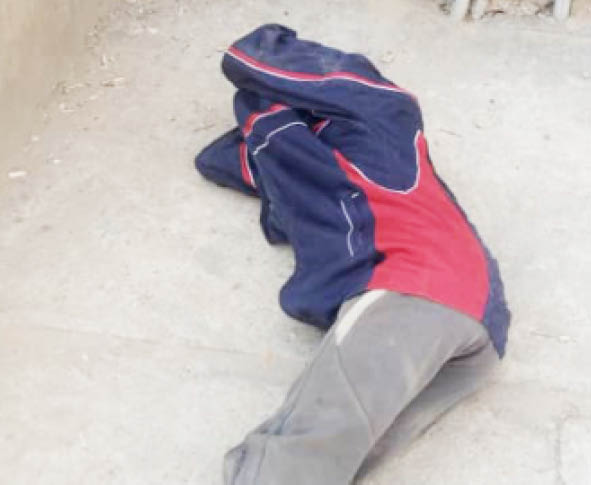
An almajiri sleeping on the bare flood
The recent viral footage of a purported cleric viciously beating an almajiri (tsangaya pupil) under his care in Borno State is a horrifying reminder of the deep-seated rot within the almajirci system—an anomaly that continues to rob northern Nigeria’s children of their dignity, their future and their humanity.
In the heartrending video which went viral, 10-year-old Bashir Gaji was seen being assaulted by one Bukar Modu, who looks mentally unstable, for allegedly absconding from class in the Bulabulin area of Maiduguri, the state capital.
In response to the gory scene, the governor, Prof. Babagana Umara Zulum, ordered the immediate arrest and prosecution of the culprit, and thereafter met with the victim, Gaji, at the Government House.
During the meeting with the boy, the governor said: “This heinous act is an affront on our values and a betrayal of our duty to protect our children, students and minors who are under our guardianship.
- Reminiscences: Nigeria could be greater than America – Lindsay Barrett
- Insecurity: NSA, the situation is really bad
“We cannot tolerate such action perpetually repeating itself… Our children deserve a safe environment to grow and become meaningful members of society.”
He also directed the Ministry of Women Affairs and Social Development to develop strategies for enhanced community sensitisation.
Zulum said the government would provide a fully furnished house for Gaji’s family and also award the child a scholarship to cover his education.
According to reports, the boy and his family currently reside in an Internally Displaced Persons (IDP) camp after his father was killed by Boko Haram insurgents.
Expectedly, the video of Gaji being betrayed by his so-called teacher only opened a floodgate of other footages showcasing the highest violation of the almajirai. One of the videos showed a teacher mercilessly beating about five youngsters with a cane as he relished the brutality against the hapless children.
The videos have rightly triggered nationwide outrage, but outrage alone is not enough. We must go beyond condemnation. It is time to dismantle this cruel and outdated practice of almajirci or tsangaya school system, and replace it with a humane, modern and effective education system that protects children instead of subjecting them to lifelong trauma.
The almajiri system is basically the problem of northern Nigeria. As it stands today, it is nothing short of child abuse disguised as religious instruction. It is a system that strips children—some as young as five—away from their parents, deposits them in unfamiliar towns and villages, and condemns them to the streets under the control of clerics who often exploit, abuse, and neglect them. Most almajirai spend their formative years begging for food and money in the name of survival, while real education—religious or formal—remains a distant dream.
The Tsangaya Model Schools introduced by former President Goodluck Jonathan were a bold attempt to address this problem. The schools sought to integrate Islamic and Western education, providing a safe, structured environment for almajirai. But these schools failed—not because the idea was flawed—but because there was no political will to sustain them. Many were poorly funded, mismanaged, or left abandoned. More importantly, they failed to gain the trust of the communities they were meant to serve, as government failed to involve grassroots leaders in their design and implementation.
Why do parents continue to surrender their children to this system? Poverty is a factor, but so is a misguided belief in religious merit. Many believe that sending their children to learn under a malam—even if it means begging—will grant them spiritual reward. But this belief is tragically exploited by some clerics, who see these children as free labour and a source of income. They are herded like cattle from city to city, holding plastic bowls, reduced to a life of suffering and shame.
The reality is that most almajirai do not even attain meaningful Islamic knowledge. Nor do they receive any form of formal certification that can help them become productive members of society. After years on the streets, they become easy prey for criminal networks, political thugs, or religious extremists. And yet, successive governments continue to look the other way.
Enough is enough. Political leaders must rise and take a definitive stance. The president, state governors, lawmakers, and traditional leaders must declare almajirci unacceptable. Silence is complicity.
Evidently, the National Commission for Almajiri Education and Out-of-School Children (NCAOOSC) has an uphill task. Even though it was established to address illiteracy and provide a multi-modal education system, including skill acquisition and entrepreneurship programmes for out-of-school children, these lofty dreams would not come to fruition until the right step is taken.
Besides, NCAOOSC must abandon top-down bureaucracy and adopt a bottom-up approach. It must secure the buy-in of ward heads, local government chairmen, governors, legislators, and traditional rulers who wield influence at the grassroots. Without them, no policy will work.
The clerics caught on camera beating these children must be prosecuted to the fullest extent of the law. No hiding behind religion. No shielding with tradition. They must be exposed, disgraced, and punished as a deterrent to others. Child abuse—no matter the form—is a crime and must be treated as such.
Finally, the Child Rights Act must be domesticated and enforced in every northern state. It is a national shame that many states in the region have either refused to adopt it or enforce it. A country that allows millions of its children to roam the streets, suffer indignity, and remain uneducated cannot hope to defeat poverty, insecurity, or underdevelopment.
We cannot afford another decade of excuses. We owe it to the almajirai—the forgotten children of the North—to break the cycle of suffering and offer them a future filled with hope, opportunity and dignity.