
The Eid al-Fitr festival
“Every nation has a festival; our festivals are Eid al-Fitr and Eid al-Adha” – Prophet Muhammad. The word ‘Id, in Arabic, refers to that which recurs or returns. Technically, the word I’d al-Fitr refers therefore to the festival which marks the end of the month-long fasting of the month of Ramadan. It is a celebration […]
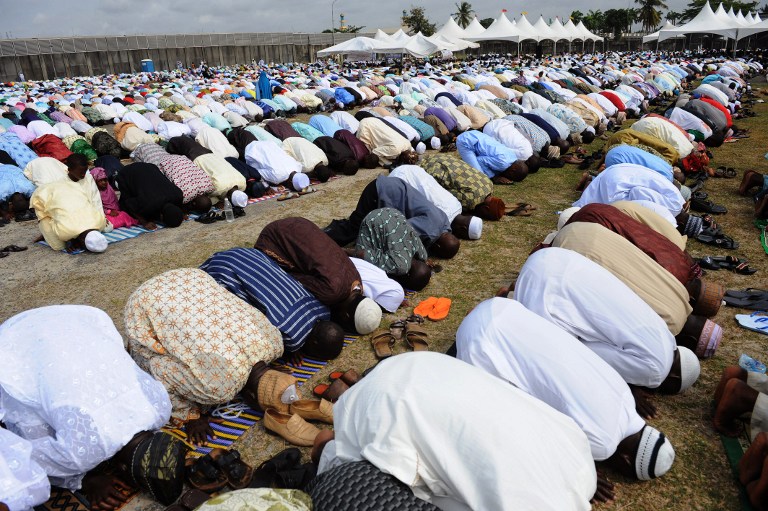
FILE: Muslims pray on the first day of Eid al-Fitr at Obalende praying ground in Lagos on August 19, 2012. Muslims around the world celebrate Eid al-Fitr, marking the end of Ramadan, the Muslim calendar’s ninth and holiest month during which followers are required to abstain from food, drink and sex from dawn to dusk. AFP PHOTO / PIUS UTOMI EKPEI
“Every nation has a festival; our festivals are Eid al-Fitr and Eid al-Adha” – Prophet Muhammad.
The word ‘Id, in Arabic, refers to that which recurs or returns. Technically, the word I’d al-Fitr refers therefore to the festival which marks the end of the month-long fasting of the month of Ramadan. It is a celebration of the completion of the training in the ‘school of Ramadan’ where Muslims ‘attended courses’ in patience, perseverance, honesty and the consciousness of the Almighty. The ‘Id al-Fitr is the occasion on which Muslims are expected to bask in an uncommon happiness, particularly for their ability to connect with the Almighty, and especially at a time when profanity and bestiality have become fashionable.
However, it is essential for us to recognise that our ‘graduation’ from the ‘school’ of Ramadan is akin to our arrival at a station that, in itself, marks the beginning of another journey. In other words, the whole essence of life and living for the conscious Muslim is all about arrival and departure; we arrive from a religious duty in order to depart for another one. The onset of the Id al-Fitr, like it is for Id al-Adha, implies the undertaking of a series of religious duties. Muslim festivals are therefore not ends in themselves but means to a more hallowed spiritual-social ends.
Thus, ahead of the ‘Id al-fitr, prepare to observe the Sunnah of the Prophet Muhammad. Plan to wake up very early in the morning; observe the tahajud (do not let this virtue slip away from your schedules after Ramadan), and in keeping with the Sunnah, take a bath before Fajr prayers and put on new clothes (or the best available). It is sunnah for men to use perfume not only on Id days but always. It is not allowed for Muslims to fast on this day. Take a light breakfast before setting out to the praying ground.
Again, do not forget that it is in the tradition of the Prophet that we give out Sadaqat-ul-fitr preferably before the Id prayers are observed. It is usually paid for and on behalf of all Muslims in a household, the young and the old. It may be paid in kind, and this may feature three to four seers of wheat, barley, rice or any staple food. (Sahih Bukhari 24:70). Of recent, Muslims scholars have addressed the necessity of monetising this act of worship based on existential necessities. In the University of Ibadan central mosque, for example, the Imam usually announces a certain amount of money to be paid by individuals in lieu of giving sadaqat al-Fitr out in kind. This falls under the legal rubric- maslahat al-Ammah- the promotion of the public convenience. Whether it is given out in cash or in kind, the more important issue is the intention behind the act. Our intention should be the extension of the happiness of the occasion to our brethren who are experiencing adversity. We should desire for our brothers and sisters the same quality of life, the like of which the Almighty has been kind to grant unto us.
But how shall we go about doing this duty? It is better we give out our sadaqat al-Fitr to our imams who would and should, following Quran 9 verse 60, distribute same among the eight categories of people who qualify to receive Zakat. Brethren, our acts of generosity stand better acceptance when they are given incognito; when we give, like Ali ibn Abi Talib, in expectation of no appreciation. We should cultivate the habit of giving, in line with the Prophet’s advice, in such a way that our left hand would not know what our right hand has handed out.
Brethren, set out early for the ‘id prayer ground. While going there in your car, stop on the way to offer seats in your car to your brethren who might be going there on foot. Do not wait to be asked before you offer such assistance. Again, this is highly virtuous.
On the way to the ‘Id praying ground, engage in much glorification of The Almighty. In a low voice, say: The Almightyu Akbar, The Almightyu Akbar, The Almightyu Akbar. Laa ilaaha ilal-lahu wal-The Almightyu Akbar, The Almightyu Akbar wa-lilla hil hamd.
‘Id prayer is performed in congregation in open areas like fields, community centres, etc. or at mosques. There is usually no Adhan (Call to Prayer) or Iqamah (call) for the prayers because they are nawafil – superogatory prayers. It consists of only two rakaʿāt (units of prayer) with an additional six Takbirs. The ‘Id prayer is usually followed by the khutbah (sermon) – this order may be reversed based on necessity- and then a supplication (dua) asking for The Almighty’s forgiveness, mercy, peace and blessings for all living beings across the world. The khutbah is also meant to remind Muslims of their responsibilities to the Almighty after the glorious month of Ramadan.
Listening to the khutbah (sermon) of ‘Id is a necessary requirement (wajib). Thus, it is not proper, as is usually the case, for you to leave the prayer ground while the khutbah is being delivered. It is equally forbidden to talk, walk about or offer prayer while the sermon is being delivered.
Brethren, as we celebrate the end of this year’s Ramadan, it is important that we constantly keep the virtues that the month has inculcated in us. Have more empathy for the poor. Let us sustain the acts of worship which we engaged in during the month. Steadfastness, patience and perseverance should remain our watchwords. Ramadan came to call our attention to the power of the spiritual realm; it came to take us away from concern for the ephemeral for that which is eternal. Ramadan came to teach us that our salvation here on earth and in the hereafter lies in how steady we are in focusing on the Almighty, how grateful we are for His blessings, and how patient shall we continue to be when, as is occasionally the case, the tide of time becomes turbulent and troublesome.
Brethren, once the ‘Id prayer is concluded, endeavour to take another route on your way back home and ponder your journeys on earth. Ask yourself, dear sister, this question just before you set out: What if this is the last festival for me on earth? May the Almighty grant you and me the favour and privilege of witnessing many more of this glorious month in life. Aaamin.