
The eternal lessons in Eid Al-Kabir festival (I)
Eid al-Kabir is indeed a great festival. This is a festival that predates the Prophet Muhammad (may the mercy and blessings of the Almighty be upon him); it is a festival instituted by the Almighty through the agency of the Prophet Ibrahim and Ismail (upon them be peace and blessings of the Almighty). Here goes […]
Eid al-Kabir is indeed a great festival. This is a festival that predates the Prophet Muhammad (may the mercy and blessings of the Almighty be upon him); it is a festival instituted by the Almighty through the agency of the Prophet Ibrahim and Ismail (upon them be peace and blessings of the Almighty).
Here goes the story, the story of faith and the faithful. He started out as a believer, a lonely believer in the Almighty at a time humanity chose to disbelieve in Him. He started out by asking his mother who his creator and God were. His mother told him it was his father, Azar. Prophet Ibrahim was not satisfied. The notion that his father was his god appeared jejune. So, he asked his mother once again who the creator of his father was. His mother told him it was Nimrod, the king of the time. “If Nimrod is the god of my father, who was his own creator”? Nobody could provide a categorical answer. But Prophet Ibrahim knew the answer. He knew that his Creator is neither a human being nor a Jinn. He knew that his Creator had no beginning and no end. He knew that his Creator is both undated and beyond spatial limitations. He knew that his Creator is He who fashioned and created the cosmos out of nothing. Thus, he chose to believe in Him. He chose to believe in the Almighty.
Thus, he was thrown into a burning fire, but the power to burn was taken away from the latter by the Almighty (Quran 21:69). He, therefore, emerged from the inferno unscathed. But in that very instance, by coming out of the fire unhurt, Prophet Ibrahim (upon him be peace) became an eternal model for all partakers of the Islamic creed. He became an exemplar in our ongoing battle against earthly principalities. Brethren, whenever someone proposes to oppress, torment and subject you to untold suffering, the Eid al-Kabir takes place every year to remind you of the emptiness of that threat once you stand for and with your Creator. No evil shall come your way except by His permission. This represents the core of our faith, of our spiritual capital.
Brethren, let us quickly fast forward to the family established by Prophet Ibrahim, a family of faith, piety and perseverance. He was the patriarch, not a masculinist. Sarah was the wife, the extremely contented and humble mother of Ishaq, from whose womb the Jews emerged. Hajar was also the other wife, mother of Ismail (upon them be peace), from whose womb Ismail emerged. Prophet Ibrahim’s family featured a man, two women and two sons, all of whom were individually destined to impact human history in extremely dissimilar and similar ways. In other words, every action of these characters, while they were on earth, was destined to be a signifier.
For example, dear brethren, Prophet Ibrahim dreamt he offered his son, Prophet Ismail, as a sacrifice to the Almighty. He proceeded to inform him of what he saw, and the latter, without hesitation, encouraged his father to carry out the divine inspiration without prevarication.
Thus, in that lonely desert that day, father and son got together to do what the father was convinced was the imprimatur of divine inspiration; the bidding of the Almighty. He wanted to sacrifice his son; the son wanted to offer himself to the Almighty. Father desired to please the Almighty; the son wanted to curry the favour of the former, who in turn was desirous of pleasing the Owner of the heavens and the earth.
Meanwhile, the mother of the son, Hajar, occupied a lonely space. In silence, she bore the pain of the then inevitable loss of her son. In silence, she opened up her heart to the Almighty. Ismail was the only fruit of her womb. She had hoped that he would be alive to take care of her tomb. But there she was all alone as she submitted her desires and aspirations to the Almighty, the Owner of her womb.
Eventually, her patience and silence were rewarded. Her fears became a glistening hope. Her son found redemption in her fortitude and in the fortress of her faith. What a unique and wonderful scene and sight to behold – of the fruit that adds value to the tree; of the water whose beautiful taste harks back to its fountain, of the hive and the comb from which honey of various tastes gushes forth.
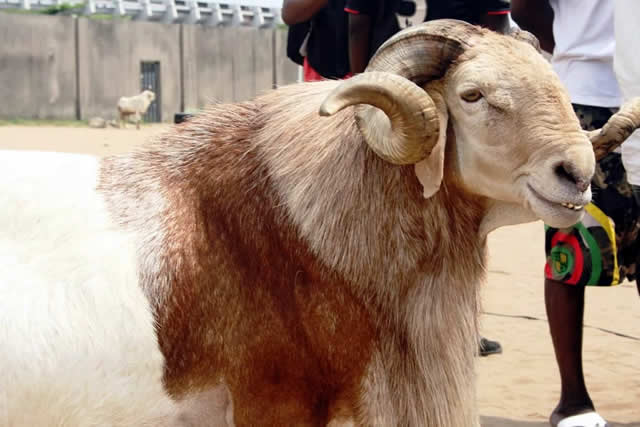
Brethren, Eid al-Kabir is here to remind us, once again, of how the Almighty usually intervenes to turn a situation of hopelessness into one of hope and happiness. Prophet Ibrahim was told, “You have indeed affirmed the dream,” and consequently, a beautiful ram was given to him as ransom for his son. Thus, sacrifice became not an end in itself but a means towards a nobler end: an end to the sacrifice of humans in history, an end to the ascension of pernicious authorities in humans, which usually make them go against the will of the Almighty, an end to greed, self-conceitedness, and inane glorification of the ephemeral, not the eternal. The sacrifice of animals on this day reminds the servants of the Almighty of their utter weakness in relation to every entity in the universe. Were it not for the will and favour of the Almighty, how could we by ourselves control and exert our authority over these sacrificial lambs?
Remember that Eid al-Kabir signifies our arrival for a religious duty; it also signals our constant departure to walk with our Creator. Somebody asked me, “Who knows tomorrow?” A brother intervened and said, “Nobody does”. But who owns tomorrow?” he queried again. ‘It is the Almighty. We all chorused. May He who knows and owns tomorrow dispel our sorrow and lead us out of this tunnel of underperformance and pettiness to that of greatness.