
The neem trees of Maiduguri (I)
One wondrous thing about Maiduguri is its teeming neem trees. On Friday last week, when I flew out of Maiduguri on Rano Air, I looked out of the window and, as usual, saw rows and rows of neem trees dotting the landscape around dwellings. I guess if the pilot had taken us around the city, […]
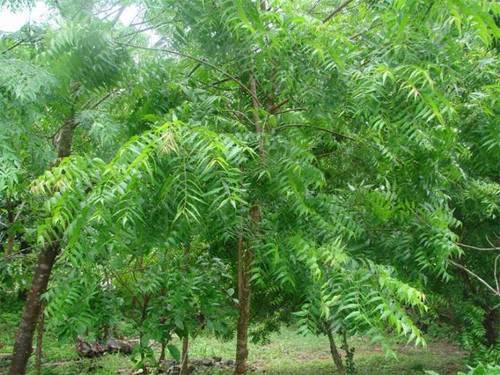
neem tree
One wondrous thing about Maiduguri is its teeming neem trees. On Friday last week, when I flew out of Maiduguri on Rano Air, I looked out of the window and, as usual, saw rows and rows of neem trees dotting the landscape around dwellings. I guess if the pilot had taken us around the city, it would be the same sight that one would marvel at. As the plane rose into the sky on that bright afternoon, I pondered over the tree that brought succour to Maiduguri, transforming the barren landscape into a greener oasis and the great men who made it possible.
Neem trees gave character to Maiduguri, just like Dala and Gwauron Dutse hills identify Kano, and the picturesque seven hills that single out Ibadan. The neem trees in and around Maiduguri would be uncountable now. They are everywhere, beautifying the streets, adorning residences, and lining up orchards and farms. When I was growing up in the early 1960s, neem trees were even more ubiquitous than what obtains now. In addition to the standalones, there were woodlots with masses of neem trees, in all corners surrounding the town.
While ancient towns such as Kano and Zaria were fortified with high mud walls, Maiduguri, a relatively new settlement established as recently as 1907, was surrounded by massive neem woodlots. Unfortunately, many of the woodlots gave way to developments in later years. I can point to two massive woodlots that were cleared in the 1970s: one immediately after the post office, on Kano Road, to make way for the Musa Usman Secretariat and the other opposite Abbaganaram to make way for the headquarters of the Nigerian Railway Corporation, the state’s low-cost houses and the new prison.
Neem trees, along with mango, guava, and cashew trees and many species of flowers, were introduced into Borno during the colonial times. I understand that the neem tree was introduced from Sudan in 1927 and came to adapt very well to the Borno environment. It thrived well in the Maiduguri nursery, and it was from there that the neem trees spread to other parts of the country and as far as Lagos.
Planting the neem tree started earnestly in Borno, and by 1949, the symbolic one millionth neem tree was planted in front of the Shehu’s palace.
The iconic tree was said to have been planted by Sir Huge Foot, the acting colonial Nigerian Governor, while on a visit to Maiduguri. This much I learnt from the biography of Musa Daggash (The Story of a Shuwa Arab Boy) written by Yakubu Mukhtar, who once served as the Vice-Chancellor, Yobe State University, Damaturu. Musa Daggash, who died in 1997 at the age of 80, was a pioneer in so many respects. He was one of the earliest to be educated in Borno. He attended the famous Katsina College in 1934 and, on graduation, became a forester. He, along with five other colleagues were the first set of forestry students at the Samaru Agricultural School in 1938.
After the training at Samaru, Musa Daggash embarked on a splendid forestry career that took him all over the northern region doing pioneering work wherever he went. Postings took him to Katsina, Hadejia, Kafanchan, Yola and Maiduguri. He was the first Principal of the School of Forestry in Naraguta, Jos, in 1958. As Independence beckoned, Musa Daggash’s forestry career also came to an end as he was tapped for higher duties. He was inducted into the administrative cadre and transferred to the federal civil service in Lagos and, in a short while, appointed permanent secretary.
During the First Republic, he was mainly in the Ministry of Mines and Power with Maitama Sule as the minister. However, when the military took over in 1966, Daggash was in the eye of the storm as permanent secretary of the Federal Ministry of Defence, working directly in the first instance with the Head of State, General Aguiyi-Ironsi, and subsequently with General Yakubu Gowon. Daggash retired in 1969 after attaining the age of fifty and thereafter became much sought after to head government parastatals, here and there.
Our paths crossed in 1977 when I joined Chad Basin Development Authority (CBDA), where he was the foundation general manager. I was privileged to be posted to his office as an Admin Officer. We worked together for only a brief period because he became part of the 230 members appointed by the Federal Government to the Constituent Assembly in October 1977 to deliberate on the draft constitution as part of the preparations for the inauguration of the 2nd Republic. This national assignment took him away for nine months.
Daggash never returned to CBDA, as he went on to another assignment after the Constituent Assembly. For the brief period I worked in his office, I found in him the kind of boss who could be free with his subordinates, discussing a range of topics whenever the occasion arose. Despite the high offices he occupied, Daggash was passionate about his forestry career, his love for neem trees and his contribution to their propagation, particularly in Maiduguri. He talked a great deal about his involvement with the neem trees project.
We will continue the discussion next week, when we will also learn how neem trees came to be known as Dogonyaro.