
The unmasking of a kingmaker
The story of the emergence of former Speaker Yakubu Dogara and his successor, Femi Gbajabiamila, will be incomplete without adequate mention of the exploits of Abdulmumuni Jibrin, an influential member of the House of Representatives from Kano State. Jibrin has succeeded in ‘installing’ two different speakers of the House of Representatives in two different circumstances, […]
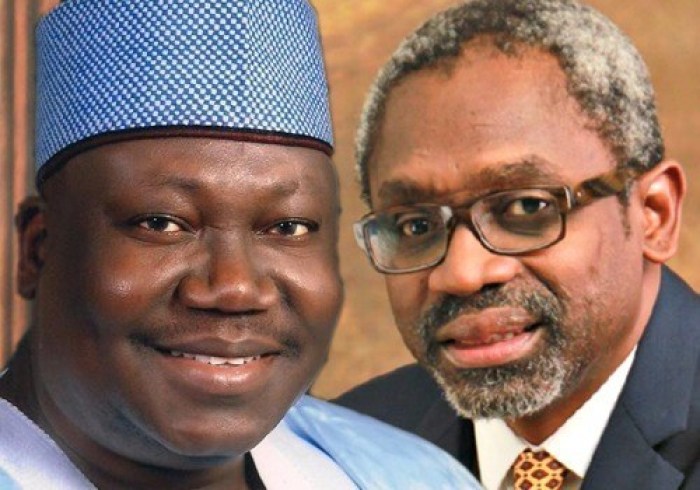
Lawan and Gbajabiamila
The story of the emergence of former Speaker Yakubu Dogara and his successor, Femi Gbajabiamila, will be incomplete without adequate mention of the exploits of Abdulmumuni Jibrin, an influential member of the House of Representatives from Kano State.
Jibrin has succeeded in ‘installing’ two different speakers of the House of Representatives in two different circumstances, first through a rebellion against the establishment; and the other in enforcing the position of same establishment.
In 2015, the youthful Jibrin who only joined the House in 2011, played prominent role in the leadership tussle between then ‘Equity Group’ headed by Yakubu Dogara and the ‘Loyalist Group’ headed by Femi Gbajabiamila. That struggle eventually produced Dogara as Speaker, thereby causing a major rift within the ruling All Progressives Congress (APC).
Fast forward to 2019, Jibrin who served as the Campaign Director General for the election of Gbajabiamila, like he did for Dogara in 2015, has also delivered the incumbent Speaker. This is a feat exclusive to him as no one person has delivered two speakers consecutively in the history of Nigeria’s House of Representatives.
Abdulmumin Jibrin is a Nigerian politician and a 3rd term member of Nigeria’s House of Representatives from Kofa, Bebeji LG, Kano state. He is 42 years of age. He was at various times chairman House Committee on Finance, Appropriation and Land Transport with oversight on Nigeria’s revenue, expenditure, railways and rail projects respectively.
He is a globally trained business executive, academician turned politician. He holds a BSc, MSc and PhD in Politics, Diplomacy and International Relations from University of Abuja and Ahmadu Bello University, Zaria. He was at various times trained at the London Business School, Harvard Business School and SBS- Swiss Business School- Zurich Switzerland where he obtained SEP, PLD and MBA respectively. He is an Alumnus of the Harvard, London and Swiss business schools.
Prior to joining politics, Abdulmumin played an active role in the private sector as Chairman/ CEO Green Forest Group Ltd. running a Nigerian conglomerate in diverse fields. He served as Chairman (Nigeria) of Turkish construction giant Tasyapi and Chairman Abuja branch of Nigeria-British Chamber of Commerce. He also lectured at the university with publications to his credit.
A consummate mobiliser, Abdulmumin was the Director, Media and Strategic Communication of the Women and Youth Presidential Campaign Team and most recently, Director General of Femi Gbajabiamila for Speaker campaign council. He is a public finance and foreign policy expert and has shown significant interest and contributed to improving Nigeria’s revenue and expenditure process. He has won numerous awards and he is a fellow of many professional bodies including the Chartered Institute of Finance and Control.
He is a Paul Harris fellow of Rotary international. He holds the traditional tittle of Jarman Bebeji conferred on him with the approval of the Kano Emirate Council. It is a tittle reserved for the courageous and generous.
In 2011, Jibrin won election to represent Kiru/Bebeji Federal constituency under the Platform of the PDP, and later decamped to the newly formed All Progressives Congress (APC) in 2014. It is worth noting that he led the first set of 37 lawmakers who defected in a massive swoop that shook the political landscape. Not surprisingly, he won re-election into the House under the new platform in 2015.
In 2015, the rebellion against the party’s position led by immediate past Senate President, Bukola Saraki and the Equity Group in the House of Representatives where Jibrin played prominent roles, eventually led to a defeat of the choices of the party. Suffice to say that it was same Jibrin who nominated Dogara for the post on that historic day thereby culminating months of chaperoning an arduous campaign that eventually paid off. Jibrin and his group were able to garner votes across the two political parties to pave the way for Dogara to emerge speaker. After the election, he was offered the chairmanship of the Appropriations Committee of the House, a position that became the springboard to the travails that bedevilled him for much of that 8th assembly.
Despite his suspension over the 2016 budget controversy and subsequent ‘relocation’ to London, Jibrin refused to pipe down on his attacks on the leadership of the House and maintained forthrightness on the matter of his suspension. Even when Jibrin completed his suspension, he still could not resume his duties as a federal lawmaker as the House insisted on an apology which he bluntly refused to offer.
However, on Tuesday, 13th March, 2018 Jibrin finally decided to end his long drawn battle with the House leadership. The following day he was ushered into the green chamber in a manner that demonstrated conciliation and mutual forgiveness. On his return, Jibrin said: “Lessons were learnt by both parties; the leadership and the victim. Lessons on the part of leadership and lessons on the part of members.” Incidentally, the court at about this time, ruled that his suspension was unconstitutional. He was subsequently appointed as Chairman of the House Committee on Land Transport and his entitlements hitherto withheld, paid in full.
Upon resumption at the House in 2018, Jibrin convened the Parliamentary Support Group PSG, with the mandate of full loyalty to President Buhari. Notably, the group was already in existence in the Senate. It was seen as a demonstration of courage by his colleagues. Thus, Jibrin even led over 100 members of the House to pay solidarity to the President in 2018 at a time when the National Assembly Joint executive session issued a 13-point demand to the President. Jibrin had earlier described it as a “PDP executive session.” Jibrin won his re-election in a resounding fashion in 2019.
Jibrin supported the aspiration of the current Speaker and was promptly offered the position of the Director General of the Campaign, in recognition of his knack for political dexterity, hard work and antecedence of success. Off to work he went, canvassing, persuading, and deploying carefully crafted political strategies that eventually paid off on June 11, 2019.
Jibrin perhaps gave the longest nomination speech ever when nominating a Speaker, engaging in a charm offensive to woo members across party lines on the day of election. Although many pundits predicted the 2019 tussle for speaker would replicate the 2015 scenario, but it turned out the rebellion had lost a fighter in Jibrin.
The same manner he was at the forefront of the action in 2015, he was at the forefront of action in 2019. Bringing energy, doggedness and organization to the campaign, something probably missing in 2019.
After the emergence of Gbajabiamila as Speaker, all eyes have been on Jibrin. What does he want? What will he be offered? Insiders in the Gbajabiamila camp revealed that everyone is confused about what to do with Jibrin. He has held the two most important committees of Finance and Appropriations consecutively with a wide scope of oversight covering almost every sector. The two committees are even referred to as the 11th and 12th Principal Officers in the House. There is also strong whispering within the House that the Kano Born politician may consider an immediate return to his private business or the university to pursue his professorial ambition. The next few days or weeks will tell.
Omolabake, a public anlyst, writes from Abuja