
Tinubu suspends airport cashless policy
The Federal Executive Council (FEC) has approved the suspension of the cashless toll payment system introduced by the Federal Airports Authority of Nigeria (FAAN) at major airports across the country. On March 1, 2026, the airport authority barred cash payments at airport toll gates, requiring motorists to use prepaid access cards or electronic payment channels. […]
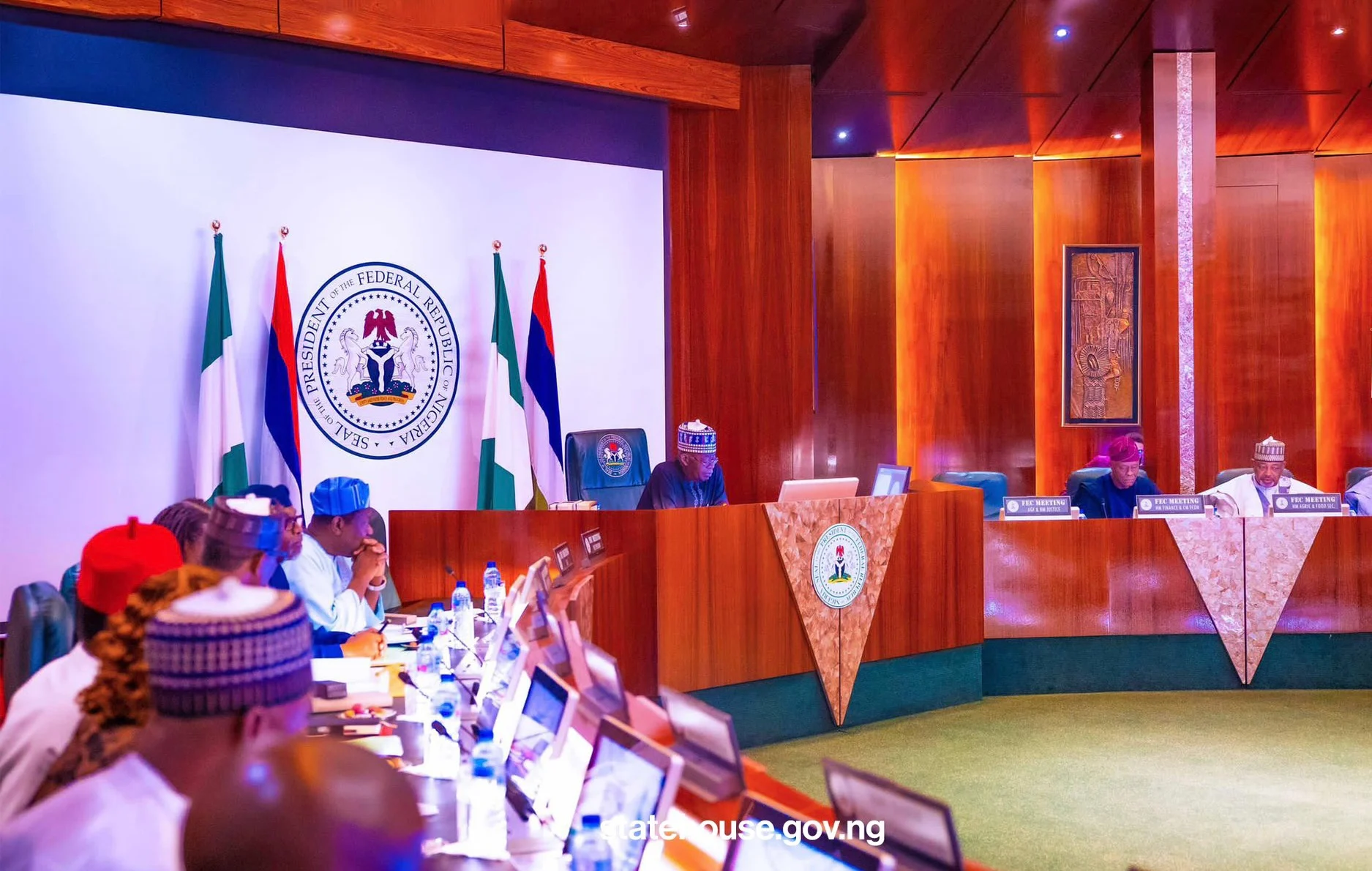
tinubu at fec meeting 1
The Federal Executive Council (FEC) has approved the suspension of the cashless toll payment system introduced by the Federal Airports Authority of Nigeria (FAAN) at major airports across the country.
On March 1, 2026, the airport authority barred cash payments at airport toll gates, requiring motorists to use prepaid access cards or electronic payment channels.
However, the situation got rowdy with passengers and motorists stranded for hours as confusion and heavy gridlock trailed the commencement of the exercise.
The development led to frustration from travellers who complained of missed flights and delayed pickups.
However, addressing State House correspondents after the Federal Executive Council, FEC meeting on Wednesday, the Minister of Aviation and Aerospace Development, Festus Keyamo said the President has agreed for the suspension of the policy.
He explained that the cashless system was initially introduced by the Federal Airports Authority of Nigeria (FAAN) to eliminate corruption and improve revenue collection for the Federal Government, replacing a decades-old practice of cash payments.
“The first memo has to do with the present cashless system we introduced at our toll gates across the country in order to eliminate corruption and optimise revenue for the Federal Government,” the minister said.
“You recall that this practice had gone on for more than 50 years where operators of the toll gates collect cash from motorists at points of collection across the country, mostly at toll gates and other points like parking lots.”
However, he noted that less than a week after the introduction of the cashless system, it began to create serious congestion around airport access roads, particularly in Lagos and Abuja.
“Mr President was very concerned about the welfare of Nigerians and the fact that most Nigerians were missing their flights.
“So Mr. President, out of empathy, directed today that we should suspend the present system because it creates a lot of gridlock and Nigerians are suffering as a result of it”, Keyamo said.
He said the President instructed the ministry and FAAN to revert temporarily to the previous payment arrangement while officials work on a more efficient electronic solution.
Keyamo explained that the government would implement a temporary hybrid arrangement allowing both cash payments and the use of prepaid FAAN cards already purchased by some motorists.
“For those who have bought FAAN cards before, we can do a hybrid system whereby we can collect cash temporarily and, of course, use the cards that they have collected temporarily for now,” he said.
The minister added that the Federal Government would engage private sector partners to develop a more efficient electronic payment platform that would eliminate cash transactions without causing delays for motorists.
He said the President had directed that the review process should not take long, emphasising the need to restore efficiency at airport entry points as quickly as possible.
Keyamo noted that Tinubu remains committed to a fully electronic system for revenue collection at airports but insisted that the new arrangement must not create the kind of congestion currently experienced.
“To the extent that it will not create the gridlock that we are having right now,” he said.
He further revealed that the government may allow private operators to manage the electronic payment system and collect revenues on behalf of the Federal Government, even if it requires paying commissions.
Keyamo stressed that the suspension of the policy should not be interpreted as a return to permanent cash transactions but rather a temporary measure aimed at easing the difficulties faced by travellers.
Keyamo added that the ministry would consult further with FAAN and provide additional briefings as work progresses on developing a more efficient and seamless payment solution for airport users.
‘Good policy, poor implementation’
Daily Trust reports that since the commencement of the policy, passengers and users of airport tollgates especially in Lagos and Abuja had gone through what they called “hellish” experience to access the airports.
In Lagos, some regular users of the tollgate going through the International Airport road to Oshodi or those connecting the domestic terminals from Oshodi end spent hours.
Some passengers had to resort to using commercial motorcycles in order not to miss their flights while many passengers actually missed their flights on account of being stuck in the traffic snarls.
Experts describe the policy as a well thought out one aimed at blocking leakages but the implementation was poorly planned.
Aviation analyst and General Secretary of Aviation Roundtable and Safety Initiative, Mr. Olumide Ohunayo said FAAN put revenue generation far and above free flow of traffic whereas it is the free movement that would naturally drive revenue.
He said, “What led to this problem was that the focus was more on revenue generation rather than traffic flow. At the airports, when the traffic flows and operation is smooth, then your revenue naturally increases.
“When you put revenue ahead of the traffic flow, you obstruct operation and in obstructing operation, you will lose revenue. I just hope lessons were learnt.
“The cashless policy is a noble idea but in the process of doing that you also neglected the cultural part. The infrastructural deficit, as at today, how many people hold credit? In other climes, with a credit card, all you just need is to tap it on the machine and the fare would be deducted from your card. We have not gotten to that level yet.
“A normal driver who drives around, I can tell you that 99.5% of people that pass that road do not have the credit cards. So that cannot work. And how many people can have access to that card, the card that FAAN is offering? I was thinking that maybe about six months would have been the best minimum.
“And in doing that, you must open the door for those who don’t have it. So when they see the pain of not having it, you are now encouraged to have the card. But when I think that I would queue and spend about 30 minutes to cross that gate and those that have the cards are spending two, three minutes, four minutes, I would have the card and for those who cannot queue you can ask them to pay triple the amount.
“If the cost of passing through that gate is N300 and you are in a hurry, you then pay N3000. When you paid that N3000, you would not want to pay it two times. So you would rather find a solution to it.”
He said as FAAN implements the cashless policy, it must take cognizance of experiences in other climes.
Another aviation analyst who spoke on the condition of anonymity said, “The decision by the government to suspend the policy is a good one. I think it’s as a result of political pressure. You don’t just come up with a policy overnight, it exposes people to extortion.”
Also, aviation security expert, Grp. Capt. John Ojikutu (retd), is of the opinion that the tollgate at the Lagos airport did not capture every user of the airport and lauded Tinubu for its suspension.
“Why is FAAN focusing on revenue from tollgates? Is FAAN’s revenue on a decline or they want to increase their revenue generation from tolling?
“How can you charge a passenger twice? Travellers pay Passenger Service Charge (PSC) to FAAN, yet you are tolling them. This is very unfortunate.”