
UK praises Nigeria’s bold economic reforms, trade ties
The United Kingdom has commended Nigeria for its bold economic reforms under President Bola Tinubu’s administration, describing them as critical to unlocking sustainable growth and enhancing the business environment for international partnerships. Speaking during a press conference in Abuja, the UK’s High Commissioner to Nigeria, Dr. Richard Montgomery, praised the Nigerian government’s commitment to reform, […]
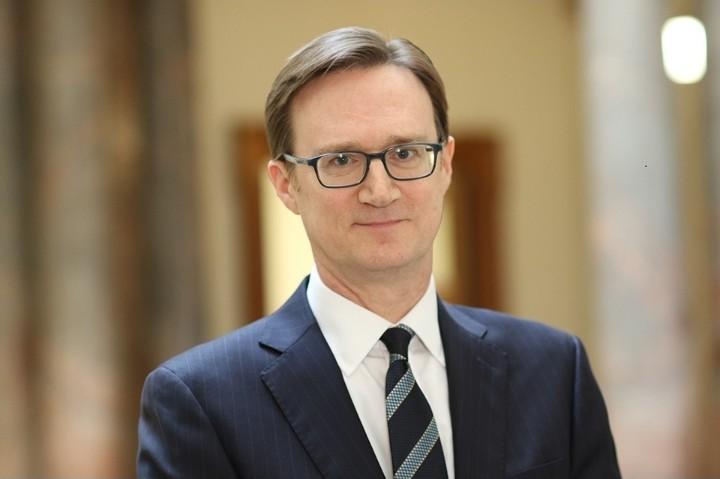
Richard Montgomery, British High Commissioner to Nigeria
The United Kingdom has commended Nigeria for its bold economic reforms under President Bola Tinubu’s administration, describing them as critical to unlocking sustainable growth and enhancing the business environment for international partnerships.
Speaking during a press conference in Abuja, the UK’s High Commissioner to Nigeria, Dr. Richard Montgomery, praised the Nigerian government’s commitment to reform, which he said aligns strongly with the UK’s economic growth agenda.
“We welcome the Nigerian government’s reform efforts, especially under President Tinubu’s 8-Point Economic Agenda. These reforms are vital to improving the business climate and creating jobs.
“I’ve been very public previously about commending the big and bold economic reforms being taken by His Excellency, President Bola Ahmed Tinubu,” he said.
- Don’t hold more than 60,000 Riyals for Hajj, NAHCON cautions pilgrims
- Web3 ai, Aptos, Sui: 3 Crypto Projects That Raised Millions Overnight & Are Still Climbing
“We all know about the abolition of the fuel subsidy, we all know about the unification of the exchange rate system, and my headline this morning is that these economic reforms are paying off, and these economic reforms are now making Nigeria more investible.
“I realise that some of these reforms for ordinary people are painful.
“Inflation is still high, it’s in the 20 percent territory, the mid-20s. And it’s going to take time to bring that rate down.
“But we can see very good prospects for that rate coming down in the coming months and years,” Montgomery stated.
His remarks come in the context of the UK-Nigeria Enhanced Trade and Investment Partnership (ETIP), a landmark bilateral agreement signed in February 2024 — the first of its kind between the UK and any African nation.
Montgomery hailed the agreement as a “truly co-created framework” designed to spur inclusive growth and support regulatory reforms.
“The ETIP reflects our shared ambition to deepen economic ties and eliminate non-tariff barriers. It’s already bearing fruit in sectors like education, creative industries, and clean energy,” Montgomery noted.
Under the ETIP framework, the UK and Nigeria are jointly advancing initiatives to boost trade across eight key sectors, including agriculture, finance, health, and legal services. The agreement also aims to simplify customs procedures and improve regulatory cooperation.
Montgomery highlighted recent UK-backed investments that reinforce the depth of the bilateral relationship. These include a $40.5 million investment in Nigeria’s cocoa sector by British International Investment plc and a £10 million injection into climate-focused infrastructure via ARM-Harith’s fund. Another significant milestone includes the recent £1.9 million Sankore initiative to support science and innovation in Nigeria.
“These investments go beyond capital—they reflect the UK’s confidence in Nigeria’s potential and the reforms unlocking that potential,” Montgomery said.
The High Commissioner also pointed to the UK’s Developing Countries Trade Scheme (DCTS) as an opportunity for Nigerian exporters to access the UK market tariff-free on over 3,000 products, including cocoa, plantain, and sesame.
“Our message is clear: the UK believes in Nigeria’s economic future. We are not just partners — we are long-term allies in growth,” he added.
He also said the commission agrees with the World Bank’s May 2025 Nigeria Development Update (NDU), whose main thrust is that the naira is now more stable, adding that a predictable economic environment buoys investments.
“Foreign exchange reserves are up, significantly up, so that makes Nigeria less risky. There’s been a very big increase in government revenue collection, not by raising tax banks, but by tax administration and management,” Montgomery added.
With the UK-Nigeria trade relationship already valued at £7.2 billion, both nations are positioning themselves for deeper economic collaboration built on mutual reform and resilience.