
Understanding the intrigues of airfares
There has been disquiet in the aviation industry in recent times over the high cost of airfares on some routes, especially the South East and South-South routes, resulting in some passengers taking a swipe on Air Peace. It was learnt that some passengers who were trying to book on the airline’s website were confronted with […]
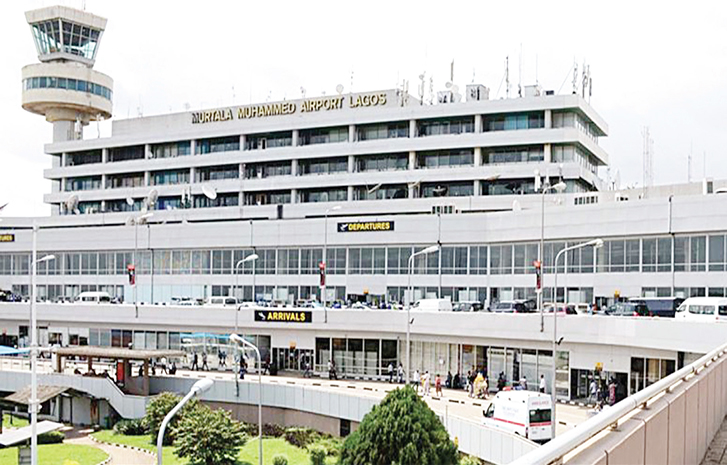
Murtala Muhammed International Airport, MMIA Lagos
There has been disquiet in the aviation industry in recent times over the high cost of airfares on some routes, especially the South East and South-South routes, resulting in some passengers taking a swipe on Air Peace.
It was learnt that some passengers who were trying to book on the airline’s website were confronted with fares reportedly higher than their expectations.
This prompted them to call out the airline, accusing it of imposing discriminatory fares on the eastern routes as against the fares on the northern routes.
The airline has however strongly denied the allegation while providing insight into the mathematics of airfares.
The airline, in a statement, said “Air Peace does not discriminate against the South East. It is the same fare that is loaded for all the routes all over Nigeria.
“If the first 10 seats of N23,000 fare finishes, the system will automatically start showing the next fare which is N27,500. If the allocated seats on this are booked, it will migrate to the next until it gets to the last 14 seats pegged at N60,000.
“As the aircraft gets fuller, the higher fares start showing up. The eastern routes, because of traffic, get sold out faster than some places thereby showing higher fares faster. But the other destinations, though slower, will also pay the same higher fares as they get fuller.”
The issue has evoked debate on the mathematics of airfares against the backdrop of advertisements of cheap fares by some airlines in recent times.
For instance, one of the start-up airlines, Green Africa, which recently commenced operation, advertised what stakeholders described as the most ridiculously cheap fares of M16,500 to N18,000. That could be the cheapest on any route for any airline in Nigeria today.
Even low-cost airlines, as findings by our correspondent showed, may not have the cheapest fares.
With several classes of tickets on their website, the cheapest comes with conditions that might not be favourable to the passengers.
A passenger who recently patronized the airline said, “I bought their ticket from Lagos to Abuja for N22,000 but when I got to the airport, I was told I’m entitled to only one hand luggage. I paid close to N10,000 to be able to travel with my luggage. In the end, the fare was about N35,000.”
Also, Dana Air recently said it had rolled out a flash sale of N18,000 fare for Enugu, Asaba and Owerri. But checks by our correspondent as of the time of filing this report showed that Asaba flight costs N37,800 for Economy Discount; N44,100 for Economy Saver; N60,300 for Economy Flexible; N95,400 for Business Saver and N117,000 for Business Flexible.
Operators who spoke with our correspondent said given the liberalisation of airfares, air tickets are now a function of demand and supply. For instance, passengers booking the first 10 seats on an airline tend to get the cheapest fares. And as more people book, the fares continue to rise.
This was also the case when an Abuja-Ilorin flight for Thursday being booked on Wednesday was priced for N69,500 on Overland Airline. The airline’s cheapest fare on that route is around N29,000.
The mathematics, according to the operators, is the earlier a passenger books, the cheaper the ticket.
Commenting on the development, an aviation stakeholder, Mr. Olumide Ohunayo, said there was nothing unusual with the airfares pricing, saying December and January always come with higher fares because of the huge demands.
He said, “This is a norm in the commercial air transport industry; where demands are high and passengers are willing to pay a premium, also have higher fares.
“If you look at it, in Nigeria, Lagos to Port Harcourt route is always expensive. Akwa Ibom is also expensive. When you compare that to neighbouring Calabar, you have about 15,000 to 20,000 naira. The demand determines fares.
Mr Sam Adurogboye, a spokesman of the Nigerian Civil Aviation Authority (NCAA) said there was nothing like exploitation in airfares, adding that the pricing is a function of demand and supply.
“It is now left for you as a passenger to decide whether you want to buy the ticket or not,” he said.