
Update on preservation of donkeys
After my piece titled Not yet Uhuru for Donkeys last week, I did some legwork to update information on what is being done to prevent the alarming extinction of donkeys. Besides phone calls and rummaging through the Google space, I also had a productive one-to-one meeting with Hon. Garba Datti Muhammad, one of the most […]
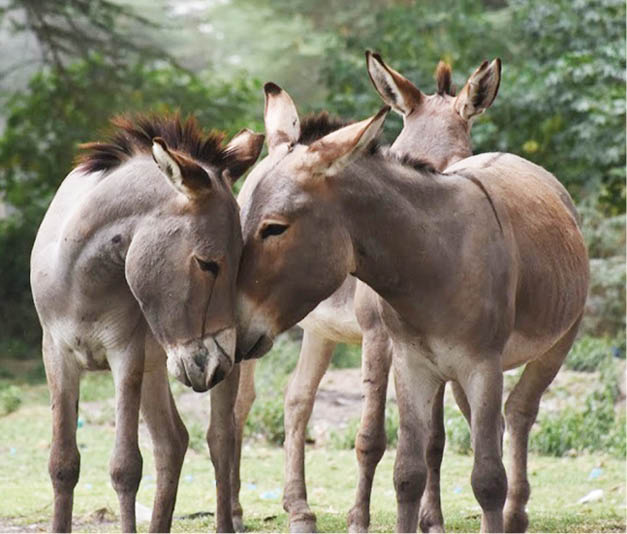
Donkeys are said to endangered in the country
After my piece titled Not yet Uhuru for Donkeys last week, I did some legwork to update information on what is being done to prevent the alarming extinction of donkeys. Besides phone calls and rummaging through the Google space, I also had a productive one-to-one meeting with Hon. Garba Datti Muhammad, one of the most passionate and tenacious advocates for the preservation of donkeys in Nigeria. He had served his people in Zaria as a legislator for four years in the Kaduna State House of Assembly and 16 years in the House of Representatives.
He had always been a proponent of the protection of the livelihood of donkeys, but it was at the House of Representatives that his advocacy came to full fruition. For it was there that he successfully spearheaded and saw through the passage of legislation prohibiting the killing of donkeys. To his regret, the bill was dilly-dallied in the Senate until the end of the 9th Assembly, when it became too late to transform it into law.
To begin with, let’s put the matter in its proper perspective. Donkeys have, over time immemorial, served as an all-around means of transportation, particularly in our rural areas. As recently as the 1970s, donkeys could be seen in our towns and more so in the villages, in large numbers, serving diligently everywhere, in the markets, farms and homes. However, from the mid-1980s onward, the donkey population began to decline at an alarming rate. The reason was not too far to find. In China, donkey skin and other parts have been used for centuries as ingredients in the production of traditional Chinese medicine, ejiao, an herbal concoction for skin health and reproductive prowess, for the upper echelons of society.
As Chinese society became more prosperous with the relaxation of the communist grip on the levers of the economy in the 1980s and disposable income rose, there was a corresponding high rise in demand for ejiao. The increased demand that could not be met locally in China meant they had to reach out to source donkeys from herds in other parts of the world. The statistics are glaring and grim enough. China had 11 million donkeys in the 1990s, which, due to a sharp rise in demand for ejiao, had tumbled to about two million in recent years.
The Chinese were ready to pay good money for donkeys from other parts of the world, particularly from African countries where large numbers were available, and owners could not resist the attractive offers. Trade in donkey parts had then reached a new level. Their numbers decreased at an alarming rate not only in Nigeria but also in Kenya, Uganda, and several other African countries. The same problem reared its head in Latin America and those parts of Asia where donkeys were prevalent as beasts of burden.
Fortunately, some international organisations adopted the plight of donkeys as part of their campaign. The Donkey Sanctuary and Brooke – Action for Working Horses and Donkeys are two of the most active, pushing governments to do what is right for donkeys and assisting worldwide in raising awareness of the plight of donkeys and what can be done to ameliorate it. We discussed this and many other matters, with Hon Garba Datti, affecting the preservation of donkeys. I learnt that over the last few years, these matters have come to a head. The issue of the donkey has been put on the front burner in many international fora.
Garba Datti himself has attended international conferences held in African countries and elsewhere, where he has presented well-researched papers on the plight of donkeys in Nigeria. Both at the immediate level, at ECOWAS, and in the wider African Union (AU), there have been agreements to ban the trade in donkey skins and prohibit the killing of donkeys. Specifically, at the 37th AU summit in 2024 in Ethiopia, African Heads of State unanimously agreed to this historic ban. Here in Nigeria, the National Council on Agriculture and Rural Development, at its 42nd regular meeting held in April 2017 in Port Harcourt, declared donkeys endangered under the Convention on International Trade in Endangered Species (CITES).
With all these bans at many levels, I wondered aloud, why is it that the killing of donkeys continues unabated? Undoubtedly, this has to do with the filthy lucre accruable to those who trade in donkey parts. They have made donkeys expensive items, priced from N250,000 upwards, and this is mainly for their body parts. Then where do we go from here? There is an existing ban on both the killing of donkeys and the trade on its body parts. Lots of arrests and seizures have also been made. However, I have not come across any convictions over these arrests.
This could be because there is a lacuna in the law, making it difficult to prosecute offenders. Or the existing laws do not have sufficiently stiff penalties to warrant prosecution. Thus, the incorrigible ones among the donkey body parts traders are left to carry on their nefarious activities unabated. I guess, as a lasting measure, both the Ministry of Livestock Development and the Ministry of Environment will need to take a holistic approach to the matter and come up with a ban that stings. If this means getting a Presidential Executive Order, so be it.