
USA law director asks Tinubu to reverse Fubara’s suspension
A professor of environmental and public international law, Cyprian F. Edward-Ekpo, has called on President Bola Tinubu to reverse the decision to suspend Governor Siminalayi Fubara before the hearing of the suit filed by some governors on the matter before the Supreme Court. Edward-Ekpo, who is also the Director, Institute of Law Research & Development […]
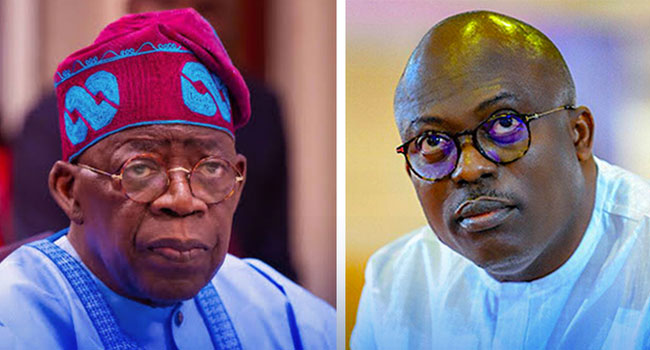
tinubu fubara
A professor of environmental and public international law, Cyprian F. Edward-Ekpo, has called on President Bola Tinubu to reverse the decision to suspend Governor Siminalayi Fubara before the hearing of the suit filed by some governors on the matter before the Supreme Court.
Edward-Ekpo, who is also the Director, Institute of Law Research & Development of United Nations (ILAWDUN), Washington D.C, USA, said the swift and corrective action will help reaffirm the president’s commitment to democracy and reposition his image as a leader who values the rule of law, and demonstrate that he listens to the people.
Following the president’s suspension of Governor Fubara, his deputy, Ngozi Odu and members of the state assembly on March 18 and the appointment of a retired military sole administrator and the ratification by the National Assembly two days later, seven governors of the opposition Peoples Democratic Party (PDP) comprising Adamawa, Bauchi, Bayelsa, Enugu, Osun, Plateau and Zamfara states have filed a suit at the Supreme Court challenging the constitutionality of the action.
Prof Edward-Ekpo said the president not acting ahead of the Supreme Court’s dismissal of the matter either by technicality or forcing the parties to withdraw the suit, as some people are anticipating, would damage his reputation as a pro-democracy advocate.
- #Takeitback: I’ll join protest if I have time –Minister
- Don’t frustrate our efforts to tackle insecurity, Sokoto govt warns residents
He wrote, “I am aware that the courts, particularly the Supreme Court, are currently saddled with this matter. Mr President, heeding my humble appeal is your best course of action. I understand that you are caught between the devil and the deep blue sea— a difficult choice—waiting for the court’s decision on this constitutional crisis or taking the more prudent and popular path of correcting the error now.
“Let me explain why the latter is the wiser option: (a) If the Supreme Court upholds the emergency declaration and the suspension of a democratically elected state governor and legislature by another democratically elected official (the President and the National Assembly), it will permanently stain your legacy. You will be remembered as the President who undermined constitutional principles and legitimized illegality. Regardless of the court’s ruling, the perception will be that the Supreme Court was influenced by you.
“However, in their commitment to justice and constitutionalism, the Supreme Court justices cannot, in good conscience, sustain such an obvious constitutional violation. Section 305 of the Constitution of Nigeria does not grant a democratically elected president the power to suspend or remove a democratically elected state government under a federal system—under any guise.
“It also does not empower the National Assembly to take a voice vote to determine a two-thirds majority or override constitutional provisions to justify a state of emergency in this instance. Additionally, such an action of imposing a sole administrator on a state would directly contradict Section 1(2) of the Constitution of Nigeria, 1999, which explicitly forbids governance by a military-style sole administrator. Furthermore, a state of emergency can only be justified when there is a genuine breakdown of law and order that overwhelms the Nigeria Police Force—conditions that were not present in Rivers State.
“Nevertheless, the Supreme Court of Nigeria, known for its tendency to violate the fundamental right to a fair hearing, may, in an attempt to evade addressing these critical constitutional questions, resort to dismissing the case on technical grounds. This could involve coercing counsel into withdrawing the case or employing other orchestrated means—tactics for which the Court has, unfortunately, become known. Should this happen, it will inevitably be perceived as judicial compromise under your influence, further eroding public trust in both the judiciary and your administration.
“(b) If the Supreme Court sets aside your actions, it will validate the allegation that you are an anti-democratic despot. This also goes to a larger negativity on your legacy.”