
Varsities shut; ASUU rejects FG’s no-work-no-pay policy
The federal government yesterday directed all vice chancellors of federal universities to enforce the “no-work-no pay” policy against lecturers participating in the ongoing warning strike of the Academic Staff Union of Universities (ASUU). This is as the leadership of the ASUU has rejected the policy, saying its members cannot be intimidated. The ASUU had on […]
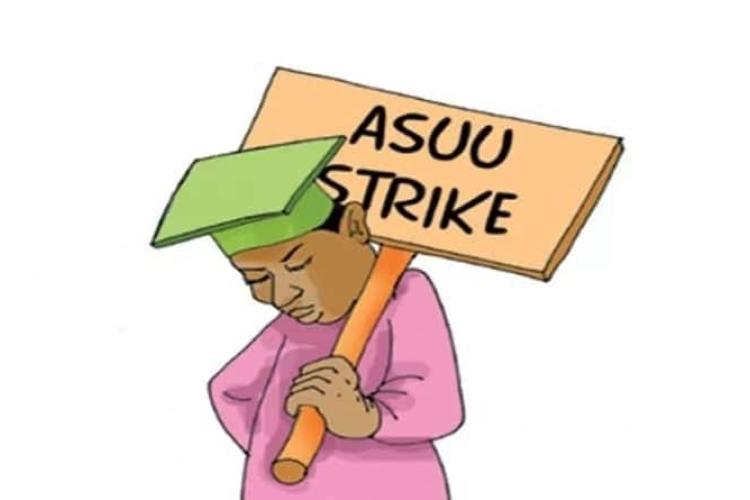
This is as the leadership of the ASUU has rejected the policy, saying its members cannot be intimidated.
The ASUU had on Sunday declared the two-week warning strike which took effect yesterday over unmet demands.
In a circular with reference number HME/FME/CORR.GEN./VOL.4/15, the Ministry of Education expressed “deep disappointment” over the continuation of ASUU’s industrial action despite what it described as repeated appeals for dialogue.
The circular quoted the Minister of Education, Tunji Alausa, as ordering all vice chancellors to “strictly apply the provisions of the Labour Laws of the Federation,” emphasizing that “no employee should receive remuneration for duties not performed during the strike period.”
To ensure compliance, the vice chancellors were instructed to conduct a physical headcount and roll call of all academic staff, prepare a detailed report identifying those who continued working and withhold salaries of staff who participated in the strike.
However, the ministry said members of the Congress of University Academics (CONUA) and the National Association of Medical and Dental Academics (NAMDA)—two breakaway unions not participating in the strike—were to be exempted from salary deductions.
The National Universities Commission (NUC) has also been directed to monitor compliance and submit a consolidated report to the Ministry within seven days.
Alausa urged the vice chancellors to handle the directive “with utmost urgency and a deep sense of responsibility in the national interest,” stressing the need to safeguard the stability and integrity of Nigeria’s higher education sector.
ASUU President, Chris Piwuna,last night said that the union would not bow to intimidation or threats.
Speaking on Channels Television’s Politics Today, he said the union remained united and resolute in its struggle in spite of the government attempts to the union through selective payment and threats.
“We don’t respond to threats, and nobody can threaten us,” Piwuna stated.
“He is threatening us, writing to NAMDA and CONUA, telling them they can get their salaries. He wants to divide us, but we are united in this matter,” he said.
The ASUU president noted that the union enjoys the solidarity of other major university and tertiary institution unions, including the Senior Staff Association of Nigerian Universities (SSANU), the Non-Academic Staff Union (NASU) and academic staff in polytechnics and colleges of education.
“CONUA is with us, NAMDA is with us, SSANU is with us, NASU is with us. The polytechnics and colleges of education are also with us,” he Piwuna said.
At the University of Jos, the ASUU’s chairperson, Professor Jurbe Molwus, told journalists yesterday that the “no work, no pay” directive had become a familiar government tactic.
“The issue of ‘no work, no pay’ is a concern, but it’s something we’re used to. We know that in a country like Nigeria, you dare to fight for your rights and dare to win,” Molwus said during a congress meeting.
“In a normal society, the leadership would normally do what’s right for the people, which is why you hear less of industrial actions by academics in other places.”
He alleged that the government’s intention was to stifle dissent and keep lecturers subdued through financial hardship.
“We believe in what Martin Luther King said, ‘Freedom is not voluntarily given by the oppressor unless it is demanded by the oppressed.’ They want to force us to accept whatever they want. They want to force us to keep quiet. They want to gag us, and that is why they are keeping our salaries low with the kind of offers they’re making. We are going to reject it with the last strength we have,” he added.
Despite the threat of withheld salaries, Molwus reaffirmed that the strike would continue until all of ASUU’s demands were met.
Across the country, universities observed near total compliance with ASUU’s two-week warning strike, bringing lectures, examinations and research activities to a halt.
At Ahmadu Bello University (ABU), Zaria, ASUU branch chairman, Comrade Haruna Jibril, confirmed that members had fully complied with the directive.
“Though the strike is in its first day, I am optimistic that compliance will be 100 percent,” he said after a congress meeting.
A visit to both the Samaru and Kongo campuses found empty lecture halls and deserted corridors. Students were seen loitering.
Hassan Adamu Kugu, a student of Library and Information Studies, said that some tests had taken place earlier in the day. “Maybe it is because the strike just started, but we wrote a test this morning. I think tomorrow’s test may not hold since the congress has now declared total compliance,” he said.
Another student, Shafiqah Abdullahi, from the Faculty of Education, expressed frustration:
“We have not had any lecture today. The lecturers were around but none entered the class. This development will not augur well for us, especially as final year students. We are the ones who will suffer most if the strike continues.”
At the Yobe State University, ASUU’s chairman Dr Ahmed Ibrahim Karage, confirmed readiness for full participation. “Yes, we are ready to embark on this journey. The strike started at midnight, and our members are ever ready to comply,” he said.
Similarly, at the Federal University, Gashua, ASUU’s chairperson, Dr Melemi Abatcha, warned that members were prepared to extend the strike indefinitely if necessary.
“All members are ready to comply with the directive of our national leadership. We will extend the strike to an indefinite one if the need arises,” he declared.
At Bayero University, Kano (BUK), students expressed fears that the two-week warning strike could escalate into a prolonged shutdown, similar to previous industrial actions that lasted months.
“We are afraid that this warning strike may become a full-fledged strike,” one student lamented, saying “We thought the issue had already been resolved. Why is it only in Nigeria that university students constantly face these challenges?”
Another student, Muhammad Umair, said: “The ASUU strike came unexpectedly. Although the government, as we heard, did not fulfill its promises, we hope the government will do something about it. However, we don’t support the strike because we need education and do not want any delay.”
At the University of Ilorin, known for its historically stable calendar, students were anxious. “I have not experienced a strike action since I got admission and this could be the first one if my school partakes,” said Adeniyi Ikeade, a 300-level Social Works student. “I pray it doesn’t hold and a resolution is found,” she added.
At the University of Maiduguri (UNIMAID), students were still writing exams when the strike began, sparking confusion and fear that their semester might be disrupted.
“My final year examination is on the 17th of this month, and now the strike begins,” said Luka Machiel, a 400level Economics student. “Going back home and returning is expensive. Let the government look into ASUU’s demands and solve this before it gets out of hand.”
A 300-level Mass Communication student, Nana Bawi, said: “The incessant strikes have tampered with the academic calendar. Many students are struggling to graduate because of economic hardship. Now that ASUU has started another strike, only God knows when it will end.”
The Minister of Education, Dr Tunji Alausa, however, insists that the government has fulfilled all of ASUU’s demands and described the ongoing strike as unnecessary.
“We have addressed every single request by ASUU; there is no need for this strike, and we are pleading with them to go back to school. If there is any group I have met with the most since assuming this position, it is ASUU,” Alausa said during an interview on Channels Television’s The Morning Brief.
He said the government had released N50 billion to settle arrears of earned academic allowances, which have now been mainstreamed into lecturers’ salaries to prevent future backlogs. He also stated that the longstanding needs assessment fund had been addressed, with N150 billion approved in the 2026 budget — the first N50 billion already disbursed.
“The president promised to release the funds in three tranches of N50 billion, and the first payment has been made. The money is sitting in the needs assessment account now,” Alausa explained.
He also assured that promotion arrears and other allowances would be fully addressed in the upcoming budget, reaffirming the administration’s commitment to improving education.
The Nigeria Labour Congress (NLC) yesterday called on the government to halt its threats and reverse the “No Work, No Pay” directive or risk a nationwide shutdown.
In a statement issued in Abuja, NLC President Joe Ajaero condemned the government’s approach as provocative and counterproductive.
“This struggle extends beyond an isolated industrial dispute. It reflects a broader societal issue,” Ajaero said.
“While the children of the elite attend private institutions or study abroad, the children of the working class and the poor are left in a public education system being systematically weakened.”
He described the situation as a deepening of inequality. “This creates an educational divide that limits social mobility and perpetuates inequality. An educated populace is essential for a progressive nation, and the current approach appears designed to reserve quality education as a commodity for the privileged few.”
Ajaero declared full solidarity with ASUU, warning that the Congress would not hesitate to mobilise all workers in solidarity. “We call on the Federal Government to immediately set aside its threats and address the core issues in the negotiated agreements with ASUU,” he said.
“If, after this two-week warning strike, the government remains unresponsive, the NLC will not stand idly by. The choice is clear: honour the agreements and salvage public education, or face the resolute and unified force of the entire Nigerian workforce,” he declared.
Members of the Academic Staff Union of Universities (ASUU) and students across the country have lamented what they described as decades of government neglect of Nigeria’s public universities, calling on the Federal Government to take urgent and sincere action to save the nation’s higher education system.
A senior university lecturer and longstanding ASUU member, who spoke to Daily Trust on condition of anonymity, accused successive governments of treating education as an afterthought and showing “consistent insensitivity” to the plight of Nigerian universities since the union’s formation in 1978.
“ASUU was born out of frustration,” the lecturer said. “The government had failed to prioritise education, and lecturers were forced to organise themselves to demand better treatment.”
Tracing the union’s history, he noted that ASUU’s struggles have often been met with repression rather than dialogue.
“In the late 1980s, union leaders were arrested, and ASUU was banned. But we continued to speak out because the survival of the university system depended on it,” he said.
He condemned the Federal Government’s recurring use of the ‘No Work, No Pay’ policy, which he described as a punitive measure against lecturers.
“It’s not just about salaries. It’s about agreements that have been signed and ignored. Every time we go on strike, it’s because the government has failed to honour its own promises,” he stated.
The lecturer said repeated strikes have weakened the academic calendar, driven many scholars abroad, and damaged public trust in the university system.
“The intimidation of intellectuals is dangerous—it stifles freedom of thought and undermines democracy,” he warned.
He called for a permanent dispute resolution framework and “genuine dialogue” between the government and ASUU.
The Academic Staff Union of Universities (ASUU) on Sunday declared a two-week nationwide strike, citing the Federal Government’s persistent failure to address long-standing issues affecting the nation’s public universities.
According to the union, the industrial action is a response to years of unfulfilled promises and unresolved grievances, many of which have crippled the university system and worsened the welfare of academic staff.
At the center of ASUU’s demands is the conclusion of the renegotiated 2009 FGN/ASUU Agreement, which was meant to improve working conditions, university autonomy, and funding for research and infrastructure. The union insists that despite several rounds of negotiations, the government has failed to finalize and implement the agreement.
The ASUU is also protesting the victimization of academics at institutions such as Kogi State University (KSU) and Lagos State University (LASU), where some lecturers were reportedly penalized for union activities.
Another major grievance is the non-release of withheld salaries from the 2022 strike action. The union argues that lecturers who lawfully exercised their right to industrial action are still being punished through the government’s “No Work, No Pay” policy.
Additionally, ASUU is demanding the payment of unpaid salaries for lecturers on sabbatical, part-time, and adjunct appointments, who have been affected by what the union describes as a flawed implementation of the Integrated Payroll and Personnel Information System (IPPIS).
The union is also calling for the remittance of outstanding third-party deductions, which include cooperative and welfare contributions that have not been forwarded to the appropriate bodies by the government.
Beyond salaries, the ASUU emphasizes the urgent need for adequate funding for the revitalization of public universities, stressing that decades of underfunding have left most campuses in deplorable conditions.
The union is also demanding the payment of arrears of the 25%–35% salary award approved by the government but yet to be implemented across many institutions.