
Where are houses for the masses?
For decades, Nigeria’s housing story has been one of lofty promises and disappointing delivery. From independence to the present, successive governments—civilian and military alike—have rolled out mass housing initiatives with fanfare, only to fall short in execution. The populist drive began under General Yakubu Gowon in 1972 with the Federal Low-Cost Housing scheme, a name […]
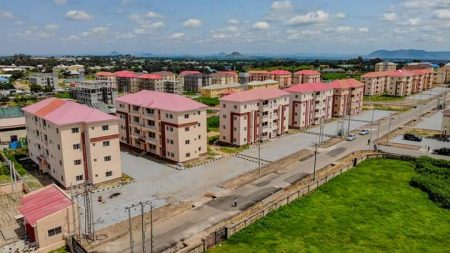
fct mass housing
For decades, Nigeria’s housing story has been one of lofty promises and disappointing delivery. From independence to the present, successive governments—civilian and military alike—have rolled out mass housing initiatives with fanfare, only to fall short in execution.
The populist drive began under General Yakubu Gowon in 1972 with the Federal Low-Cost Housing scheme, a name that has lingered in the country’s policy lexicon. President Shehu Shagari’s ambitious National Low-Cost Housing Programme targeted 200,000 units over four years, yet barely 32,000 were built. The military interregnum from 1983 to 1998 shifted focus to urban renewal, but projects were poorly structured and largely abandoned. When democracy returned in 1999, President Olusegun Obasanjo sought to break from government-led failures by introducing a private sector-driven National Housing Policy under a mortgage finance system. But weak mortgage structures, prohibitive interest rates and exclusion of low-income earners meant that once again, the promise of housing for the people remained elusive.
The late President Umaru Musa Yar’adua proposed the Vision 20:2020 short-lived housing goal. The Affordable Housing Scheme of former President Goodluck Jonathan failed to deliver mass housing, mainly through what was called Public- Private Partnership (PPP). The late President Muhammadu Buhari’s National Housing Programme, set up in 2016 to provide regional housing projects, was considered revolutionary. But most houses built across the country are unaffordable and left to rot away. President Bola Ahmed Tinubu’s supposedly market-driving housing reforms that leverage private developers and mortgages are grossly unaffordable due to Nigerians’ low income, inflation, devaluation of the naira, unemployment, underemployment and weak purchasing power of the naira.
A recent report by Daily Trust showed how the mismatch between government policies and the needs of the people could be wasteful. A survey of housing projects in several states established that many of them are wasting away because they are unaffordable. In Bauchi State, for example, where there are four sets of about 6,000 housing units, they were either completed but unoccupied or abandoned halfway through construction. Some are overgrown with weeds and taken over by reptiles. The housing projects were executed between 2007 and 2023, but they have suffered the same fate — not affordable to the masses.
Mass housing projects in Nigeria are designed to make political statements and provide opportunities for wealth for the political elite rather than what they are supposed to achieve. If the watchword of the projects were ‘affordable housing for the people,’ then the design and strategies of such houses should have been totally different.
Federal and state government schemes have focused on constructing two or three-bedroom, iron and concrete-block houses, even in rural areas. Such houses cost between N40 million and N100 million, amounts that the youths, who constitute about 60 per cent of the population, cannot afford.
Low-income earners cannot afford houses that cost between N5 million and N20 million. This is evident in the expansion of slums around many state capitals and other urban centres in the country.
If the government were interested in urban renewal, investments in mass housing should have been directed to the construction of houses that are affordable to low-income earners. Asian countries carry out such projects to align with the realities of their people.
It is disturbing that the government has not shown interest in what could be termed Nigeria’s traditional housing system, which sees to the construction of houses with mud and bricks instead of highly expensive cement, concrete blocks and iron rods.
It is expected that Nigeria’s universities should have carried out research into how to modernise our traditional building system in order to standardise them as a strategy for making housing affordable to the masses. Japan, for instance, has modernised its traditional wooden and rural houses called Minka for the construction of Dauchi Housing Estates that combine modernist apartment blocks with elements of Japanese communal living.
South Korea has constructed apartment complexes in its capital city, Seoul, with the Hanok (traditional wooden houses with ondol heating) system. Malaysia’s low-cost housing scheme is the traditional Rumah Melayu (timber stilt houses), which is the incorporation of stilt-house ventilation concepts into modern concrete flats. Other countries like China, Taiwan, Singapore and India have standardised their traditional housing system to build low-cost houses for their people.
We call on the government to work closely with researchers and professionals in the fields of architecture, civil engineering, building, and survey to come up with realistic, affordable housing schemes that align with our culture and needs, instead of funnelling money into the pockets of politicians and contractors to build houses for reptiles and wild grasses. At present, Nigeria’s housing policies are designed by corruption-motivated civil servants and implemented by political contractors whose interest is the next election. Mass housing issues are too important to be left under the control of career civil servants.
Though governments have claimed to create mortgage systems that make access to housing loans possible, in practice, it has not worked. The majority of Nigerians being targeted for mass housing cannot meet the conditions set by mortgage banks due to their weak earnings. Asian countries build traditional houses in the form of apartments for low-income earners, who access mortgages through their employers. Any organisation or individual that employs more than 30 employees is usually required to provide a housing scheme similar to health insurance. In Nigeria, this is not the practice, mainly because even employers are aware that their staff cannot pay for mortgages from their monthly salaries. This system must change.
The mass housing schemes in the country, especially in the current era, favour only few Nigerians. It is not too late for the government to step back, rethink, and come up with truly affordable housing for people in urban centres and rural areas.