
Where the rain beat us
“Overcoming poverty is not a gesture of charity. It is the protection of a fundamental human right, the right to dignity and a decent life. — Nelson Mandela Three Nigerians — Tamuno, Dike and Hadi — share their thoughts on President Buhari’s vision to lift 100 million Nigerians out of poverty in 10 years…. Hadi: […]
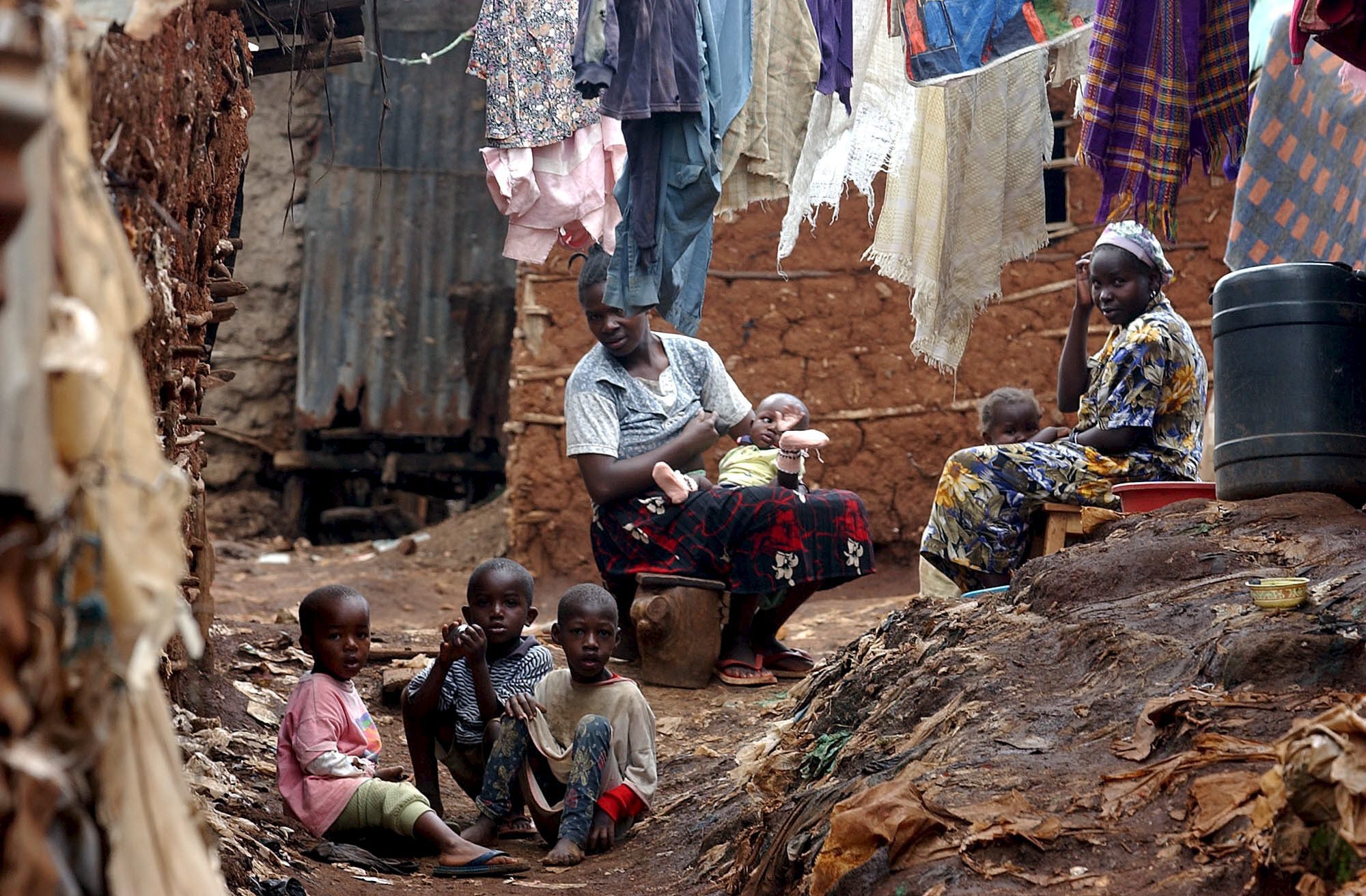
A family sitting in front of their makeshift home watches as members of Action Aid’s “Get on Board” campaign march through Kibera, Kenya’s largest slum and home to more than 1 million people, demanding an end to poverty on Wednesday 4 May 2005. The Get on Board campaign bus left Johannesburg on 31 March and is expected to arrive in Scotland on 6 July at the G8 gathering of the world’s most powerful leaders to pressure western governments to help eradicate poverty in Africa. EPA/STEPHEN MORRISON
“Overcoming poverty is not a gesture of charity. It is the protection of a fundamental human right, the right to dignity and a decent life. — Nelson Mandela
Three Nigerians — Tamuno, Dike and Hadi — share their thoughts on President Buhari’s vision to lift 100 million Nigerians out of poverty in 10 years….
Hadi: What was your takeaway from President Buhari’s Democracy Day speech?
Dike: Takeaway? What I want from the president is speed. He’s already taking too long to assemble his team.
Tamuno: For me, the most challenging vision espoused by President Buhari was the plan to lift 100 million Nigerians out of poverty in 10 years, meaning that every year, at least 10 million people will exit the pangs of extreme poverty.
Dike: If wishes were horses…
Hadi: Beggars would ride. But the news actually is that beggars do ride. Sometimes.
Tamuno: Well, China did it. According to the World Bank, more than 850 million people have been lifted out of extreme poverty (living on the equivalent of US$ 1.90 or less per day) as China’s poverty rate fell from 88 percent in 1981 to 0.7 percent in 2015. That’s a whopping 24 million exiting the poverty shackle every year.
Dike: I’m not saying the vision is unattainable. What I’m asking is whether we are ready to do what it takes to lift our people out of extreme poverty.
Hadi: If China can do it, so can we. In fact India also lifted 271 million people out of poverty between 2006 and 2016 — 27 million per year.
Dike: Nigeria is neither China nor India. Our Naira used to be at par with the British pound, but what is the exchange rate today? I’ll say the rain started to beat us when we progressively de-industrialised, when we openly embraced a policy of charity beginning abroad. All those areas where our people worked no longer exist. Jobs have been shrinking and imported goods increasing.
Hadi: You have a point there. To think that we had thriving auto industry — Peugeot, Volkswagen, Leyland, ANAMCO, Steyr and Bedford, where have they all gone? What became of all those working there? I agree with you, we have to bring back the industries.
Tamuno: What about the fishing industry? Do you know how many people worked in the Ibru fishing company? Where are the Nigerian trawlers today? The Chinese and Indians have taken over our waters, thousands of miles away from their homes.
Dike: I can reel off more names: The steel rolling mills, Kingsway, Leventis, Bhojsons and UTC stores (now South Africa’s Shoprite has taken over), Lennards, Bata, Dunlop, Berec, Michelin, Nigeria Airways, the textile mills.
Hadi: Ah, now you remind me. Kaduna was the headquarters of textiles. Today, having destroyed the textile mills, we are back at the starting blocks. We import textiles. Whatever came over us.
Dike: There’s no sense of national pride. We even import our Naira.
Tamuno: In the past, when the National Printing and Minting Company lived up to its name, we minted our currency here. We printed our own ballot papers and international passports. Imagine the billions going to foreign mints and printers because of a lack of self-belief coupled with greed afflicting those in charge.
Hadi: Well, thankfully, the trains are coming back. It’s like we are inventing rail travel all over again, but better late than never. Hopefully, we shall get back to printing our Naira, election materials and international passports locally. For the sake of national pride, at least.
Dike: When you destroy your own factories, import everything you used to produce, develop taste for foreign food and other goods, and emasculate the few surviving enterprises, you’re writing a letter to poverty.
Hadi: I’m interested in what we can do differently. I’m sure that we could spend the whole day cataloguing what is wrong. The important thing now is to roll up our sleeves and work.
Tamuno: But you won’t get anywhere if you don’t first acknowledge where the rain beat you and then chart a new path going forward.
Hadi: I think we all know where the rain beat us. When many trees fall atop each other in a storm, the best thing to do is lift off the topmost tree first. So, I expect the government to focus on the low hanging fruits so that positive change can become manifest in the quickest possible time.
Dike: Are we agreed on what constitute the low hanging fruits?
Tamuno: For me, one of the urgent promises the president should fulfil without delay is the formalisation of modular refineries. Our local people have shown that refining petroleum is not rocket science. Why are we preventing them from contributing to the pool? Let’s set the rules and monitor the production. I can assure you that thousands of legal modular refineries would spring up immediately the government gives the go-ahead.
Dike: The long and short of all we are saying is that the president must tweak the various policies underpinning economic activities. The first step is to assemble a good economic team. He needs to bring into government people who have international track record. Mark my words, the kind of economic team the president puts together will determine whether his vision of lifting 10 million Nigerians our of poverty every year, is attainable or not.
Hadi: Nigerians cannot succeed if the president fails. It is in our interest that this poverty-exiting vision materialises.
Dike: You remind me of Kofi Anan’s timeless statement: “Extreme poverty anywhere is a threat to human security everywhere.”