
Why Kano wheat farmers record low yields
Kano wheat farmers have reported lower-than-expected yields, which they attributed to this year’s lack of cold harmattan weather. The yield from the previous year was significantly higher than the current season, according to some farmers who spoke with Weekend Trust, pointing out that this was mostly due to the absence of cold weather, which had […]
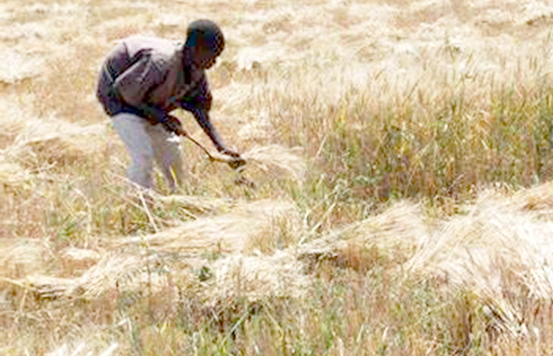
Wheat harvest
Kano wheat farmers have reported lower-than-expected yields, which they attributed to this year’s lack of cold harmattan weather.
The yield from the previous year was significantly higher than the current season, according to some farmers who spoke with Weekend Trust, pointing out that this was mostly due to the absence of cold weather, which had a complementary effect.
Abubakar Bunkure, a wheat farmer in Bunkure Local Government Area, told our correspondent that he only harvested 10 bags (100kg) of wheat from the one hectare of land he cultivated under irrigation.
Bunkure said consistent watering and fertiliser application using local manure helped him to mitigate a significantly low yield as the cool harmattan weather that is conducive to wheat growing was low this year.
He explained that he had to pay money for unrestricted use of the irrigation system, which kept the farm consistently moist.
“I managed to get 10 bags of wheat this harvest season. It is a big setback for me compared to last year. In fact, it would have been less but for the fact that I consistently watered the farm and adequately applied fertiliser.
“Wheat without cold weather does not give you a good yield. I think that was the reason some of us recorded low yield this season,” Bunkure said.
Another farmer, Sadisu Karfi, who plies his trade in Kura Local Government Area, a wheat farming hub in Kano, said many farmers recorded below expected harvest, which he said might not be unconnected with the changing weather conditions.
He said, “To be honest, I didn’t do wheat this season, but many farmers I know who grew wheat are not very happy with what they harvested. It is below expectations, given the high hopes at the beginning of the planting season.
“Without the cold, the weather was not conducive to the cultivation of wheat. This might have contributed, but only God knows for sure.
“Many of them are moving on, trying to prepare the land for onions and tomatoes before the rainy season.”
Sani Muhammad Danbatta said farmers at Danbatta did not show interest in wheat cultivation this year despite the availability of irrigation facilities provided through Thomas Dam.
Sani said most farmers in the area grew perishable items like tomatoes, pepper and onions.
Weekend Trust reported in January that wheat farmers had expressed concern over the non-receipt of federal government’s promised intervention under its Agro-Pocket initiative.
The farmers said they had waited for the intervention but nothing had come despite repeated promises. They lamented that although the federal government assured them of support to boost wheat production through subsidised farm inputs, they were yet to benefit from any assistance as the planting season advanced this year.
In Garun Malam Local Government Area, Malam Habibu Garba told our correspondent that farmers were asked to wait in vain for the National Wheat Intervention Programme, an initiative many of them participated in last year.
The intervention, implemented through the National Agricultural Growth Scheme and Agro-Pocket (NAGS-AP), was designed to increase local wheat production, reduce Nigeria’s dependence on imports and strengthen national food security. However, after months of expectation, farmers said there was nothing for them in 2026.
“Under the association, farmers were mobilized; and many of us either hired farmlands or cultivated our own plots. We tilled the land and planted in anticipation of the intervention. Unfortunately, time has passed without anything from the government, and there has been no explanation whatsoever.
“This situation is very disturbing. Many of us are now worried about what the outcome would be at harvest time,” Garba said.