
Why Katsina farmers are turning to tiger nuts
Tiger nuts, often referred to as Aya in Hausa, have been helping many farmers to maintain their agricultural viability in Katsina State. Mostly grown in northern Nigerian settlements and border villages, Tiger nuts are becoming more well-known as a major cash crop for many farmers rather than just as nuts. It used to be seen […]
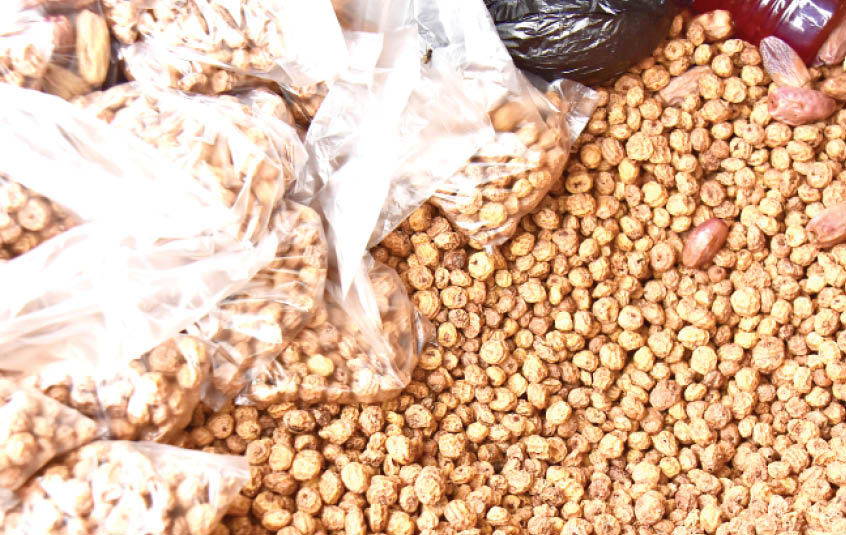
Tiger nuts
Tiger nuts, often referred to as Aya in Hausa, have been helping many farmers to maintain their agricultural viability in Katsina State.
Mostly grown in northern Nigerian settlements and border villages, Tiger nuts are becoming more well-known as a major cash crop for many farmers rather than just as nuts.
It used to be seen as wild nuts sold in little roadside bowls, tied in small white polythene bags and sold in many markets, either as fresh or dried small nuts, but over time, it developed into a profitable agricultural product that supports thousands of farmers, merchants and processors across many states.
The crop is already a prospective export that draws customers throughout Africa.
In addition to their regular activities, farmers in some parts of Katsina have been growing tiger nuts for local consumption, according to Lawai Haro, a nut dealer who claimed to have been in the business for more than 30 years.
At one of the main markets for the crop, Jibia, huge first-grade tiger nuts sells at N2,500 per kilo, while 100 kg costs N100,000. The final grade of the nuts is priced at N1,000 per measure or N400,000 for a 100kg bag.
However, as more people become aware of the crop’s nutritional and commercial significance, demand for it increased recently. Communities like Mani, Mashi, Jibia and Dankama have gradually developed into significant production and trading hubs where tonnes of the crop are harvested and sold each season.
Tiger nuts, scientifically known as cyperus esculentus, were first grown primarily for local consumption, according to an agricultural expert at the Audu Bako College of Agriculture, Dambatta, Malam Bala Bashir.
It is frequently consumed raw, dried or processed into well-known drinks like kunu aya, a creamy beverage that is popular throughout northern Nigeria.
Bashir further said that as the number of persons using the nuts increased, it gradually gained greater recognition. He emphasised that the nuts are now processed into flour, cooking oil, biscuits and dairy substitutes overseas, which is why the demand from the global market has increased.
He revealed that the ecological condition of Katsina made the state naturally suitable for tiger nut farming because it thrives in sandy soil, adding that farmers typically plant the crop at the onset of the rainy season or under irrigation during the dry season. He explained that within three to five months, the tubers mature underground and are ready for harvesting.
According to one of the farmers, Muttaka Mani, after harvesting the small tubers, they are washed, dried under the sun and sorted for sale. Mani revealed that what was initially a mere production for local consumption had grown to become a significant crop that is more attractive to smallholder farmers who require relatively modest inputs compared to other crops.
Weekend Trust gathered that what was once a subsistence agricultural practice has now evolved into a major income source because in many rural communities in Katsina, farmers said tiger nut farming provided quicker returns than some traditional crops, such as millet or sorghum.
Findings revealed that traders from cities like Kano, Lagos and even neighbouring countries frequently visit Katsina markets to purchase the commodity in bulk; as such, large quantities are transported to various parts of the country, where exporters package them for international markets, especially in Europe and parts of South America, among other places.
Nutritionists believe that tiger nuts are gaining popularity globally as “super-food” because of their high fibre content, natural sweetness and health benefits.
It was also gathered that beyond farming, tiger nut production supports a growing value chain in Katsina because young people and women are increasingly involved in sorting, drying, packaging and processing the crop into beverages and other products.
Local markets in the state bustle with activities as traders negotiate prices and transporters move bags of the crop for distribution to other markets across the country.
Small-scale processors producing kunu aya are also finding a ready market in urban centres, where demand for natural, plant-based drinks is rising.
But Alhaji Usman Hannafi, a licensed commodity exporter, said that despite the growing demand for the crop, Nigeria as a country and Katsina State in particular were yet to fully explore the global tiger nut market, which is said to have a huge opportunity for exporters.
“Countries like Spain have long used tiger nuts to produce horchata, a popular drink similar to kunu aya; and much of the raw material used in international markets comes from Africa, including Nigeria.
“As an exporter, I believe that with a better organisation, improved storage facilities and modern processing plants, Katsina could become a major supplier to the global market,” he said.
Some farmers told Weekend Trust that the production sector receives virtually zero intervention from the government or other agencies; hence it faces several obstacles.
According to one of the farmers, Malam Hudu Magani, farmers complain about limited access to improved seedlings, poor storage facilities and fluctuating market prices.
He explained that issues related to post-harvest losses were also common due to inadequate skills, a question about the best practices or drying and preservation methods.
“Access to financing remains another hurdle as many smallholder farmers lack the capital needed to expand their farms or invest in mechanised production.
“With all the contributions the sector makes to the state economy, farmers are left without an effective access to finance.
“Security challenges in some producing communities have also affected production activities and trade routes,” he said.
With the increasing global demand for plant-based foods and healthy natural crops, stakeholders said tiger nuts could become one of the agricultural products that would redefine the rural economy of Katsina State.