
Why Nigerians keep N9 of every N10 notes outside bank
Despite the spread of mobile banking, fintech platforms and electronic payments, Nigerians are increasingly choosing to hold their money in cash, with experts pointing to election spending, distrust of banks, informal economic activities and memories of the naira redesign crisis as major reasons. Latest data from the Central Bank of Nigeria (CBN) shows that […]
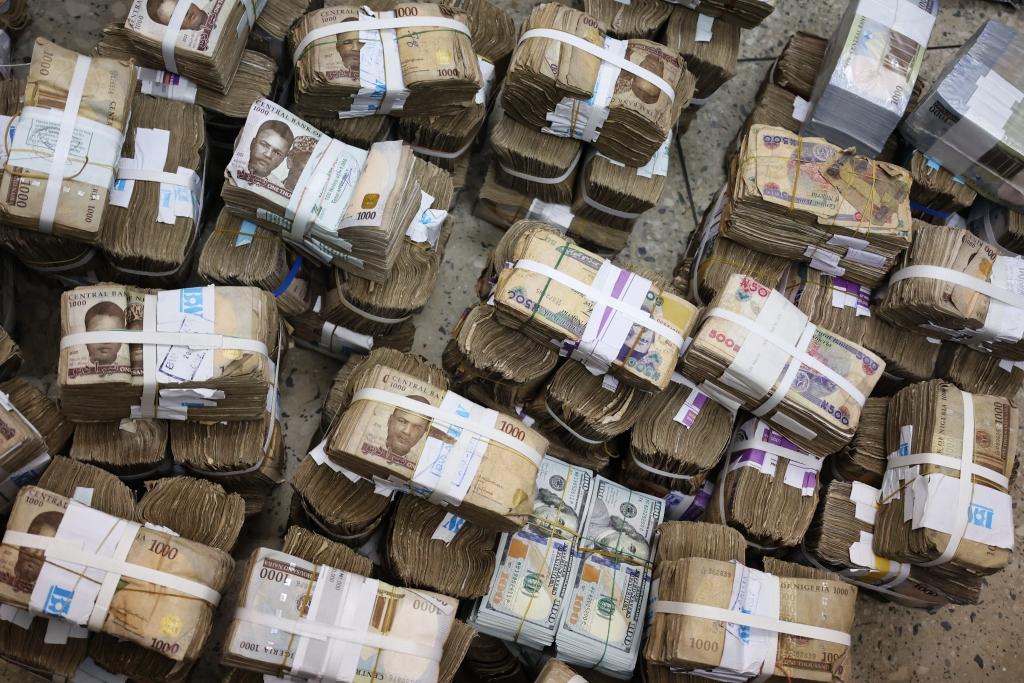
Despite the spread of mobile banking, fintech platforms and electronic payments, Nigerians are increasingly choosing to hold their money in cash, with experts pointing to election spending, distrust of banks, informal economic activities and memories of the naira redesign crisis as major reasons.
Latest data from the Central Bank of Nigeria (CBN) shows that currency outside banks rose to N5.08 trillion in April 2026, representing more than 90 per cent of the N5.64 trillion in total currency circulating in the economy.
In practical terms, about nine out of every 10 naira notes in circulation are being held outside the formal banking system.
Economists say the figures reflect deeper structural realities in Nigeria’s economy, where millions of transactions still take place in cash and outside formal financial channels.
Speaking with Daily Trust on Thursday, Former Chief Economist at Zenith Bank Plc, Marcel Okeke, said the build-up to the 2027 general elections is one factor driving the growing preference for cash.
“Several reasons explain why Nigerians are holding more cash. We are already in an election season and politicians everywhere are holding back cash because if such funds move through the banking system they can be traced,” he said.
According to him, political mobilisation activities are traditionally cash-intensive.
”If you have been following political rallies so far, you will discover everything is about cash. Politicians need the money to distribute to supporters. Election activities are one of the reasons we are seeing a lot of currency outside the banking system,” he added.
Beyond politics, Okeke said Nigeria’s vast informal economy continues to keep huge volumes of money away from banks.
He pointed to traditional savings schemes, popularly known as “ajo” or “esusu”, where cash circulates outside regulated financial institutions.
”We also observe that a lot of money is moving through the informal sector. These people do not bring their money to the banks, so the money is not captured within the system,” he said.
Another factor, he noted, is growing frustration among bank customers over account maintenance fees and other charges.
”Many Nigerians feel discouraged by the several charges on their accounts. They ask themselves why they should keep money in the bank when deductions continue. Some prefer to keep cash at home instead,” he said.
For many Nigerians, however, the preference for cash goes beyond fees and politics.
An Abuja resident, Rachael George, said her confidence in banks has gradually declined due to difficulties accessing cash when needed.
”It’s been a while since I last visited a bank. What am I going there for?” she asked.
”If you go to the bank, sometimes you don’t get enough cash, maybe N10,000 or N20,000. There are times they tell you to come back later because there is no cash available.”
The lingering memories of the 2022-2023 naira redesign crisis also continue to shape behaviour.
During the policy implementation, many Nigerians struggled to access cash, businesses recorded losses and long queues became common at banks and Automated Teller Machines (ATMs).
For some citizens, the experience reinforced the belief that keeping part of their savings in cash offers protection against future disruptions.
”I fear that election activities may cause another cash scarcity like we witnessed before the 2023 elections,” said Adeyemi Tolani. “So why should I leave all my money in the bank?”
Another resident, Michael Ameh, recalled the desperation many Nigerians faced during the cash shortage.
”I remember how people queued even in places of worship waiting for offerings so they could exchange cash and make transfers. I’d rather keep some savings in cash now,” he said.
Economist Shedrach Israel said the dominance of cash reflects the realities of an economy where a significant share of economic activities remains outside formal financial structures.
According to him, while Nigeria has recorded impressive growth in electronic payments, digital transactions have not displaced cash because many businesses still rely on physical currency for daily operations.
”The large informal sector means a substantial amount of transactions occur outside regulated financial channels. As long as that remains the case, cash will continue to play a dominant role,” he said.
Historical data suggests the trend is deeply rooted.
When former President Olusegun Obasanjo assumed office in 1999, about 86.5 per cent of currency in circulation was outside banks. By the end of his administration in 2007, the figure had declined to 79.5 per cent, one of the strongest improvements recorded since the return to democratic rule.
The ratio rose again under subsequent administrations. It increased from 73 per cent to 77.8 per cent during the administration of the late President Umaru Musa Yar’Adua and from 75 per cent to 78 per cent under former President Goodluck Jonathan.
The sharpest increase occurred during the administration of former President Muhammadu Buhari, when the proportion climbed from 75.6 per cent in 2015 to a record 96.4 per cent by May 2023 amid the disruptions associated with the naira redesign policy.
When President Bola Tinubu took office in June 2023, the ratio stood at 86.9 per cent. By April 2026, it had risen again to 90.1 per cent, suggesting that many Nigerians have returned to their long-standing preference for holding cash.
The development presents a paradox for policymakers.
Nigeria is simultaneously experiencing record growth in electronic payments, with mobile banking, fintech services, Point-of-Sale (PoS) terminals and instant transfers becoming increasingly common.
Yet the expansion of digital finance has not significantly reduced the volume of cash held outside banks.
Instead, many Nigerians appear to be embracing both systems at once, using digital channels for convenience while maintaining substantial cash reserves for security, accessibility and day-to-day transactions.
For economists, the message behind the numbers is clear: until issues such as financial inclusion gaps, weak banking infrastructure, trust deficits, the size of the informal economy and election-related cash spending are addressed, cash is likely to remain king in Nigeria.
And for now, the figures tell a striking story: despite years of banking reforms and technological innovation, Nigerians continue to keep nine of every 10 naira notes outside the banking system.