
Why our eggs are best in Nigeria – Plateau farmers
The Poultry Association of Nigeria (PAN), Plateau State Chapter, has declared that the eggs produced in the state remain the best in the country. Speaking during the commemoration of the 2025 World Egg Day in Jos, the association’s chairperson, Mrs. Shinkur Angela Jima, described the state’s eggs as the best and most durable, owing to […]
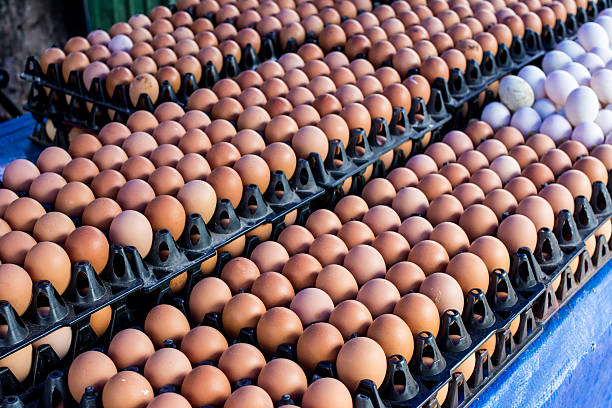
Eggs
The Poultry Association of Nigeria (PAN), Plateau State Chapter, has declared that the eggs produced in the state remain the best in the country.
Speaking during the commemoration of the 2025 World Egg Day in Jos, the association’s chairperson, Mrs. Shinkur Angela Jima, described the state’s eggs as the best and most durable, owing to Plateau’s friendly and conducive environment and weather.
According to her, the state’s climate, favorable temperature, and geography make it an ideal place for poultry farming.
“The Nigerian poultry industry is the leading egg producer in Africa, producing over one billion eggs, yet the market is not saturated,” she said.
- Poverty of the mind and the crisis of consciousness
- Tinubu to private sector: Back economic reforms to drive sustainable growth
She continued, “Plateau State’s eggs are said to be the best in Nigeria because our favourable weather, under which our eggs are produced, makes them have a longer shelf life of up to a month without spoiling.”
She, however, lamented that egg consumption among families in the state is still very low. This forces farmers to rely on middlemen who offer “peanuts” due to poor pricing, even amidst the high cost of feed.
The PAN chairperson stressed that improving egg pricing is a collective responsibility, requiring farmers to work together in unity to curtail the excesses of middlemen.
Corroborating the chairperson, Mr. Caleb Menegbe, the CEO of Kukuruku Agro Concept located at Latya in Jos, said that the quality of Plateau eggs is so renowned that sellers in other states crave them.
He re-echoed the views of the other farmers, stressing that the poultry market in the state is external market dependent, as 70 to 80 percent of the eggs produced in Plateau are not consumed in the state, because residents often think they are a luxury.
According to him, the bulk of the market comes from the North East, and even as far as Niger Republic and the Central African Republic.
“And these outsiders who consume our eggs more are consumers of a lot of tea… tea is like a tradition for them. And they eat eggs to go with the tea,” he said. “So, even though we have the best of eggs, we don’t have the ready market because of the consumption gap. If people of the state can consume eggs like people from other states, it would be better.”
On the capital-intensive nature of running a poultry business, he said it requires a lot of financial muscle, explaining that to nurture a bird to the point where it can begin to produce is not easy.
According to him, to keep and nurture one bird until the point of production, one needs about N12,000, and for a farm of 1,000 birds, one needs about N12 million to do that. That, and more, he said, is the problem facing the poultry industry in the state.
Many farmers who spoke with our correspondent explained why the state is at the heart of poultry farming in Nigeria.
Mrs. Amorudu Husseni, a poultry farmer in Bukuru, Jos, said the declaration that Plateau has the best eggs is not out of place because people come from other states to patronize them more than they go to other states.
According to her, the hot weather in other states makes their eggs spoil easily, and people are less likely to patronize eggs that are not durable.
The farmer noted that she has a 1,500-bird farm, and those who come to her farm to buy eggs often take them to Abuja and Borno State, where there is high demand for eggs produced in Plateau State.
Husseni explained that she has a farm that can take up to 5,000 birds, but that it is capital intensive as 5,000 birds cost above N7 million, and worse still, they can take between 22 and 25 weeks before they begin laying eggs.
Another farmer, Victor Ameh, said because of the longer shelf life, colour, quality and ‘ruggedness’ of Plateau eggs, dealers and traders come from other states to patronize him.
On his part, Mohammed Uduanokhai, a poultry farmer in Jebbu-Bassa, Bassa LGA, Plateau State, said apart from the aforementioned qualities, the eggs produced in Plateau are also bigger than those of other states.
That is another strong reason, he said, why people from other states come to patronize the eggs produced in Plateau. He again pointed out that Plateau people do not consume eggs much, forcing the farmers to rely on patronage from other states.
This outcome, he stated, is also a problem because if there is a lull in the demand for eggs from those other states, it will affect their business in Plateau, and invariably affect the price of eggs because business is all about demand and supply.
“Nonetheless, the eggs produced in Plateau State are second to none because of the temperature in the state. An egg produced in Bauchi State, for instance, which is a hot zone, cannot stay more than a week before it goes bad,” he said. “But eggs produced in Plateau can stay up to three weeks and they would still be in good shape.”
He said the major challenge is the cost of investment, because there are no government incentives to support farmers.
Funding and investment in the poultry sector, he pointed out, is a major problem, emphasizing that to invest in about 1,000 birds and nurture them to the point that they can begin to produce, a farmer will need about N10 million. Not many people can afford that right now. According to him, this was not the case years ago when a farmer could invest in 1,000 birds with N1 million.