
Why Taraba farmers are abandoning maize, rice for sesame, melon
A near-total collapse in grain prices has forced many farmers in Taraba State to switch from cultivating maize and rice to cash crops like sesame and melon, which offer better financial returns. Farmers interviewed by Daily Trust said current market trends have left them with no option but to reduce the cultivation of food crops […]
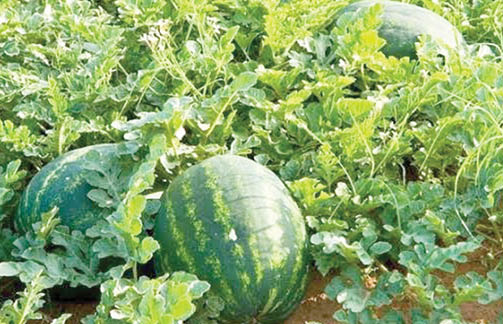
A watermelon farm
A near-total collapse in grain prices has forced many farmers in Taraba State to switch from cultivating maize and rice to cash crops like sesame and melon, which offer better financial returns.
Farmers interviewed by Daily Trust said current market trends have left them with no option but to reduce the cultivation of food crops and focus on cash crops due to their higher value.
Sule Dauda, a farmer in Iware, Ardo-Kola Local Government Area, said he produced 200 bags of maize last year and reserved 140 bags to sell during the cropping season. However, he was disappointed by the drastic fall in the prices of maize and rice.
He said a 100kg bag of maize now sells for less than ₦30,000, while a single bag of fertiliser costs ₦45,000. He explained that the money he earned from selling his 140 bags of maize at ₦30,000 each could not cover the expenses of tractor hiring, fertiliser, labour, and chemicals required to produce another 200 bags.
Dauda added that he was fortunate to have produced 30 bags of sesame and 50 bags of melon last season, noting that the income he generated from selling those crops was higher than what he earned from his maize. For that reason, he said, he has planted more sesame and melon than maize and rice this year.
Adams Garba, a farmer in Kwatan Nanido, Gassol Local Government Area, also cited the fall in grain prices, with a 100kg bag of maize selling at ₦30,000, as a major challenge. He said high production costs—including tractor hire, chemicals, and labour—have made farming unprofitable.
“With these high costs, many farmers will switch to cultivating cash crops like soybeans, melon and sesame seed,” he said.
Madam Janet Adams, a farmer in Zangon Kwambi, Ardo-Kola LGA, blamed the situation on food importation, which she said is undermining local agriculture in the North. She confirmed that while the cost of farm inputs is rising, the prices of farm produce are dropping daily.
“Farmers usually sell their produce during the planting season to buy inputs and pay for labour,” she said. “But with current market trends, they are facing serious disappointment.”
Bello Lawal, a smallholder farmer, said most rural dwellers depend solely on farming and have no alternative source of livelihood. “We don’t have a choice. We must keep farming,” he said.
Ali Maihula, a farmer in Bali LGA, said food production has dropped because farmers are discouraged from growing food crops due to the collapse in grain prices. He said despite the losses, some farmers continue to cultivate food crops because they have no alternative.
“Maize and rice have given way to sesame and melon, which currently have better prices,” he said. “It’s unwise to produce maize or rice now because you can’t even recover your investment, let alone make a profit.”
The Chief of Mutum Biyu Chiefdom, Alhaji Sani Suleiman Muhammed, expressed concern over the trend. While acknowledging the sharp decline in grain prices and the high cost of farm inputs, he warned that abandoning food production in favour of cash crops could endanger national food security.
He urged both the state and federal governments to support genuine farmers with subsidised inputs.
“Right now, a bag of fertiliser costs ₦40,000, and tractor-hiring and labour are very expensive, yet grain prices have dropped drastically,” he lamented.
The monarch also revealed that farmers in his domain are battling a rodent infestation. “Rats have invaded farms and destroyed many maize seedlings that had already germinated,” he said.
He called on the Taraba State government to urgently address the problem, warning that agriculture in the North, which is the region’s mainstay, is now under serious threat due to falling profits and increasing reliance on food imports.