
Cocoa: Why Nigeria must meet EU December 2025 deadline
Nigeria may not export cocoa to European Union markets if it fails to meet Deforestation-free Regulation (EUDR) by December 2025. As the fourth largest producer of cocoa in the world, the country is a major player in the global market. Its 300,000 smallholder farmers produce an average of 320,000 tonnes annually; and the country’s sector […]
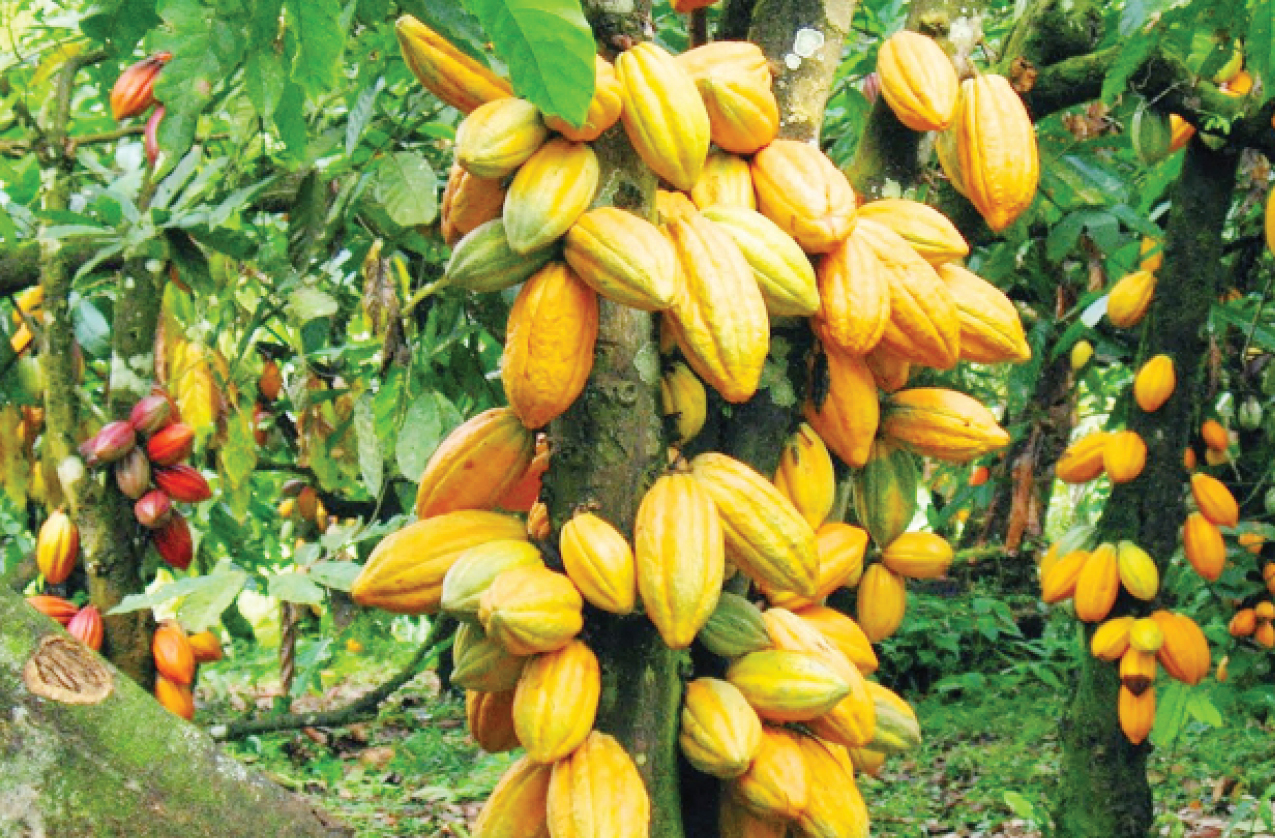
Cocoa trees
Nigeria may not export cocoa to European Union markets if it fails to meet Deforestation-free Regulation (EUDR) by December 2025.
As the fourth largest producer of cocoa in the world, the country is a major player in the global market. Its 300,000 smallholder farmers produce an average of 320,000 tonnes annually; and the country’s sector is valued at $700 millionUS.
Failure to adhere to EUDR compliance will have an impact on the sector as over 60 per cent of Nigerian cocoa is exported to the European market.
The EUDR is a regulatory framework designed to combat and mitigate the environmental consequences of deforestation. It is a key component of the EU Green Deal and aligns with EU’s overall strategy to safeguard forests around the world.
- Textile Industry’s ‘Comeback’: Reviving textile without cotton
- Battle for 2027: Despite APC’s overtures, opposition still holds winning card – Umar Ardo
The rule establishes criteria for determining which items are deforestation-free and mandates businesses to use sustainable sourcing procedures and traceability mechanisms to ensure that their supply chains do not contribute to deforestation.
EU’s goal is to alleviate pressure on forests and safeguard biodiversity by fostering openness and accountability in essential commodity production.
The European Parliament endorsed the initial proposal for the EUDR in 2022 and it took effect on June 29, 2023. Although it was due to go into effect on December 30, 2024, EU institutions postponed it by one year. It will not take effect until December 30, 2025.
The regulation requires all cocoa and other listed commodities imported into the EU to be deforestation-free, legally produced and fully traceable.
Small and micro businesses are allowed a longer transition period. They have till June 2026 to meet the standards.
With just four months to go, the federal government, through various agencies, must put its house in order to avoid rejection as the country’s agricultural products have already been denied access to the European markets over excessive use of chemicals.
On Monday, the federal government moved to strengthen compliance measures in the cocoa industry against deforestation practices.
It held the Nigeria-EU Cocoa Roundtable on EUDR Compliance at the State House in Abuja to put in place strategies for compliance in order to meet the deadline.
The Senior Special Assistant to the President on Agribusiness and Productivity Enhancement, Dr Kingsley Uzoma, said Nigeria stood ready and resolute to meet the European Union Deforestation Regulation (EUDR) compliance framework.
Uzoma explained that the essence of the discussion on the EUDR compliance framework, which prohibits the import of cocoa and other commodities linked to deforestation after December 2020, basically requires traceability, due diligence and proof of deforestation-free supply chains, reinforcing environmental stewardship.
The roundtable brought together senior policymakers, state governments, cocoa farmers’ associations, exporters, development partners and the civil society to align on Nigeria’s readiness for EUDR compliance, launch a roadmap for traceability and sustainability in cocoa production, identify areas for technical support, financing, and policy harmonisation and establish a collaborative framework for implementation.
Dr Uzoma reckoned that “cocoa is a cornerstone of Nigeria’s economic diversification agenda, standing as a strategic non-oil export that fuels our transition from petroleum dependency.”
Africa produced 3.151 million metric tonnes of cocoa in 2023/2024, with Nigeria contributing for 320,000 tonnes and seeking to expand output to 500,000 tonnes by 2025 through focused initiatives.
“According to the National Bureau of Statistics, cocoa exports in Nigeria experienced a 606 per cent increase in the last quarter of 2024. Nigeria’s cocoa exports rose from about N171 billion in the last quarter of 2023 to N1.2 trillion. This remarkable growth reflects not only global demand but the resilience and potential of Nigeria’s agricultural sector.
“Cocoa is no longer just a commodity, it is a strategic lever in our economic transformation. This positions cocoa as a vital contributor, accounting for roughly 29 per cent of our total agricultural exports and 5.6 per cent of non-oil exports overall.
“Nigeria stands ready and resolute. With our rich heritage in cocoa, producing an average of nearly 320,000 tonnes annually over the past decades, and a clear policy roadmap, we are poised to lead in sustainable agribusiness. Let us forge a new era of strategic partnership, where Nigerian cocoa becomes a global symbol of sustainability, innovation and shared prosperity. Together, we can build a deforestation-free future that uplifts farmers, protects forests and strengthens trade ties across continents,” he said.
The Minister of Agriculture and Food Security, Senator Abubakar Kyari said Nigeria did not have an option but to put in place a compliance mechanism so that “the commodities exported from Nigeria to Europe will not face the ban we have seen ahead.”
“I am sure the National Task Force on EUDR, which I co-chair with the minister of industry, trade and investment, will be more galvanised and empowered to ensure that the functions of the NTF are carried out seamlessly,” he said.
The Minister of Industry, Trade and Investment, Dr Jumoke Oduwole, said EUDR compliance was a “call to action, a platform to align national ambition with global standards and a crucial step in ensuring the resilience, sustainability and competitiveness of our cocoa value chain.
“The EU Deforestation Regulation is reshaping the way agricultural commodities are traded globally. But beyond that, Nigeria and this administration is at the forefront of climate change and climate justice and what is important to us and the use of our land for sustainability. So, without an external project, this is something that is ‘Nigeria first’ as Mr President has put it always. So we are thinking first and joining the rest of the world to see how we are using our resources for the betterment of everybody.
“So, for Nigeria, Africa’s fourth largest cocoa exporter, it is both a formidable challenge and a transformative opportunity.
“With the EU accounting for over 60 per cent of our cocoa exports, compliance is not optional. It is an economic, environmental and developmental imperative; and importantly, we have to support our domestic farmers and investors who are in this space.”
For the minister, what is expected right now is to see for “foreign exchange earners, job creation, all the things that will make sure that we hit our $1 trillion economy mark, the priority that we have given to food sovereignty and making sure that we accelerate diversification of our non-oil exports under item number seven out of the Renewed Hope Agenda.”
The director-general and chief executive officer of the National Space Research and Development Agency, Dr Matthew Adepoju, assured that the agency would provide special data and satellite technology to ensure compliance with the EUDR in the cocoa industry and the deadline is met.
Dr Adepoju said the issue of producing cocoa that meets the guidelines of the EU “is simply for us to show and support our farmers with space technology – that where they are producing the cocoa from in Nigeria is actually cocoa farmlands – not that they are cutting wood forests to create a new farmland.
“We have centres and laboratories across the country. In the South-West alone, we have two centres and one laboratory. And we have enough manpower to get the job done for the whole country in the area of cocoa mapping. And of course, in the South-South and South-East too, we have a laboratory and a centre.”
Key players like Tulip Cocoa said they were already committed to the full compliance of the EUDR by aligning its operations with the global best practices to protect forests and biodiversity.
The sustainability manager of the Tulip Group, Dr Taiwo Osun, said they “are strengthening traceability systems to ensure transferring supply chains from farm to export in partnership with governments and agencies that are also working together for the same purpose. Our sustainability programme focuses on farmers’ empowerment, improving livelihoods through training, fair trade practices and climate-smart agriculture.”
Cocoa growers voiced their serious concerns last year about the country’s sluggish approach to enforcing compliance, believing that it would cause them a great deal of trouble.
The National Cocoa Management Committee (NCMC) and the Cocoa Farmers Association of Nigeria (CFAN) have written to the EU Commission, urging for a review of the regulations and the deadline.
The federal government has faced a great deal of pressure and criticism for not meeting the standards necessary for the international market to accept the country’s exported goods.
However, with the current action, cocoa farmers’ associations said the EUDR compliance framework created an opportunity to penetrate the EU market to boost their cocoa trade as more value would be added to their production.